  1. Home
  2. Space
  3. News

This exoplanet whizzes around its star once a week and is bombarded by flares

Add as a preferred source on Google
NASA’s TESS, Spitzer Missions Discover World Orbiting Unique Young Star

Around 32 light-years away from Earth, practically in our backyard, lies a dramatic young star named AU Microscopii or AU Mic for short. This star is just 20 to 30 million years old. This might sound ancient, but by star standards, it’s a baby — for reference, our sun is 150 times older.

Recommended Videos

Orbiting this baby star is a planet of dramatic events, AU Mic b, recently discovered using data from NASA’s Transiting Exoplanet Survey Satellite (TESS) and the now-retired Spitzer Space Telescope.

A year on this Neptune-sized planet lasts just over one Earth week as it orbits extremely close to its star. And it is constantly bombarded with flares from the star, caused by the star’s strong magnetic fields. The star is often covered with starspots — similar to sunspots — which erupt with flares that bathe the planet in radiation.

rendering of the young planet AU Mic b
This rendering of the young planet AU Mic b is part of NASA’s fun-but-informative Galaxy of Horrors poster series. The planet’s star, AU Microscopii, emits powerful, fiery flares that would likely terrorize any lifeforms that tried to make a home here. NASA's Exoplanet Exploration Program

Because the star AU Mic is so young, both it and its planet are still surrounded by the disk of dust and gas from which they formed. That makes this system the ideal place for researchers to observe to understand more about how planetary systems develop over time.

“We think AU Mic b formed far from the star and migrated inward to its current orbit, something that can happen as planets interact gravitationally with a gas disk or with other planets,” coauthor Thomas Barclay, associate project scientist for TESS at NASA’s Goddard Space Flight Center, explained in a statement.
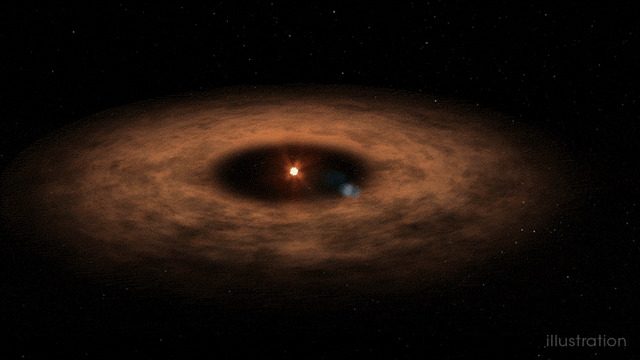
artist's concept shows the dusty disk surrounding the star AU MIcroscopii
This artist’s concept shows the dusty disk surrounding the star AU MIcroscopii. Astronomers have studied this system extensively but only recently identified the presence of a planet there. The find provides a laboratory for studying planet evolution and formation. NASA's Goddard Space Flight Center/Chris Smith (USRA)

Barclay and his team have also compared the system to planets in another nearby system, the Beta Pictoris Moving Group. “By contrast, Beta Pictoris b’s orbit doesn’t appear to have migrated much at all. The differences between these similarly aged systems can tell us a lot about how planets form and migrate,” he said.

There may even be more planets hiding in the orbit of AU Mic, so the scientists will return to this system to study it more and see if they can find them.

“There is an additional candidate transit event seen in the TESS data, and TESS will hopefully revisit AU Mic later this year in its extended mission,” lead researcher Peter Plavchan said. “We are continuing to monitor the star with precise radial velocity measurements, so stay tuned.”

The research is published in the journal Nature.

Georgina Torbet
Georgina has been the space writer at Digital Trends space writer for six years, covering human space exploration, planetary…
Blue Origin successfully re-uses a New Glenn rocket for the first time ever
Blue Origin achieves first New Glenn reflight despite payload setback
Blue Origin

Blue Origin has achieved a major milestone in its spaceflight ambitions by successfully reusing a booster from its heavy-lift New Glenn rocket for the first time. The historic launch, conducted on April 19, marks a significant step forward for Jeff Bezos’ space company as it seeks to compete with rivals like SpaceX in the rapidly evolving commercial launch market.

A Milestone With A Mixed Outcome

Read more
Stunning close-up footage shows NASA’s moon rocket roaring to space
On its first crewed flight, NASA's lunar rocket displays its awesome power.
NASA's SLS rocket roars skyward at the start of the Artemis II mission on April 1, 2026.

As NASA’s Artemis II astronauts journey back to Earth following their breathtaking close encounter with the moon earlier this week, the space agency has just shared some stunning footage (below) of the rocket launch that sent the crew on its way on April 1.

The close-up tracking shot shows the awesome power of the Space Launch System (SLS) rocket’s four core RS-25 engines together and its two solid rocket boosters as the 98-meter-tall vehicle roars away from the launchpad at the Kennedy Space Center in Florida.

Read more
How to watch NASA’s moon crew splash down at end of historic mission
The Orion spacecraft's final moments before splashdown will be the most perilous of the entire mission.
Earth and the moon as seen from the Orion spacecraft during the Artemis II mission in April 2026.

The Artemis II astronauts have looped around the moon, captured some extraordinary imagery (above), set a slew of records, and are now on their way back to Earth.

The 10-day mission will reach its climax on Friday, April 10, during a dramatic homecoming that will see the Orion spacecraft enter our planet’s atmosphere at a speed of nearly 25,000 miles per hour.

Read more