  1. Home
  2. Space
  3. News

Hubble sees a cosmic bat flapping its wings deep in the Serpens Nebula

Add as a preferred source on Google
Hubble Spots Giant Flapping Shadow

Out in the depths of the Serpens Nebula, located 1,300 light-years away, lurks a strange creature. Here, where stars are born amid swirling dust and gas, lies a young star HBC 672, also known as the Bat Shadow. This star is famous for appearing to have shadowy wings extending out from it, and now scientists using the Hubble Space Telescope have spotted something curious: These wings appear to be flapping.
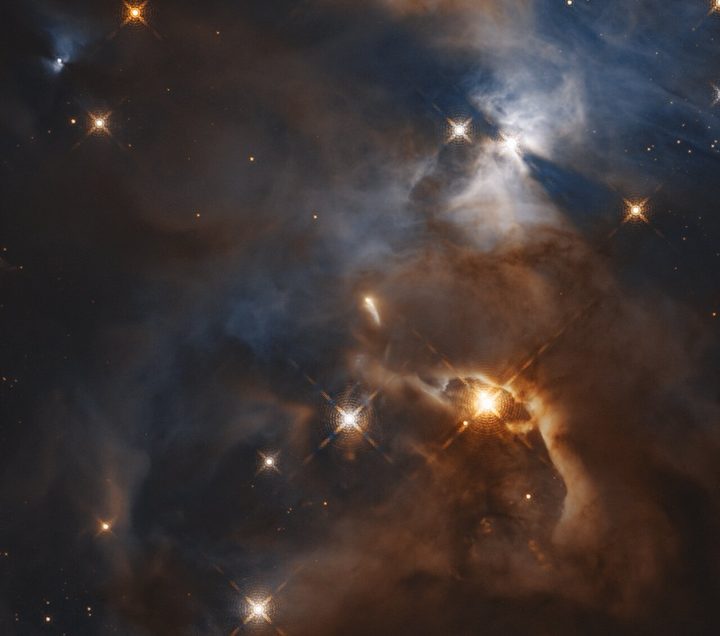
Bat Shadow (2018 Observation)
This image shows only the feature which was nicknamed the Bat Shadow. It is the shadow of a protoplanetary disc orbiting the star in the center of the image. NASA, ESA, K. Pontoppidan

Astronomers first observed the shadow of HBC 672 in 2018, and theorized the star has a planet-forming disk around it which, although not observed directly, casts a shadow onto a cloud behind it. And now, seeing this shadow move, they think that it could be caused by a planet passing through the disk and warping it, which in turn warps the shadow.

Recommended Videos

“You have a star that is surrounded by a disc, and the disc is not like Saturn’s rings — it’s not flat. It’s puffed up,” lead author Klaus Pontoppidan explained in a statement. “And so that means that the light from the star, if it goes straight up, can continue straight up — it’s not blocked by anything. But if it tries to go along the plane of the disc, it doesn’t get out, and it casts a shadow.”
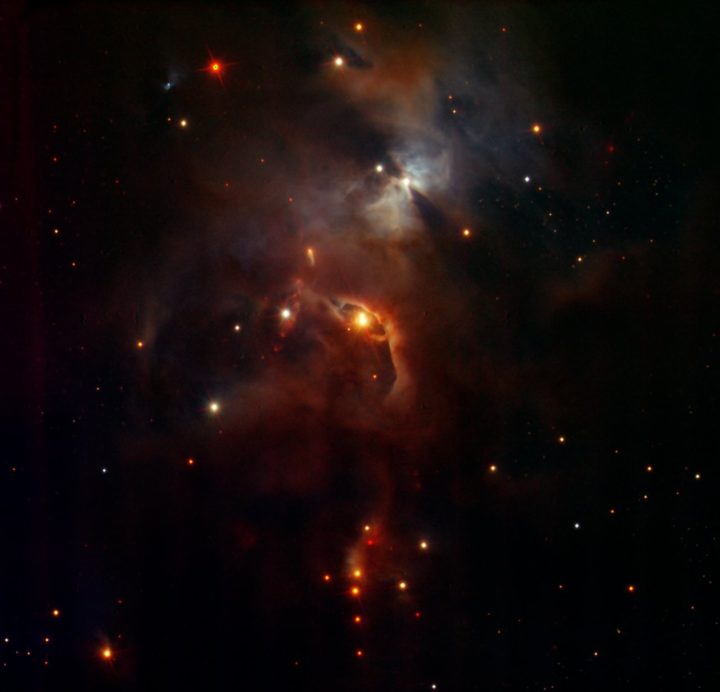
Serpens Nebula, seen by HAWK-I
This image shows the Serpens Nebula as seen by the HAWK-I instrument installed on the Very Large Telescope of the European Southern Observatory. The filters used by HAWK-I to create this image cover wavelengths similar to the filters used by Hubble. ESO

Even though the disk itself is too small and far away to be seen by Hubble, the researchers believe that it is saddle-shaped, which would explain the apparent movement of the shadow. “If there were just a simple bump in the disk, we’d expect both sides of the shadow to tilt in opposite directions, like airplane wings during a turn,” team member Colette Salyk said in the statement.

The shadow is absolutely massive, at around 200 times the diameter of our solar system. In fact, it’s so large that it takes around 45 days for light from the star to travel to its edge.

The findings will be published in the Astrophysical Journal.

Georgina Torbet
Georgina has been the space writer at Digital Trends space writer for six years, covering human space exploration, planetary…
Scientists have found a hidden galaxy inside the Milky Way, and they’re calling it Loki
A lost dwarf galaxy may be hiding inside the Milky Way.
milky-way-hidden-galaxy-loki

Our home galaxy has a secret buried inside. A new study published in the Monthly Notices of the Royal Astronomical Society suggests that the Milky Way swallowed an ancient dwarf galaxy billions of years ago, and its stellar remains are still embedded within ours.

Researchers have named this lost galaxy Loki, after the Norse trickster god, and the name is quite fitting because it remained hidden in plain sight for a very long time.

Read more
NASA aims September launch for Roman space telescope and it’s going to be a huge shift
An earlier target for Roman means one of NASA’s most ambitious observatories is getting close, with the potential to open a huge new era in space discovery
Machine, Wheel, Astronomy

NASA is now aiming to launch the Nancy Grace Roman Space Telescope as soon as early September 2026, a faster timeline than its earlier commitment to fly no later than May 2027. That alone makes this one of the agency’s most important missions to watch over the next few months.

The reason is simple, Roman is built to scan vast parts of the sky with sharp infrared vision.

Read more
Blue Origin successfully re-uses a New Glenn rocket for the first time ever
Blue Origin achieves first New Glenn reflight despite payload setback
Blue Origin

Blue Origin has achieved a major milestone in its spaceflight ambitions by successfully reusing a booster from its heavy-lift New Glenn rocket for the first time. The historic launch, conducted on April 19, marks a significant step forward for Jeff Bezos’ space company as it seeks to compete with rivals like SpaceX in the rapidly evolving commercial launch market.

A Milestone With A Mixed Outcome

Read more