  1. Home
  2. Space
  3. News

Three galaxies are in the process of merging in this Hubble image

Add as a preferred source on Google

This week’s image from the Hubble Space Telescope shows a dramatic collision of three different galaxies. The trio, located in the Boötes constellation, are in the process of merging and will eventually form one single large galaxy.
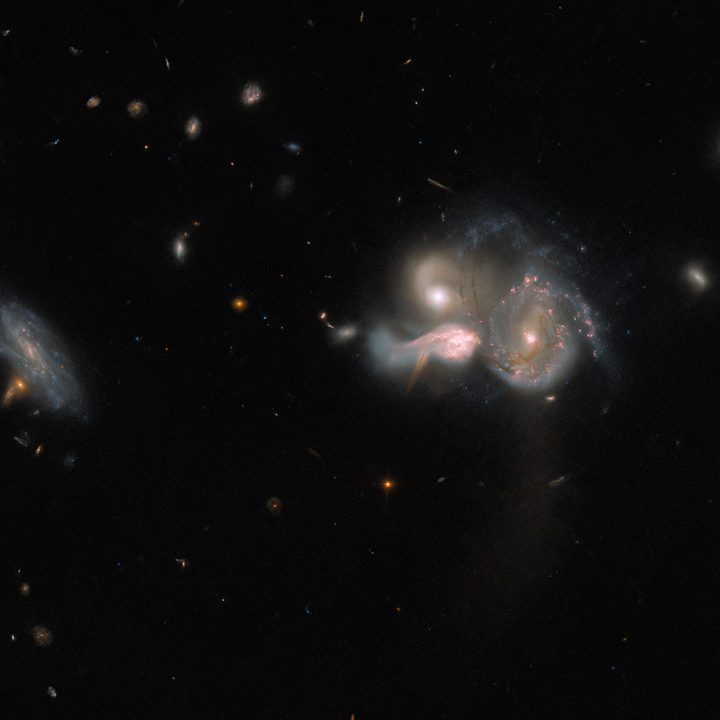
A spectacular trio of merging galaxies in the constellation Boötes takes center stage in this image from the NASA/ESA Hubble Space Telescope.
A spectacular trio of merging galaxies in the constellation Boötes takes center stage in this image from the NASA/ESA Hubble Space Telescope. These three galaxies are set on a collision course and will eventually merge into a single larger galaxy, distorting one another’s spiral structure through mutual gravitational interaction in the process. An unrelated foreground galaxy appears to float serenely near this scene, and the smudged shapes of much more distant galaxies are visible in the background. ESA/Hubble & NASA, M. Sun

“This colliding trio – known to astronomers as SDSSCGB 10189 – is a relatively rare combination of three large star-forming galaxies lying within only 50,000 light-years of one another,” Hubble scientists write. “While that might sound like a safe distance, for galaxies this makes them extremely close neighbors. Our own galactic neighbors are much further away; Andromeda, the nearest large galaxy to the Milky Way, is more than 2.5 million light-years away from Earth.”

Recommended Videos

Galactic collisions, when two or more galaxies meet each other, are not uncommon in the universe. The results of these enormous collisions can be varied, with either the galaxies merging to form a new larger galaxy, as is the case here, or one galaxy annihilating another.

Although it’s unlikely that stars from each galaxy will collide, because of the amount of space between each star, the heart of most galaxies contains a supermassive black hole, and the merging of these huge beasts can give off gravitational waves and send stars flying off in strange directions.

Typically if a larger galaxy collides with a smaller satellite galaxy, the larger galaxy will strip away stars and material from the smaller galaxy and maintain most of its shape. In other cases, the enormous gravitational forces involved in a collision can pull one or both galaxies into strange shapes.

Our own galaxy, the Milky Way, will collide with the nearby Andromeda galaxy in around 4 billion years’ time. This collision may also involve another nearby galaxy, the Triangulum galaxy, which could be pulled into orbit around the merger as well before eventually colliding as well.

Georgina Torbet
Georgina has been the space writer at Digital Trends space writer for six years, covering human space exploration, planetary…
Scientists have found a hidden galaxy inside the Milky Way, and they’re calling it Loki
A lost dwarf galaxy may be hiding inside the Milky Way.
milky-way-hidden-galaxy-loki

Our home galaxy has a secret buried inside. A new study published in the Monthly Notices of the Royal Astronomical Society suggests that the Milky Way swallowed an ancient dwarf galaxy billions of years ago, and its stellar remains are still embedded within ours.

Researchers have named this lost galaxy Loki, after the Norse trickster god, and the name is quite fitting because it remained hidden in plain sight for a very long time.

Read more
NASA aims September launch for Roman space telescope and it’s going to be a huge shift
An earlier target for Roman means one of NASA’s most ambitious observatories is getting close, with the potential to open a huge new era in space discovery
Machine, Wheel, Astronomy

NASA is now aiming to launch the Nancy Grace Roman Space Telescope as soon as early September 2026, a faster timeline than its earlier commitment to fly no later than May 2027. That alone makes this one of the agency’s most important missions to watch over the next few months.

The reason is simple, Roman is built to scan vast parts of the sky with sharp infrared vision.

Read more
Blue Origin successfully re-uses a New Glenn rocket for the first time ever
Blue Origin achieves first New Glenn reflight despite payload setback
Blue Origin

Blue Origin has achieved a major milestone in its spaceflight ambitions by successfully reusing a booster from its heavy-lift New Glenn rocket for the first time. The historic launch, conducted on April 19, marks a significant step forward for Jeff Bezos’ space company as it seeks to compete with rivals like SpaceX in the rapidly evolving commercial launch market.

A Milestone With A Mixed Outcome

Read more