  1. Home
  2. Space
  3. News

Hubble captures a tempestuous pair of Herbig-Haro objects

Add as a preferred source on Google

This week’s image from the Hubble Space Telescope shows Herbig-Haro objects, a pair or objects captured by Hubble’s Wide Field Camera 3 instrument. The camera took the image using 11 different filters spread across the visible light, infrared, and ultraviolet wavelengths, allowing researchers to observe different features.

This pair of Herbig-Haro objects is located 1,250 light-years away in the constellation of Orion, and the objects are formed from the dramatic outbursts of newly born stars. They were the first Herbig-Haro objects to be recognized, leading to the names HH 1 and HH 2. Newly born stars only develop into Herbig-Haro objects under certain circumstances: The stars must give off jets of ionized gas which is extremely hot and charged. These jets hit nearby clouds of dust and gas, creating the glowing forms in the collision.
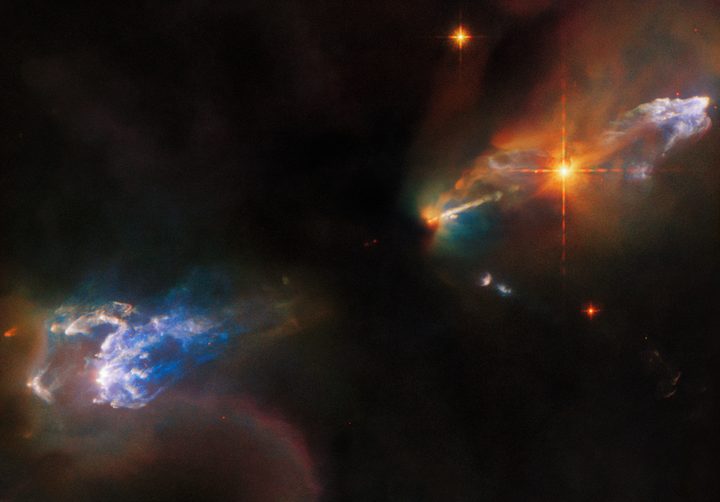
The lives of newborn stars are tempestuous, as this image of the Herbig-Haro objects HH 1 and HH 2 from the NASA/ESA Hubble Space Telescope depicts. Both objects are in the constellation Orion and lie around 1,250 light-years from Earth. HH 1 is the luminous cloud above the bright star in the upper right of this image, and HH 2 is the cloud in the bottom left.
The lives of newborn stars are tempestuous, as this image of the Herbig-Haro objects HH 1 and HH 2 from the NASA/ESA Hubble Space Telescope depicts. Both objects are in the constellation Orion and lie around 1,250 light-years from Earth. HH 1 is the luminous cloud above the bright star in the upper right of this image, and HH 2 is the cloud in the bottom left. ESA/Hubble & NASA, B. Reipurth, B. Nisini

“While both Herbig-Haro objects are visible, the young star system responsible for their creation is lurking out of sight, swaddled in the thick clouds of dust at the center of this image,” Hubble scientists wrote. “However, an outflow of gas from one of these stars is streaming out from the central dark cloud and is visible as a bright jet. Astronomers once thought the bright star between that jet and the HH 1 cloud was the source of these jets, but it is an unrelated double star that formed nearby.”

Recommended Videos

Hubble has imaged similar Herbig-Haro objects before, such as when it captured objects HH 46 and HH 47 in the constellation of Vela or when it observed the object HH 34 in the Orion nebula, which is the site of vigorous star formation. One of Hubble’s most stunning and unusual images is of object HH 505, which is in a particularly colourful and attractive nebula that has been shaped and sculpted by the forces of the jets given off by young stars.

Georgina Torbet
Georgina has been the space writer at Digital Trends space writer for six years, covering human space exploration, planetary…
Scientists have found a hidden galaxy inside the Milky Way, and they’re calling it Loki
A lost dwarf galaxy may be hiding inside the Milky Way.
milky-way-hidden-galaxy-loki

Our home galaxy has a secret buried inside. A new study published in the Monthly Notices of the Royal Astronomical Society suggests that the Milky Way swallowed an ancient dwarf galaxy billions of years ago, and its stellar remains are still embedded within ours.

Researchers have named this lost galaxy Loki, after the Norse trickster god, and the name is quite fitting because it remained hidden in plain sight for a very long time.

Read more
NASA aims September launch for Roman space telescope and it’s going to be a huge shift
An earlier target for Roman means one of NASA’s most ambitious observatories is getting close, with the potential to open a huge new era in space discovery
Machine, Wheel, Astronomy

NASA is now aiming to launch the Nancy Grace Roman Space Telescope as soon as early September 2026, a faster timeline than its earlier commitment to fly no later than May 2027. That alone makes this one of the agency’s most important missions to watch over the next few months.

The reason is simple, Roman is built to scan vast parts of the sky with sharp infrared vision.

Read more
Blue Origin successfully re-uses a New Glenn rocket for the first time ever
Blue Origin achieves first New Glenn reflight despite payload setback
Blue Origin

Blue Origin has achieved a major milestone in its spaceflight ambitions by successfully reusing a booster from its heavy-lift New Glenn rocket for the first time. The historic launch, conducted on April 19, marks a significant step forward for Jeff Bezos’ space company as it seeks to compete with rivals like SpaceX in the rapidly evolving commercial launch market.

A Milestone With A Mixed Outcome

Read more