  1. Home
  2. Space
  3. News

Telescope team-up sees Hubble and Webb working together

Add as a preferred source on Google

After two images we shared last week showed how scientific knowledge can be increased by tools like the Hubble Space Telescope and the James Webb Space Telescope imaging the same target separately, this week sees a project in which data from the two telescopes has been brought together.

Both telescopes were trained on the galaxy pair VV 191 and showed how light from the elliptical galaxy on the left filters through the dusty arms of the spiral galaxy on the right. That allowed researchers to learn about the dust in the spiral galaxy. “This is a rather unique opportunity to measure how much dust has been produced in this spiral galaxy, like our own, by previous generations of stars,” explained lead researcher Rogier Windhorst of Arizona State University in a statement. “Mind you that this is the kind of dust that the next generation of stars and planets, and in our case people, are also formed from.”
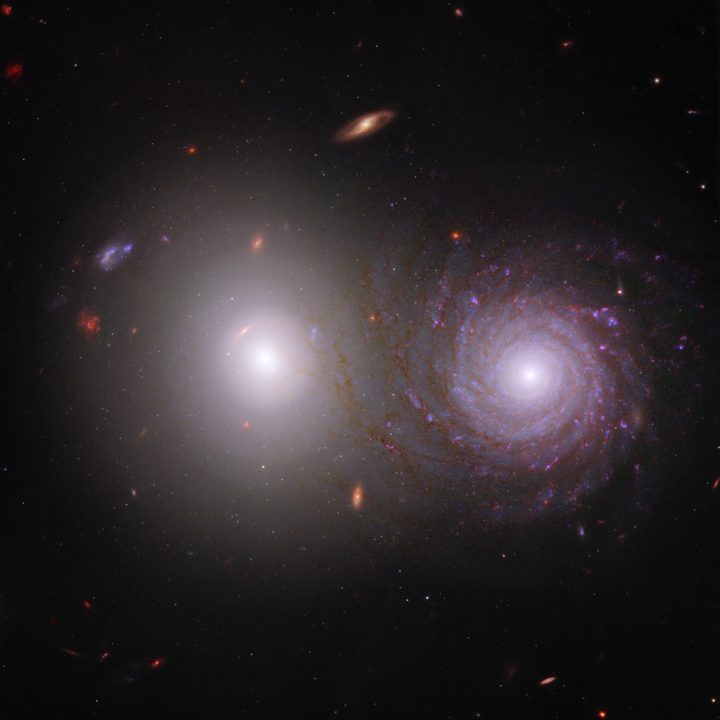
Galaxy pair VV 191 imaged by Hubble and Webb.
By combining data from NASA’s James Webb Space Telescope and NASA’s Hubble Space Telescope, researchers were able to trace light that was emitted by the large white elliptical galaxy at left through the spiral galaxy at right and identify the effects of interstellar dust in the spiral galaxy. This image of galaxy pair VV 191 includes near-infrared light from Webb, and ultraviolet and visible light from Hubble. SCIENCE: NASA, ESA, CSA, Rogier Windhorst (ASU), William Keel (University of Alabama), Stuart Wyithe (University of Melbourne), JWST PEARLS Team IMAGE PROCESSING: Alyssa Pagan (STScI)

Hubble observes primarily in the visible light and ultraviolet portions of the electromagnetic spectrum, while Webb looks at the infrared range which is beyond human vision. In pairing up data from both telescopes, researchers used Hubble data for bluish tones in the image and Webb data to pick up on the dust features.

Recommended Videos

“We got more than we bargained for by combining data from NASA’s James Webb Space Telescope and NASA’s Hubble Space Telescope,” Windhorst said.

That included some surprising findings, like a red smudge to the northwest position of the left-hand galaxy. That smudge is actually another extremely distant galaxy, which has been magnified and distorted in a phenomenon called gravitational lensing. You can even just about see its reflection as a dot at the southeast position relative to the foreground galaxy.

“I find it astonishing how Webb can provide for completely unexpected findings, such as the lensed galaxy behind the elliptical galaxy in the VV191 system, with relative ease and with only half an hour of exposure time,” said another of the researchers, Jake Summers, also of Arizona State. “The resolution of Webb never ceases to amaze me — I was blown away by the fact that it can resolve individual globular clusters in the main elliptical galaxy.”

The research has been submitted to The Astrophysical Journal but has not yet been peer-reviewed or published.

Georgina Torbet
Georgina has been the space writer at Digital Trends space writer for six years, covering human space exploration, planetary…
Scientists have found a hidden galaxy inside the Milky Way, and they’re calling it Loki
A lost dwarf galaxy may be hiding inside the Milky Way.
milky-way-hidden-galaxy-loki

Our home galaxy has a secret buried inside. A new study published in the Monthly Notices of the Royal Astronomical Society suggests that the Milky Way swallowed an ancient dwarf galaxy billions of years ago, and its stellar remains are still embedded within ours.

Researchers have named this lost galaxy Loki, after the Norse trickster god, and the name is quite fitting because it remained hidden in plain sight for a very long time.

Read more
NASA aims September launch for Roman space telescope and it’s going to be a huge shift
An earlier target for Roman means one of NASA’s most ambitious observatories is getting close, with the potential to open a huge new era in space discovery
Machine, Wheel, Astronomy

NASA is now aiming to launch the Nancy Grace Roman Space Telescope as soon as early September 2026, a faster timeline than its earlier commitment to fly no later than May 2027. That alone makes this one of the agency’s most important missions to watch over the next few months.

The reason is simple, Roman is built to scan vast parts of the sky with sharp infrared vision.

Read more
Blue Origin successfully re-uses a New Glenn rocket for the first time ever
Blue Origin achieves first New Glenn reflight despite payload setback
Blue Origin

Blue Origin has achieved a major milestone in its spaceflight ambitions by successfully reusing a booster from its heavy-lift New Glenn rocket for the first time. The historic launch, conducted on April 19, marks a significant step forward for Jeff Bezos’ space company as it seeks to compete with rivals like SpaceX in the rapidly evolving commercial launch market.

A Milestone With A Mixed Outcome

Read more