1. Home
  2. Space
  3. Emerging Tech
  4. News

Here’s how the InSight mission to Mars will confirm its landing to NASA

Add as a preferred source on Google

NASA’s InSight mission aims to send a lander to Mars to study the crust, mantle, and core of the red planet. Launched in May this year, InSight is now nearly at its destination and will soon be touching down on the surface of Mars.

NASA has shared details on how it will monitor the touching down of the lander at the end of its 91 million mile journey. The first tools it will use are radio telescopes, which can pick up simple radio signals. As the lander descends into the Mars atmosphere, it will send out radio signals that researchers back home at NASA can pick up. Two locations will be listening out for the signal: one at the National Science Foundation’s Green Bank Observatory in Green Bank, West Virginia and one at the Max Planck Institute for Radio Astronomy’s facility at Effelsberg, Germany. These radio signals cannot give data about what the lander finds, but they can be used to work out basic information like what at speed the lander is descending thanks to the Doppler effect in which the frequency of a sound wave is affected by the movement of the source relative to the observer.

Recommended Videos

More detailed information about the lander will be gathered using two small spacecraft called Mars Cube One (MarCO). The MarCOs are each about the size of a briefcase and are an experimental technology that should fly behind the InSight lander and relay data back to Earth in real-time. They may even be able to capture an image of the surface of Mars as soon as the lander touches down.
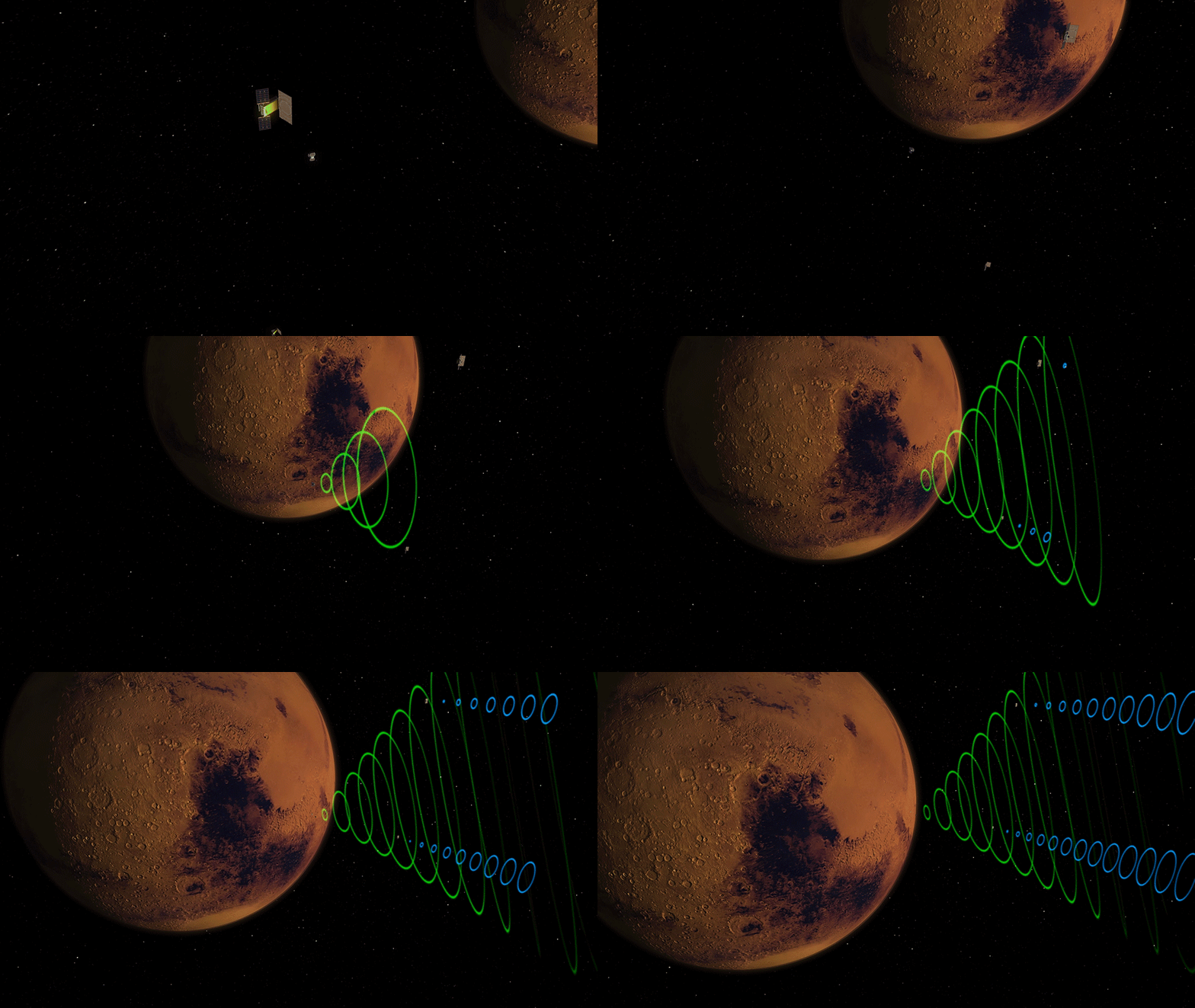
This animation depicts the MarCO CubeSats relaying data from NASA’s InSight lander as it enters the Martian atmosphere. Credit NASA/JPL-Caltech

In addition to the MarCOs, the Mars Reconnaissance Orbiter (MRO) spacecraft will also be nearby to record data about the InSight’s descent, although researchers will have to wait for the orbiter to disappear behind Mars and reappear on the other side before it can send back data. Finally, the 2001 Mars Odyssey, NASA’s oldest spacecraft at Mars, will also record data and images of InSight. Odyssey will pay particular attention to whether InSight has correctly deployed its solar arrays, which are especially important for the craft to collect solar power so it can perform its operations on Mars.

The landing is scheduled for November 26, 2018.

Georgina Torbet
Georgina has been the space writer at Digital Trends space writer for six years, covering human space exploration, planetary…
Stunning close-up footage shows NASA’s moon rocket roaring to space
On its first crewed flight, NASA's lunar rocket displays its awesome power.
NASA's SLS rocket roars skyward at the start of the Artemis II mission on April 1, 2026.

As NASA’s Artemis II astronauts journey back to Earth following their breathtaking close encounter with the moon earlier this week, the space agency has just shared some stunning footage (below) of the rocket launch that sent the crew on its way on April 1.

The close-up tracking shot shows the awesome power of the Space Launch System (SLS) rocket’s four core RS-25 engines together and its two solid rocket boosters as the 98-meter-tall vehicle roars away from the launchpad at the Kennedy Space Center in Florida.

Read more
How to watch NASA’s moon crew splash down at end of historic mission
The Orion spacecraft's final moments before splashdown will be the most perilous of the entire mission.
Earth and the moon as seen from the Orion spacecraft during the Artemis II mission in April 2026.

The Artemis II astronauts have looped around the moon, captured some extraordinary imagery (above), set a slew of records, and are now on their way back to Earth.

The 10-day mission will reach its climax on Friday, April 10, during a dramatic homecoming that will see the Orion spacecraft enter our planet’s atmosphere at a speed of nearly 25,000 miles per hour.

Read more
Notable firsts of the Artemis II moon mission … so far
The Artemis II crew are now on their way home, so let's take a look at the mission's achievements so far.
The moon as seen from the Orion spacecraft during the Artemis II mission.

Having just looped around the moon in a historic flyby of our nearest neighbor, the Artemis II crew are now on their way back to Earth.

NASA’s Victor Glover, Reid Wiseman, and Christina Koch, along with the Canadian Space Agency’s Jeremy Hansen, launched aboard the Orion spacecraft from the Kennedy Space Center on April 1, lifted to space by the mighty SLS rocket.

Read more