  1. Home
  2. Space
  3. News

Space station crew had an amazing stroke of luck during Starship launch

Add as a preferred source on Google

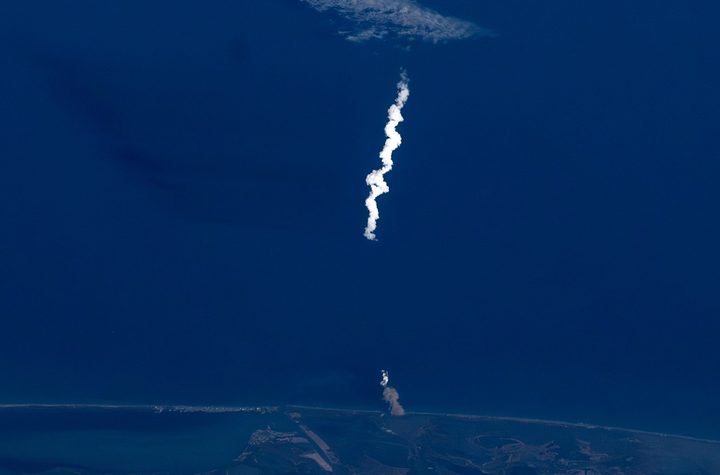
The sixth Starship mission captured from the ISS.
The sixth Starship mission captured from the ISS. NASA / Don Pettit

NASA astronaut and current space station inhabitant Don Pettit seems to have the luck of the stars. During SpaceX’s sixth test flight of its massive Starship rocket from Boca Chica, Texas, on Tuesday, the International Space Station (ISS) just happened to be passing directly above — some 250 miles above, to be precise — giving keen photographer Pettit the perfect opportunity to capture the Starship’s launch.

Recommended Videos

Pettit shared a photo of the event on his X account on Thursday, along with the comment, “We happened to be overhead!”

Starship launch from @ISS. We happened to be overhead! pic.twitter.com/SLRlLoRriv

— Don Pettit (@astro_Pettit) November 21, 2024

Pettit’s image shows the trail left by the Super Heavy’s 33 Raptor engines as it powers the Starship spacecraft to orbit, casting a shadow over the waters of the Gulf of Mexico as it goes.

The ISS orbits Earth at a speed of about 17,500 mph (28,000 kph) and makes around 16 orbits of the planet in 24 hours, so the crew were incredibly lucky to be so close to the action on Tuesday.

Pettit and his fellow ISS crew members were also fortunate enough to get a view of SpaceX’s Polaris Dawn Crew Dragon capsule as it hurtled back to Earth with four people aboard at the end of a historic mission in September. Pettit, who has earned a stellar reputation for his brilliant photographic work across multiple orbital missions, captured an astonishing shot showing a streak of light created by the capsule as it returned home.

He also recently shared a surreal image showing Earth as you’ve never seen it before, and also posted images that look more like works of art than real locations on Earth.

With Pettit only a couple of months into his six-month ISS mission, we can look forward to a lot more amazing photography from the American astronaut.

Trevor Mogg
Contributing Editor
Not so many moons ago, Trevor moved from one tea-loving island nation that drives on the left (Britain) to another (Japan)…
Scientists have found a hidden galaxy inside the Milky Way, and they’re calling it Loki
A lost dwarf galaxy may be hiding inside the Milky Way.
milky-way-hidden-galaxy-loki

Our home galaxy has a secret buried inside. A new study published in the Monthly Notices of the Royal Astronomical Society suggests that the Milky Way swallowed an ancient dwarf galaxy billions of years ago, and its stellar remains are still embedded within ours.

Researchers have named this lost galaxy Loki, after the Norse trickster god, and the name is quite fitting because it remained hidden in plain sight for a very long time.

Read more
NASA aims September launch for Roman space telescope and it’s going to be a huge shift
An earlier target for Roman means one of NASA’s most ambitious observatories is getting close, with the potential to open a huge new era in space discovery
Machine, Wheel, Astronomy

NASA is now aiming to launch the Nancy Grace Roman Space Telescope as soon as early September 2026, a faster timeline than its earlier commitment to fly no later than May 2027. That alone makes this one of the agency’s most important missions to watch over the next few months.

The reason is simple, Roman is built to scan vast parts of the sky with sharp infrared vision.

Read more
Blue Origin successfully re-uses a New Glenn rocket for the first time ever
Blue Origin achieves first New Glenn reflight despite payload setback
Blue Origin

Blue Origin has achieved a major milestone in its spaceflight ambitions by successfully reusing a booster from its heavy-lift New Glenn rocket for the first time. The historic launch, conducted on April 19, marks a significant step forward for Jeff Bezos’ space company as it seeks to compete with rivals like SpaceX in the rapidly evolving commercial launch market.

A Milestone With A Mixed Outcome

Read more