  1. Home
  2. Space
  3. News

How James Webb will peer through a dusty cloud to study supermassive black hole

Add as a preferred source on Google

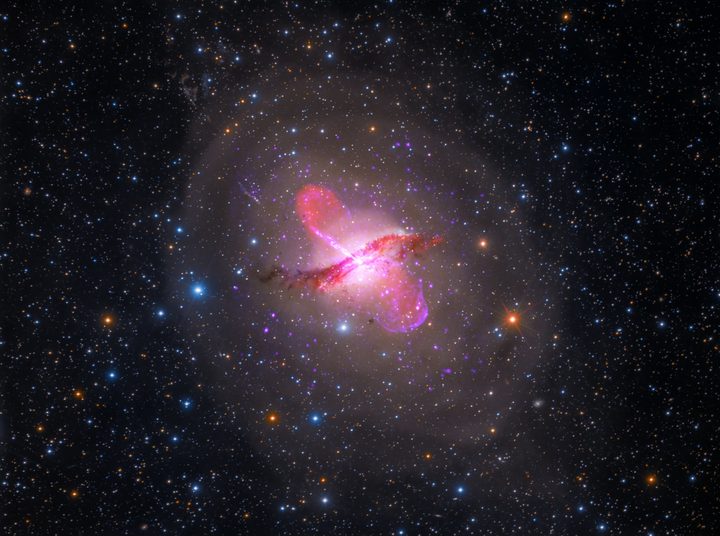
Centaurus A sports a warped central disk of gas and dust, which is evidence of a past collision and merger with another galaxy. It also has an active galactic nucleus that periodically emits jets. It is the fifth brightest galaxy in the sky and only about 13 million light-years away from Earth, making it an ideal target to study an active galactic nucleus – a supermassive black hole emitting jets and winds – with NASA's upcoming James Webb Space Telescope.
Centaurus A sports a warped central disk of gas and dust, which is evidence of a past collision and merger with another galaxy. It also has an active galactic nucleus that periodically emits jets. It is the fifth brightest galaxy in the sky and only about 13 million light-years away from Earth, making it an ideal target to study an active galactic nucleus – a supermassive black hole emitting jets and winds – with NASA’s upcoming James Webb Space Telescope. X-ray: NASA/CXC/SAO; optical: Rolf Olsen; infrared: NASA/JPL-Caltech; radio: NRAO/AUI/NSF/Univ.Hertfordshire/M.Hardcastle

When the James Webb Space Telescope launches later this year, it’ll be the most complex space observatory in the world. Now, NASA has shared a glimpse into the kind of work that it will be able to perform in a profile of research that will be conducted on the nearby galaxy Centaurus A.

Recommended Videos

The galaxy Centaurus A is enormous and very active, with a warped central disk that was twisted out of shape when it collided with another galaxy. And its center is even more intriguing, as its supermassive black hole is spewing out jets of material with such energy that they travel beyond the bounds of the galaxy itself.

It’s this active galactic nucleus that scientists want to observe in more detail. But to do that, they need to look through the dust around the core to see the central region in more detail. That’s what the upcoming James Webb telescope will be able to do.

“There’s so much going on in Centaurus A,” explained Nora Lützgendorf, the lead researcher of the team which will study this galaxy, in a statement. “The galaxy’s gas, disk, and stars all move under the influence of its central supermassive black hole. Since the galaxy is so close to us, we’ll be able to use Webb to create two-dimensional maps to see how the gas and stars move in its central region, how they are influenced by the jets from its active galactic nucleus, and ultimately better characterize the mass of its black hole.”

To understand complex, active areas like galactic nuclei, it helps to look at them in different parts of the electromagnetic spectrum, such as X-ray and radio. Different wavelengths can detect different features, so looking across a range of wavelengths builds up a more complete picture. Webb’s infrared instruments, for example, can look through clouds of dust to see what lies beneath.

“Multi-wavelength studies of any galaxy are like the layers of an onion,” said fellow lead researcher Macarena García Marín. “Each wavelength shows you something different. With Webb’s near- and mid-infrared instruments, we’ll see far colder gas and dust than in previous observations, and learn much more about the environment at the center of the galaxy.”

Webb will be able to take not only images of this region, but also use an instrument called a spectrograph to find out the composition of the material as well. “When it comes to spectral analysis, we conduct many comparisons,” Marín said. “If I compare two spectra in this region, maybe I will find that what was observed contains a prominent population of young stars. Or confirm which areas are both dusty and heated. Or maybe we will identify emission coming from the active galactic nucleus.”

The researchers plan to create a map of this busy region, and from this map, they’ll be able to see how the gravity of the supermassive black hole affects material around it. From this, they’ll be able to more accurately pin down the black hole’s mass.

And this could be just the beginning of the discoveries. “The most exciting aspect about these observations is the potential for new discoveries,” Marín said. “I think we might find something that makes us look back to other data and reinterpret what was seen earlier.”

Georgina Torbet
Georgina has been the space writer at Digital Trends space writer for six years, covering human space exploration, planetary…
Scientists have found a hidden galaxy inside the Milky Way, and they’re calling it Loki
A lost dwarf galaxy may be hiding inside the Milky Way.
milky-way-hidden-galaxy-loki

Our home galaxy has a secret buried inside. A new study published in the Monthly Notices of the Royal Astronomical Society suggests that the Milky Way swallowed an ancient dwarf galaxy billions of years ago, and its stellar remains are still embedded within ours.

Researchers have named this lost galaxy Loki, after the Norse trickster god, and the name is quite fitting because it remained hidden in plain sight for a very long time.

Read more
NASA aims September launch for Roman space telescope and it’s going to be a huge shift
An earlier target for Roman means one of NASA’s most ambitious observatories is getting close, with the potential to open a huge new era in space discovery
Machine, Wheel, Astronomy

NASA is now aiming to launch the Nancy Grace Roman Space Telescope as soon as early September 2026, a faster timeline than its earlier commitment to fly no later than May 2027. That alone makes this one of the agency’s most important missions to watch over the next few months.

The reason is simple, Roman is built to scan vast parts of the sky with sharp infrared vision.

Read more
Blue Origin successfully re-uses a New Glenn rocket for the first time ever
Blue Origin achieves first New Glenn reflight despite payload setback
Blue Origin

Blue Origin has achieved a major milestone in its spaceflight ambitions by successfully reusing a booster from its heavy-lift New Glenn rocket for the first time. The historic launch, conducted on April 19, marks a significant step forward for Jeff Bezos’ space company as it seeks to compete with rivals like SpaceX in the rapidly evolving commercial launch market.

A Milestone With A Mixed Outcome

Read more