  1. Home
  2. Space
  3. News

James Webb Space Telescope unfolds its tennis-court-sized sunshield

Add as a preferred source on Google

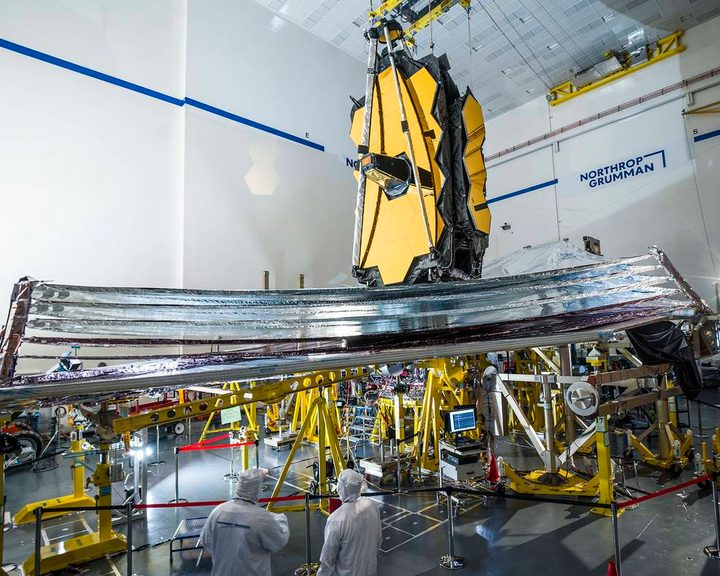
To help ensure success, technicians carefully inspect the James Webb Space Telescope’s sunshield before deployment testing begins, while it is occurring, and perform a full post-test analysis to ensure the observatory is operating as planned.
To help ensure success, technicians carefully inspect the James Webb Space Telescope’s sunshield before deployment testing begins, while it is occurring, and perform a full post-test analysis to ensure the observatory is operating as planned. NASA/Chris Gunn

Progress on the testing of NASA’s next-generation telescope, the James Webb Space Telescope, is back underway after delays this year due to the coronavirus pandemic. Recently, the James Webb unfolded its massive sunshield in a series of tensioning tests which prepare the telescope for launch next year.

Recommended Videos

The latest test involved the telescope deploying its tennis-court-sized sunshield which will protect the delicate electronics of the telescope from the heat of the sun. “This is one of Webb’s biggest accomplishments in 2020,” said Alphonso Stewart, Webb deployment systems lead, in a statement. “We were able to precisely synchronize the unfolding motion in a very slow and controlled fashion and maintain its critical kite-like shape, signifying it is ready to perform these actions in space.”

The testing involved running the hardware through its paces, including the 139 actuators, eight motors, and thousands of other components that control the complex unfurling process. The testing is further complicated by the fact that in space, the unfurling will happen without gravity, but here on Earth, the gravity can cause friction issues.

The telescope, which will be a successor to the Hubble Space Telescope and which will search for habitable worlds among other scientific objectives, has been hit with a series of delays, including work on the project being suspended due to the coronavirus. But work is back underway now, with the team at NASA’s Goddard Space Flight Center in Greenbelt, Maryland performing tests on the hardware to ensure everything is ready for launch.

The team is hopeful that the launch of the telescope can go ahead in 2021. “This milestone signals that Webb is well on its way to being ready for launch. Our engineers and technicians achieved incredible testing progress this month, reducing significant risk to the project by completing these milestones for launch next year,” Bill Ochs, project manager for Webb, said in the statement. “The team is now preparing for final post-environmental deployment testing on the observatory these next couple of months prior to shipping to the launch site next summer.”

Georgina Torbet
Georgina has been the space writer at Digital Trends space writer for six years, covering human space exploration, planetary…
Scientists have found a hidden galaxy inside the Milky Way, and they’re calling it Loki
A lost dwarf galaxy may be hiding inside the Milky Way.
milky-way-hidden-galaxy-loki

Our home galaxy has a secret buried inside. A new study published in the Monthly Notices of the Royal Astronomical Society suggests that the Milky Way swallowed an ancient dwarf galaxy billions of years ago, and its stellar remains are still embedded within ours.

Researchers have named this lost galaxy Loki, after the Norse trickster god, and the name is quite fitting because it remained hidden in plain sight for a very long time.

Read more
NASA aims September launch for Roman space telescope and it’s going to be a huge shift
An earlier target for Roman means one of NASA’s most ambitious observatories is getting close, with the potential to open a huge new era in space discovery
Machine, Wheel, Astronomy

NASA is now aiming to launch the Nancy Grace Roman Space Telescope as soon as early September 2026, a faster timeline than its earlier commitment to fly no later than May 2027. That alone makes this one of the agency’s most important missions to watch over the next few months.

The reason is simple, Roman is built to scan vast parts of the sky with sharp infrared vision.

Read more
Blue Origin successfully re-uses a New Glenn rocket for the first time ever
Blue Origin achieves first New Glenn reflight despite payload setback
Blue Origin

Blue Origin has achieved a major milestone in its spaceflight ambitions by successfully reusing a booster from its heavy-lift New Glenn rocket for the first time. The historic launch, conducted on April 19, marks a significant step forward for Jeff Bezos’ space company as it seeks to compete with rivals like SpaceX in the rapidly evolving commercial launch market.

A Milestone With A Mixed Outcome

Read more