  1. Home
  2. Space
  3. News

This is Jupiter as you’ve never seen it before

Add as a preferred source on Google

The groundbreaking James Webb Space Telescope is peering farther into deep space than any observatory that has gone before, but it’s also producing breathtaking images of celestial bodies closer to home.

Take this awesome shot of Jupiter, for example.
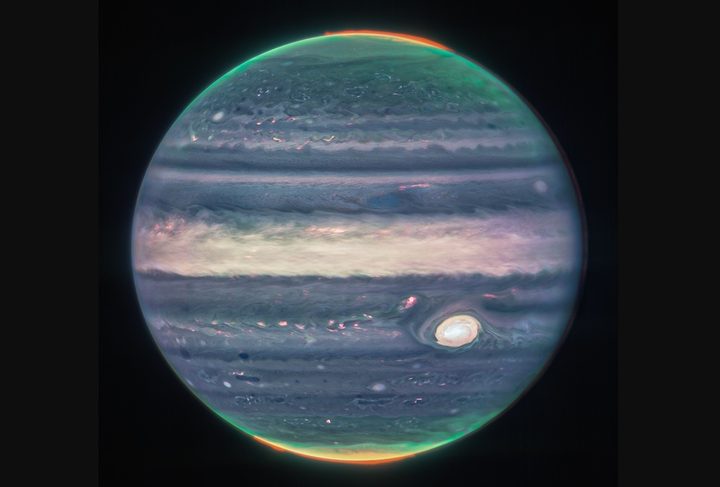
Jupiter, captured by the James Webb Space Telescope.
NASA, ESA, CSA, Jupiter ERS Team; image processing by Ricardo Hueso (UPV/EHU) and Judy Schmidt.

Captured by the Webb telescope’s Near-Infrared Camera (NIRCam), the image highlights gorgeous auroras extending to high altitudes above both the northern and southern poles of the planet.

Recommended Videos

The infrared light captured by the camera is invisible to the human eye, so the Webb team — working with citizen scientist Judy Schmidt — mapped the data in a way to make the details stand out. This explains why Jupiter’s distinctive Great Red Spot — a storm system described as “so big it could swallow Earth” — appears as white in the image.

The captured images are clearly way beyond what the Webb team had been hoping for.

“We hadn’t really expected it to be this good, to be honest … it’s really remarkable,” planetary astronomer Imke de Pater, who helped lead the observation, said in a post on NASA’s website.

After further analysis of the extraordinary image, Heidi Hammel, Webb interdisciplinary scientist for solar system observations, noted: “The brightness here indicates high altitude — so the Great Red Spot has high-altitude hazes, as does the equatorial region. The numerous bright white ‘spots’ and ‘streaks’ are likely very high-altitude cloud tops of condensed convective storms.”

In a wider image (below) captured by the Webb telescope, two tiny moons called Amalthea and Adrastea are visible.
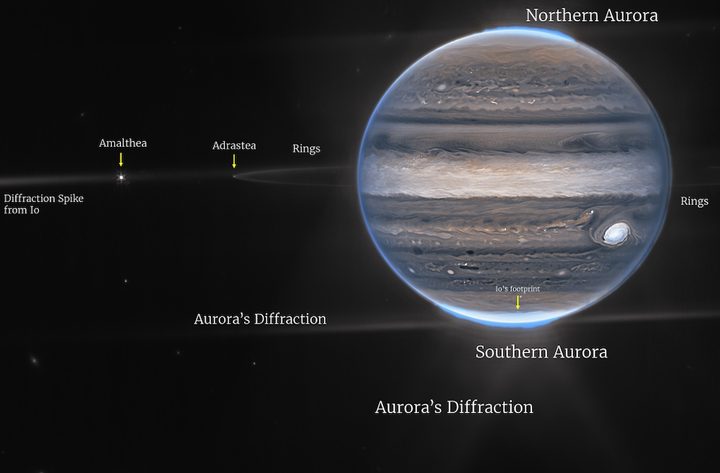
Jupiter and its surroundings, captured by the James Webb Space Telescope.
NASA, ESA, CSA, Jupiter ERS Team; image processing by Ricardo Hueso (UPV/EHU) and Judy Schmidt.

After launching from Earth in December 2021, the Webb telescope — the most powerful ever built — is now in an orbit around a million miles away. NASA and its partners in Europe and Canada recently shared the first set of high-resolution color images from a mission that scientists believe could tell us more about the origins of the universe. It’s also searching for distant planets that could support life.

Other dazzling images captured by Webb include this this stunner showing the Cartwheel Galaxy located around 500 million light-years away in the Sculptor constellation.

Trevor Mogg
Contributing Editor
Not so many moons ago, Trevor moved from one tea-loving island nation that drives on the left (Britain) to another (Japan)…
Scientists have found a hidden galaxy inside the Milky Way, and they’re calling it Loki
A lost dwarf galaxy may be hiding inside the Milky Way.
milky-way-hidden-galaxy-loki

Our home galaxy has a secret buried inside. A new study published in the Monthly Notices of the Royal Astronomical Society suggests that the Milky Way swallowed an ancient dwarf galaxy billions of years ago, and its stellar remains are still embedded within ours.

Researchers have named this lost galaxy Loki, after the Norse trickster god, and the name is quite fitting because it remained hidden in plain sight for a very long time.

Read more
NASA aims September launch for Roman space telescope and it’s going to be a huge shift
An earlier target for Roman means one of NASA’s most ambitious observatories is getting close, with the potential to open a huge new era in space discovery
Machine, Wheel, Astronomy

NASA is now aiming to launch the Nancy Grace Roman Space Telescope as soon as early September 2026, a faster timeline than its earlier commitment to fly no later than May 2027. That alone makes this one of the agency’s most important missions to watch over the next few months.

The reason is simple, Roman is built to scan vast parts of the sky with sharp infrared vision.

Read more
Blue Origin successfully re-uses a New Glenn rocket for the first time ever
Blue Origin achieves first New Glenn reflight despite payload setback
Blue Origin

Blue Origin has achieved a major milestone in its spaceflight ambitions by successfully reusing a booster from its heavy-lift New Glenn rocket for the first time. The historic launch, conducted on April 19, marks a significant step forward for Jeff Bezos’ space company as it seeks to compete with rivals like SpaceX in the rapidly evolving commercial launch market.

A Milestone With A Mixed Outcome

Read more