  1. Home
  2. Space
  3. News

Why the Mars InSight lander is covering itself in dirt

Add as a preferred source on Google

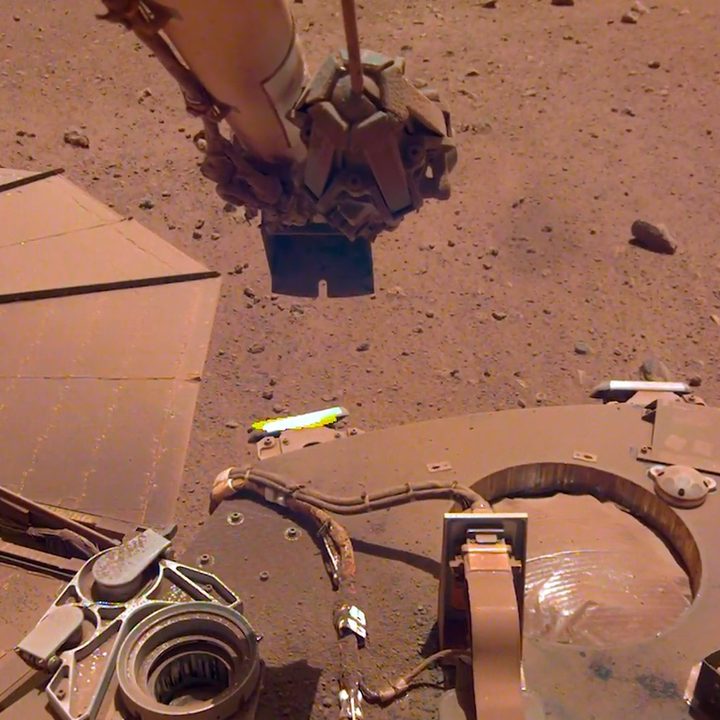
To clean a bit of dust from one of its solar panels, NASA’s InSight lander trickled sand above the panel. The wind-borne sand grains then picked up some dust on the panel, enabling the lander to gain about 30 watt-hours of energy per sol on May 22, 2021, the 884th Martian day of the mission.
To clean a bit of dust from one of its solar panels, NASA’s InSight lander trickled sand above the panel. The wind-borne sand grains then picked up some dust on the panel, enabling the lander to gain about 30 watt-hours of energy per sol on May 22, 2021, the 884th Martian day of the mission. NASA/JPL-Caltech

It’s not easy powering a robot on Mars. NASA rovers like Curiosity and Perseverance use a nuclear power system, but other explorers like the InSight lander rely on solar power. The good news is that the sun provides a constant source of energy. The bad news is that Mars is a very dusty place, and dust eventually covers solar panels and stops them from working. That’s what happened to the now-defunct Opportunity rover, which ran out of power when a dust storm rolled in and prevented it from charging via its solar panels.

Recommended Videos

So the InSight team has come up with a counterintuitive approach to fixing this problem, which they recently tried out: They got the lander to dump more dirt onto itself.

The team has been considering how to approach the power issue for a year and has tried other approaches like using motors to shake the dust loose — but without success. So they decided to try something wild: They used lander’s robotic arm to scoop up some sand and trickle it next to a solar panel. The wind picked up the sand and blew it across the panel, which carried some of the dust away as it went.

This surprising approach resulted in an improvement of 30 watt-hours of energy per martian day.

“We weren’t sure this would work, but we’re delighted that it did,” Matt Golombek, a member of the InSight science team at NASA’s Jet Propulsion Laboratory, said in a statement.

The power issue is becoming pressing because Mars will soon approach its aphelion, or the point at which it is furthest from the sun. That means there is less solar energy available, and although the lander has turned off many of its science instruments to minimize power usage during the cold season, it still needs enough power to keep its heaters and computer running.

InSight recently had its mission extended by two years, but we’ll have to wait and see whether the dust management approach yielded enough power for the lander to keep running. “While it’s no guarantee that the spacecraft has all the power it needs, the recent cleaning will add some helpful margin to InSight’s power reserves,” NASA wrote.

Georgina Torbet
Georgina has been the space writer at Digital Trends space writer for six years, covering human space exploration, planetary…
Scientists have found a hidden galaxy inside the Milky Way, and they’re calling it Loki
A lost dwarf galaxy may be hiding inside the Milky Way.
milky-way-hidden-galaxy-loki

Our home galaxy has a secret buried inside. A new study published in the Monthly Notices of the Royal Astronomical Society suggests that the Milky Way swallowed an ancient dwarf galaxy billions of years ago, and its stellar remains are still embedded within ours.

Researchers have named this lost galaxy Loki, after the Norse trickster god, and the name is quite fitting because it remained hidden in plain sight for a very long time.

Read more
NASA aims September launch for Roman space telescope and it’s going to be a huge shift
An earlier target for Roman means one of NASA’s most ambitious observatories is getting close, with the potential to open a huge new era in space discovery
Machine, Wheel, Astronomy

NASA is now aiming to launch the Nancy Grace Roman Space Telescope as soon as early September 2026, a faster timeline than its earlier commitment to fly no later than May 2027. That alone makes this one of the agency’s most important missions to watch over the next few months.

The reason is simple, Roman is built to scan vast parts of the sky with sharp infrared vision.

Read more
Blue Origin successfully re-uses a New Glenn rocket for the first time ever
Blue Origin achieves first New Glenn reflight despite payload setback
Blue Origin

Blue Origin has achieved a major milestone in its spaceflight ambitions by successfully reusing a booster from its heavy-lift New Glenn rocket for the first time. The historic launch, conducted on April 19, marks a significant step forward for Jeff Bezos’ space company as it seeks to compete with rivals like SpaceX in the rapidly evolving commercial launch market.

A Milestone With A Mixed Outcome

Read more