1. Home
  2. Space
  3. News

Michael Strahan describes Blue Origin rocket ride as ‘a special journey’

Add as a preferred source on Google

New York Giants football legend and Good Morning America co-anchor Michael Strahan has been talking about his recent trip to the edge of space, describing the adventure as “a special journey” and “almost like an out-of-body experience.”

Strahan blasted skyward courtesy of Blue Origin in what was the spaceflight company’s third crewed mission using its suborbital New Shepard rocket.

Recommended Videos

"It's almost like an out of body experience, it's hard to even believe it happened." @michaelstrahan talks going to space one-on-one with @arobach.

LATEST: https://t.co/U7ROimgvM7 pic.twitter.com/HJ1DNAdxWM

— ABC News (@ABC) December 11, 2021

The five other passengers comprised Laura Shepard Churchley, the eldest daughter of Alan Shepard, the first American to fly to space and whom Blue Origin named its rocket after; Dylan Taylor, a space industry executive and philanthropist; investor Evan Dick; and Bess Ventures founder Lane Bess and his son, Cameron.

The 10-minute ride went precisely according to plan, with the rocket lifting off from Blue Origin’s launch site in West Texas on Saturday morning before climbing to above the Kármán line, the point 62 miles above Earth that’s generally considered to mark the start of space.

As the New Shepard booster returned to Earth to successfully perform an upright landing, the six passengers inside the capsule enjoyed amazing views way above Earth, as well as several minutes of weightlessness during which they could leave their seats and float around. A short while later they returned to their seats for the parachute-assisted ride back home. A video posted by ABC News showed the passengers during their period of weightlessness.

Video from inside the #BlueOrigin New Shepard capsule carrying our @michaelstrahan and the #NS19 crew this morning!

LATEST: https://t.co/HTrhUSwili pic.twitter.com/3umjialuZS

— ABC News (@ABC) December 11, 2021

Speaking a short while after returning to Earth, Strahan, the best-known passenger among the group, said it was “hard to believe” the trip had even happened. He added that blasting off from the launch pad and floating around inside the capsule was “a crazy feeling.”

In comments released after the flight, Blue Origin CEO Bob Smith said it had been “a great year” for the company as it moves toward the launch of a full-fledged space tourism service that will not only offer seats to high-paying passengers, but also give scientists another way to conduct experiments in microgravity conditions.

Virgin Galactic, founded by billionaire entrepreneur Richard Branson, is also aiming to launch a similar service.

While such tourism services open up the experience of space travel to more people than ever before, critics argue the rocket rides serve little purpose and could even impact global warming by pumping more greenhouse gases into the atmosphere.

Blue Origin also has ambitions to build orbital rockets and even a next-generation space station for low-Earth orbit.

Trevor Mogg
Contributing Editor
Not so many moons ago, Trevor moved from one tea-loving island nation that drives on the left (Britain) to another (Japan)…
Lightsails have hit another speed bump on the road to interstellar travel
The coolest interstellar travel idea may get betrayed by the light pushing it
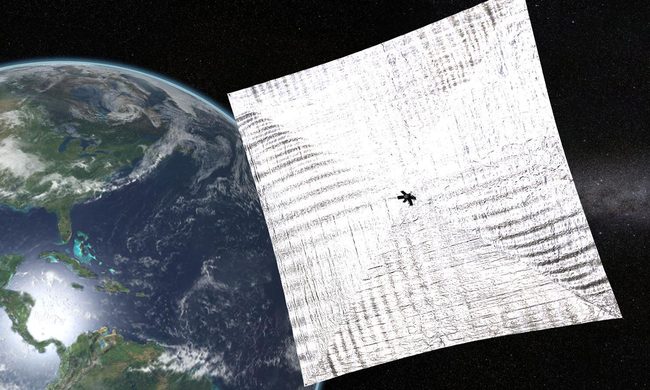
LightSail in Earth orbit

Laser-powered lightsails are one of the coolest answers to spaceflight. It might not be as sci-fi-sounding as a warp drive, but now, its practicality has also come under question. Using lightsails, a spacecraft could unfurl an ultra-thin reflective sail and let a powerful laser push it toward another star, without relying on fuel.

The tech was simple and elegant--except it's also more complicated than it sounds. A new preprint from researchers Chao Shen and Jiaze Li of the Harbin Institute of Technology suggests that relativistic lightsails may run into a hidden propulsion problem once they start moving extremely fast.

Read more
The galaxy has an exoplanet size mystery, and NASA’s EVE mission wants to solve it
This planet-hunting mission wants to catch baby worlds before they grow up
Artist’s Illustration of Exoplanets Orbiting Barnard’s Star

Mankind venturing into space ended up creating more questions than it answered, and one of the dilemmas is related to the planet sizes. Astronomers have found plenty of rocky super-Earths and plenty of puffier sub-Neptunes, but far fewer planets with a radius of about 1.8 times Earth’s.

That gap is known as the radius valley, and a proposed mission called the Early eVolution Explorer, or EVE, wants to figure out why it exists. NASA has a simple plan: look at planets while they are still young. The mission concept, detailed in a new arXiv preprint and covered by Phys.org, would focus on newly formed star clusters to see what small planets look like before billions of years of evolution.

Read more
We just got a hot signal that a Tesla and SpaceX merger could happen, after all
Tesla

For years, the idea of Tesla and SpaceX becoming a single company has lived somewhere between ambitious business theory and Elon Musk fan fiction. The two companies already share DNA, leadership influence, engineering talent, and long-term goals. But every time the topic surfaced, it felt more like an interesting thought experiment than a realistic possibility. Now, one of the most important people at SpaceX has added fresh fuel to the conversation.

Speaking in a recent CNBC interview, SpaceX President and COO Gwynne Shotwell was asked about the possibility of closer ties between Tesla and SpaceX. Her response wasn’t a flat-out denial. In fact, she suggested that bringing the two companies together could make life a little easier for Musk. That may sound like an offhand comment, but coming from Shotwell, it’s noteworthy. She’s been at SpaceX since its earliest days and remains one of the company's most influential executives.

Read more