  1. Home
  2. Space
  3. News

Starship’s 10th flight won’t include that magical maneuver

A key maneuver will be missing from the Starship's 10th test flight

Add as a preferred source on Google
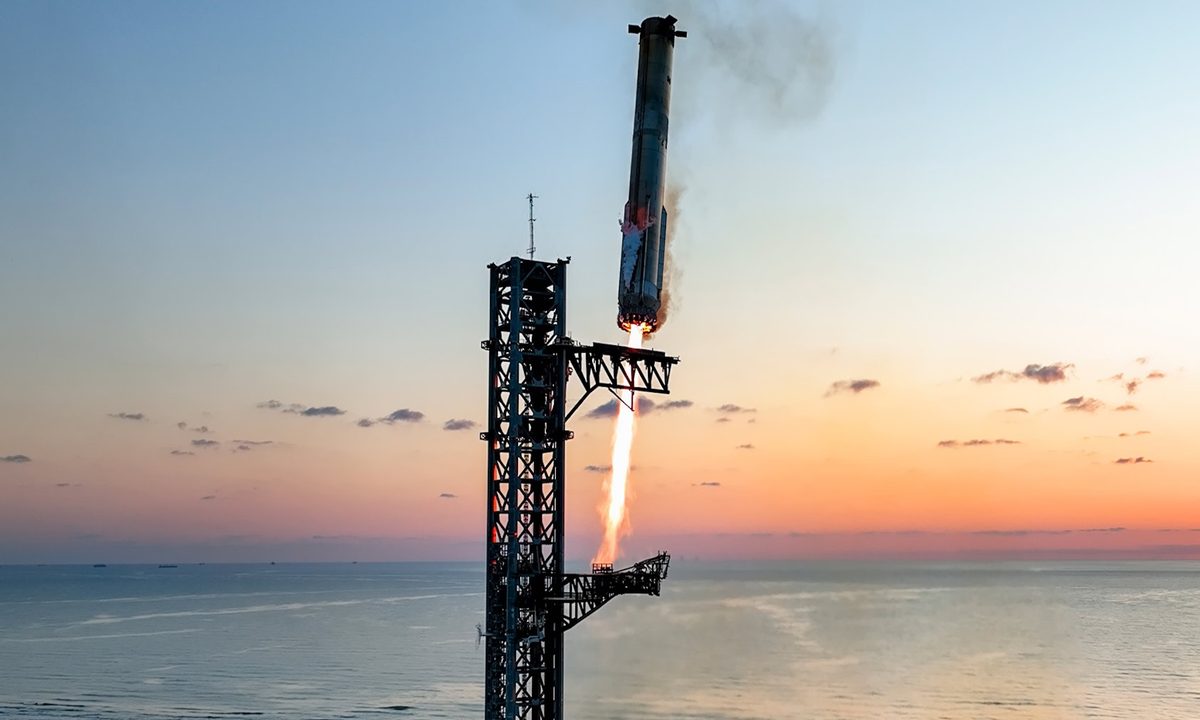
The Starship's first-stage booster coming in to land after deploying the spacecraft to orbit in a recent flight test.
The Starship's first-stage booster coming in to land after deploying the spacecraft to orbit in a recent flight test. SpaceX

SpaceX is gearing up for the 10th launch of the Starship, the most powerful rocket ever to fly.

Whether you’re watching this weekend’s launch online or in person, the Starship flights from SpaceX’s Starbase facility near Boca Chica, Texas, are always dramatic, with the massive 121-meter-tall rocket generating an astonishing 17 million pounds of thrust as the vehicle roars away from the launchpad.

Recommended Videos

Just a few minutes into the flight, all being well, the upper-stage Starship spacecraft will separate from the first-stage Super Heavy booster.

In three of its nine test flights to date, the 71-meter-tall Super Heavy booster has performed a spectacular  — and autonomous — landing back at the launch site, with a pair of giant mechanical arms on the launch tower securing the descending rocket just meters above the ground.

But for its 10th flight, SpaceX has said it won’t be attempting the catch, instead sending the Super Heavy booster into the ocean in a controlled splashdown.

The absence of the impressive maneuver during the upcoming test mission will come as a big disappointment for many Starship fans who were hoping to witness the catch (you can watch an earlier one instead).

SpaceX has decided to forgo the landing because one of the goals of the 10th flight includes testing a steeper — and therefore riskier — descent angle for the booster as part of efforts to improve the rocket’s efficiency.

Of course, it could attempt the steeper descent while bringing the rocket back to Starbase, but that would risk damaging the launch tower, which is a costly and crucial part of the facility. 

So, bringing the Super Heavy down in the ocean lets SpaceX test the descent process while minimizing risk. 

Future flights will see the launch tower come back into use for landings, hopefully soon. Catching the booster in this way allows SpaceX to reuse it for multiple missions, just like it does now with its workhorse Falcon 9 rocket. In upcoming tests, SpaceX also wants to land the Starship spacecraft back at Starbase so that it can reuse that as well. 

Trevor Mogg
Contributing Editor
Not so many moons ago, Trevor moved from one tea-loving island nation that drives on the left (Britain) to another (Japan)…
Scientists have found a hidden galaxy inside the Milky Way, and they’re calling it Loki
A lost dwarf galaxy may be hiding inside the Milky Way.
milky-way-hidden-galaxy-loki

Our home galaxy has a secret buried inside. A new study published in the Monthly Notices of the Royal Astronomical Society suggests that the Milky Way swallowed an ancient dwarf galaxy billions of years ago, and its stellar remains are still embedded within ours.

Researchers have named this lost galaxy Loki, after the Norse trickster god, and the name is quite fitting because it remained hidden in plain sight for a very long time.

Read more
NASA aims September launch for Roman space telescope and it’s going to be a huge shift
An earlier target for Roman means one of NASA’s most ambitious observatories is getting close, with the potential to open a huge new era in space discovery
Machine, Wheel, Astronomy

NASA is now aiming to launch the Nancy Grace Roman Space Telescope as soon as early September 2026, a faster timeline than its earlier commitment to fly no later than May 2027. That alone makes this one of the agency’s most important missions to watch over the next few months.

The reason is simple, Roman is built to scan vast parts of the sky with sharp infrared vision.

Read more
Blue Origin successfully re-uses a New Glenn rocket for the first time ever
Blue Origin achieves first New Glenn reflight despite payload setback
Blue Origin

Blue Origin has achieved a major milestone in its spaceflight ambitions by successfully reusing a booster from its heavy-lift New Glenn rocket for the first time. The historic launch, conducted on April 19, marks a significant step forward for Jeff Bezos’ space company as it seeks to compete with rivals like SpaceX in the rapidly evolving commercial launch market.

A Milestone With A Mixed Outcome

Read more