  1. Home
  2. Space
  3. News

This planet is hotter than a star and has four seasons every 36 hours

Add as a preferred source on Google
NASA’s TESS Delivers New Insights Into an Ultrahot World

NASA’s planet-hunting satellite TESS (Transiting Exoplanet Survey Satellite) has been used to discover more about one of the most extreme planets ever detected, KELT-9 b, which is not only hotter on the surface than some stars but also has two summers and two winters every 36 hours.

Recommended Videos

KELT-9 b is famous for being the hottest exoplanet yet discovered, with a surface temperature of 7,800 degrees Fahrenheit (4,300 degrees Celsius). It’s so hot that the hydrogen molecules in its atmosphere are torn apart in planetwide meltdowns.

“The weirdness factor is high with KELT-9 b,” John Ahlers, an astronomer at Universities Space Research Association and NASA’s Goddard Space Flight Center said in a statement. “It’s a giant planet in a very close, nearly polar orbit around a rapidly rotating star, and these features complicate our ability to understand the star and its effects on the planet.”
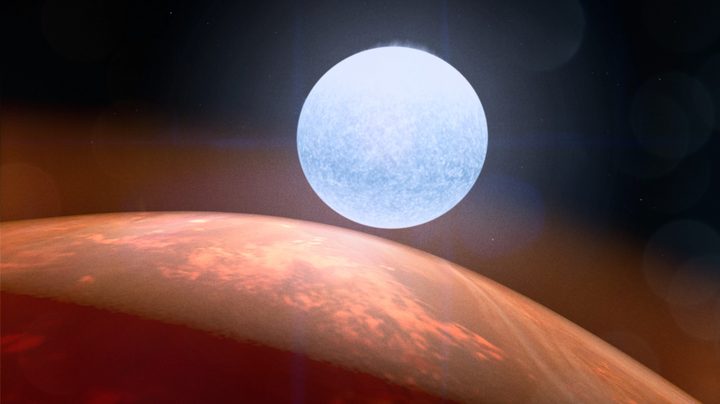
This illustration shows how planet KELT-9 b sees its host star
This illustration shows how planet KELT-9 b sees its host star. Over the course of a single orbit, the planet twice experiences cycles of heating and cooling caused by the star’s unusual pattern of surface temperatures. NASA's Goddard Space Flight Center/Chris Smith (USRA)

One reason that the planet has such extreme features is that it is tidally locked, meaning one side of the planet always faces the sun. It is this side that becomes extremely hot, while the far side is relatively cooler, leading to strange interactions in the planet’s atmosphere as parts of it warm and cool.

Another reason the planet is strange is that its host star is unusual as well, spinning 38 times faster than the sun to complete a rotation in just 16 hours. The speed of this rotation affects the star’s shape, making it flatter at the poles and thicker around the circumference. In turn, this shape changes the temperature distribution of the star, with the poles being hotter and the equator being cooler.

When the planet passes over the star’s poles it experiences a kind of “summer” and when it passes over the cooler equator it experiences a kind of “winter.” “So KELT-9 b experiences two summers and two winters every year, with each season about nine hours,” NASA explains.

As well as being a fascinating example of an extreme planet and star system, KELT-9 can also help scientists learn about detecting other exoplanets.

“Of the planetary systems that we’ve studied via gravity darkening, the effects on KELT-9 b are by far the most spectacular,” Jason Barnes, a professor of physics at the University of Idaho and a co-author of the paper, said in the statement. “This work goes a long way toward unifying gravity darkening with other techniques that measure planetary alignment, which in the end we hope will tease out secrets about the formation and evolutionary history of planets around high-mass stars.”

The findings are published in the Astronomical Journal.

Georgina Torbet
Georgina has been the space writer at Digital Trends space writer for six years, covering human space exploration, planetary…
Blue Origin successfully re-uses a New Glenn rocket for the first time ever
Blue Origin achieves first New Glenn reflight despite payload setback
Blue Origin

Blue Origin has achieved a major milestone in its spaceflight ambitions by successfully reusing a booster from its heavy-lift New Glenn rocket for the first time. The historic launch, conducted on April 19, marks a significant step forward for Jeff Bezos’ space company as it seeks to compete with rivals like SpaceX in the rapidly evolving commercial launch market.

A Milestone With A Mixed Outcome

Read more
Stunning close-up footage shows NASA’s moon rocket roaring to space
On its first crewed flight, NASA's lunar rocket displays its awesome power.
NASA's SLS rocket roars skyward at the start of the Artemis II mission on April 1, 2026.

As NASA’s Artemis II astronauts journey back to Earth following their breathtaking close encounter with the moon earlier this week, the space agency has just shared some stunning footage (below) of the rocket launch that sent the crew on its way on April 1.

The close-up tracking shot shows the awesome power of the Space Launch System (SLS) rocket’s four core RS-25 engines together and its two solid rocket boosters as the 98-meter-tall vehicle roars away from the launchpad at the Kennedy Space Center in Florida.

Read more
How to watch NASA’s moon crew splash down at end of historic mission
The Orion spacecraft's final moments before splashdown will be the most perilous of the entire mission.
Earth and the moon as seen from the Orion spacecraft during the Artemis II mission in April 2026.

The Artemis II astronauts have looped around the moon, captured some extraordinary imagery (above), set a slew of records, and are now on their way back to Earth.

The 10-day mission will reach its climax on Friday, April 10, during a dramatic homecoming that will see the Orion spacecraft enter our planet’s atmosphere at a speed of nearly 25,000 miles per hour.

Read more