  1. Home
  2. Space
  3. News

James Webb spots ancient Spiderweb cluster that’s 10 billion years old

Add as a preferred source on Google
This image shows the Spiderweb protocluster as seen by Webb’s NIRCam (Near-InfraRed Camera).
This image shows the Spiderweb protocluster as seen by Webb’s NIRCam (Near-InfraRed Camera). ESA/Webb, NASA & CSA, H. Dannerbauer

A new image from the James Webb Space Telescope shows thousands of glittering galaxies that it spied by peering through clouds of dust and using its infrared instruments to reveal what lies beneath. In the center of the image is the Spiderweb protocluster, which is a group of galaxies in the early stages of forming a “cosmic city.”

The light from the Spiderweb has been traveling for an astonishing 10 billion years to reach us, so looking at it is like looking back in time to the early stages of the universe. Astronomers are interested in studying this cluster of over 100 galaxies interacting together because it shows how galaxies clumped together to form groups when the universe was still young.

Recommended Videos

“We are observing the buildup of one the largest structures in the universe, a city of galaxies in construction,” explained researcher Jose M. Pérez-Martínez of the Institute of Astrophysics of the Canary Islands and the University of La Laguna in Spain. “We know that most galaxies in local galaxy clusters (the biggest metropolises of the universe) are old and not very active, whereas in this work, we are looking at these objects during their adolescence. As this city in construction grows, their physical properties will also be affected. Now, Webb is giving us new insights into the buildup of such structures for the first time.”
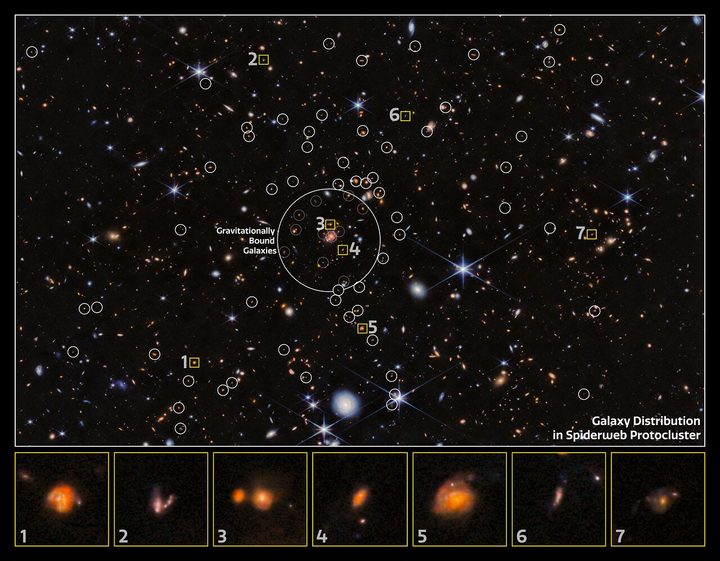
This annotated image shows the galaxy distribution in the Spiderweb protocluster as seen by Webb’s NIRCam (Near-InfraRed Camera). The galaxies are annotated by white circles, and the collection of gravitationally-bound galaxies is identified in the centre of the image. A selection of these galaxies are featured as individual close-ups at the bottom of the image.
This annotated image shows the galaxy distribution in the Spiderweb protocluster as seen by the James Webb Space Telescopes’s NIRCam (Near-InfraRed Camera). The galaxies are annotated by white circles, and the collection of gravitationally bound galaxies is identified in the center of the image. A selection of these galaxies are featured as individual close-ups at the bottom of the image. ESA/Webb, NASA & CSA, H. Dannerbauer

This annotated version of the Webb image highlights the galaxies that make up the Spiderweb group. Though there are many galaxies highlighted by the white circles, only a relatively small number of these are within the circle in the center, which indicates those that are bound together by gravity. When Webb looked through the dust at this region, it spotted many more galaxies in this protocluster than the researchers had anticipated.

“As expected, we found new galaxy cluster members, but we were surprised to find more than expected,” explained Rhythm Shimakawa of Waseda University in Japan. “We found that previously known galaxy members (similar to the typical star-forming galaxies like our Milky Way galaxy) are not as obscured or dust-filled as previously expected, which also came as a surprise.”

Webb is revealing all sorts of new information about the early universe, as it is the most powerful telescope currently available and can look at extremely distant objects — allowing it to see the early stages of the universe. Researchers have been surprised to find that the early universe is much busier and brighter than they had expected, suggesting that stars may have been forming faster than predicted.

In the case of the Spiderweb protocluster, the researchers think that the lower amounts of dust seen in these galaxies may be to do with the way these galaxies form and grow. Unlike the galaxies we see close to use today, in which star formation is often driven by galaxies interacting or merging with each other, there seems to be plentiful gas in the region from which stars are forming in this case.

The research is published in two papers in The Astronomical Journal.

Georgina Torbet
Georgina has been the space writer at Digital Trends space writer for six years, covering human space exploration, planetary…
Stunning close-up footage shows NASA’s moon rocket roaring to space
On its first crewed flight, NASA's lunar rocket displays its awesome power.
NASA's SLS rocket roars skyward at the start of the Artemis II mission on April 1, 2026.

As NASA’s Artemis II astronauts journey back to Earth following their breathtaking close encounter with the moon earlier this week, the space agency has just shared some stunning footage (below) of the rocket launch that sent the crew on its way on April 1.

The close-up tracking shot shows the awesome power of the Space Launch System (SLS) rocket’s four core RS-25 engines together and its two solid rocket boosters as the 98-meter-tall vehicle roars away from the launchpad at the Kennedy Space Center in Florida.

Read more
How to watch NASA’s moon crew splash down at end of historic mission
The Orion spacecraft's final moments before splashdown will be the most perilous of the entire mission.
Earth and the moon as seen from the Orion spacecraft during the Artemis II mission in April 2026.

The Artemis II astronauts have looped around the moon, captured some extraordinary imagery (above), set a slew of records, and are now on their way back to Earth.

The 10-day mission will reach its climax on Friday, April 10, during a dramatic homecoming that will see the Orion spacecraft enter our planet’s atmosphere at a speed of nearly 25,000 miles per hour.

Read more
Notable firsts of the Artemis II moon mission … so far
The Artemis II crew are now on their way home, so let's take a look at the mission's achievements so far.
The moon as seen from the Orion spacecraft during the Artemis II mission.

Having just looped around the moon in a historic flyby of our nearest neighbor, the Artemis II crew are now on their way back to Earth.

NASA’s Victor Glover, Reid Wiseman, and Christina Koch, along with the Canadian Space Agency’s Jeremy Hansen, launched aboard the Orion spacecraft from the Kennedy Space Center on April 1, lifted to space by the mighty SLS rocket.

Read more