

Having tested lots of the best Android tablets over many years, I’ve become well acquainted with how Google’s operating system works on large-screen devices. I like some of them, and I’m a a regular user of Android myself – but the fact that my go-to tablet for personal use remains an iPad Pro says it all.
The best Android phones remain some of the most-anticipated mobiles each year, yet historically, iPad has remained the dominant tablet force. I’ve just come off of a month of testing the OnePlus Pad Go 2, which should be a tempting iPad alternative due to its price and size (a 12-inch screen for a cost that’s comparable to the base-level 10-inch iPad), but that time just reminded me how far Android lags behind iPadOS.
According to Statcounter, Apple hovers just north of a 50% market share of the tablet market, with Samsung sitting below at 25-25%, and other brands even further down. Amazon’s a well-known name in the sector, thanks to its cheap options, but the best Amazon Fire tablets amount to only 5% of the market.
So what can Android tablet makers, and the operating system’s overlord Google, do to make up that difference? Based upon my four weeks with the OnePlus, and the other Android slates I’ve tested, I have a few areas that I’d point to.
Multi-tasking and multi-functionality

Lots of Android users point the blame at Google for making Android tablets unappealing. The operating system, the arguments go, is designed for smartphones – it feels like tablets are treated like big phones, instead of separate devices. I concur.
Multi-tasking is a great example. On iPad, I frequently have two or three tabs open at once. Summoning them is easy; I just have to press and hold on an icon in the task bar, and then drag it to the side of the screen where I want it to be.
Split-screening on Android is a much more involved process, largely because it doesn’t have a native task-bar that can be brought up over apps. To multi-screen on the OnePlus Pad, for example, I have to swipe and hold up for the recent apps menu to appear. Then I have to press the three-dot menu, select Split View, hunt around for my second app and then select it. That’s much more work than on iPadOS.
The lack of a task bar hurts too. The Pad Go 2 has a File Dock that I can summon by swiping in from the side, but I have to manually choose its apps, and opening anything summons it as a floating window instead of a full app. I can transform it into a full app by tapping the three-dot menu at its top, but again this reliance on tapping takes longer than iPadOS’ intuitive system.
When I’m doing my tech coverage, I need to have loads of tabs open; there’s my writing app, a browser for research, Spotify, an image editor, and plenty more. Suffice to say, multi-tasking is hugely important for me.
For Android to begin to rival iPadOS as an OS for working devices, it needs to come on leaps and bounds in this department – and by that I mean, it needs to get more like iPadOS. I’ve already tested some tablets using forks of Android which solve some of the problems, like Xiaomi’s HyperOS, so I know it’s possible – but it needs to be the default, not something manufacturers have to add.
The sizing problems

Since I’m asking big questions of the operating system, let’s look at a pet peeve of mine that backs up the theory that Android isn’t well-designed for big screens.
When I look at my iPad’s home screen, I see a menu busy with apps and widgets – but it’s not cluttered. But even when completely full, the interface on Android tablets – like the OnePlus Pad – feels sparse. The OS doesn’t make the most of the display area, resulting in loads of empty space.
This spacing issue continues to the swipe-down quick-settings menu. You have to summon it by swiping on the right side of the display, and all the icons appear crammed to the side. For certain options you need to swipe through a cramped menu, not making the most of the giant display.
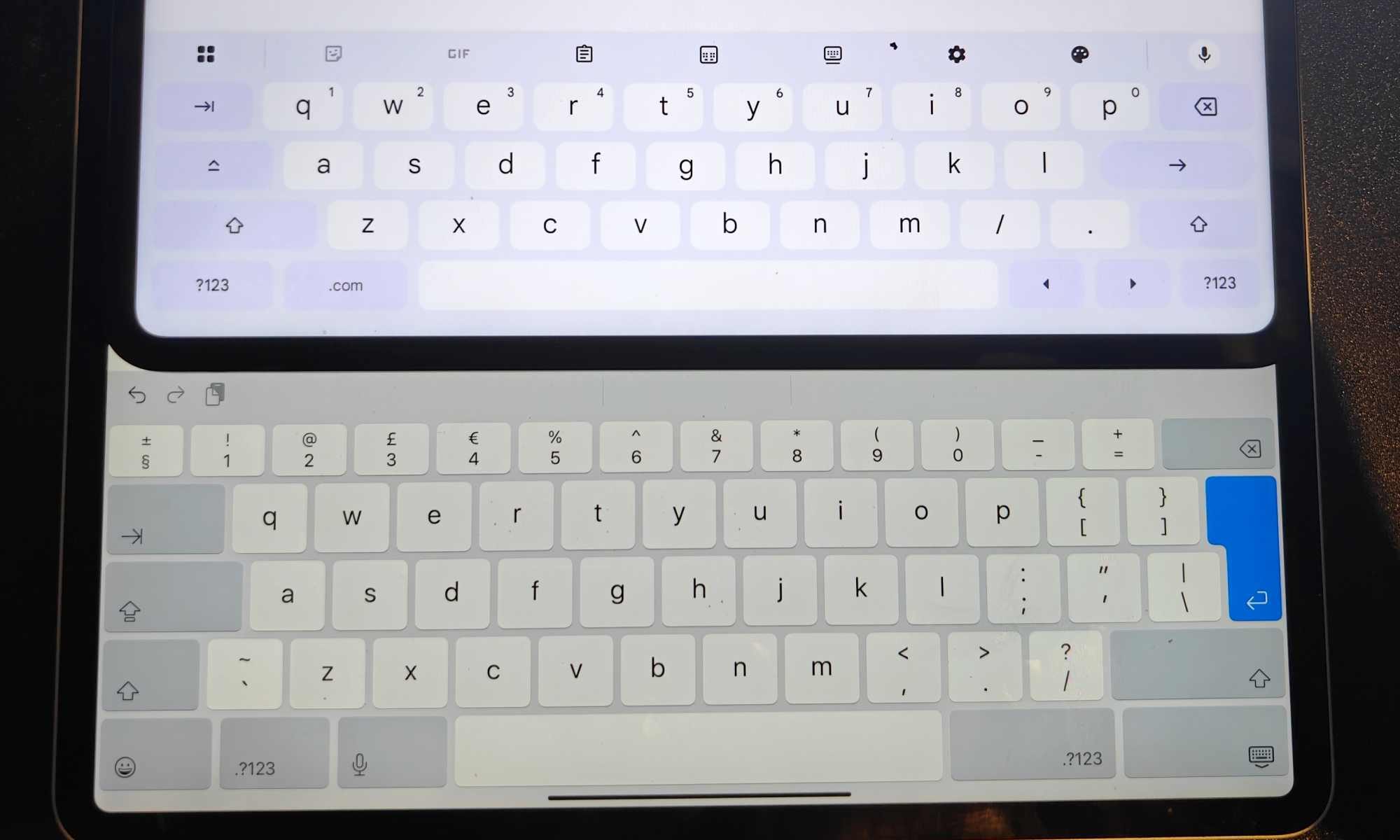
I have the opposite problem with the on-screen keyboard, an issue that some users might not need to worry about if they’re buying a keyboard too – but that’s not going to be every user by a long shot.
On Android slates, the keyboard feels quite stretched out – I never had an issue with the iPad equivalent, because its spacing seems to roughly match computer keyboards. Not on Android though, and on the OnePlus I kept typing the wrong letters and missing the space bar because nothing is where I thought it’d be. You can see in the picture above, how even the three rows of letter keys enjoys a lot more height on the iPad.
A lack of apps

Historically, something that forced me over to iPad instead of Android was the app choice. A sizeable list of useful creative and productivity apps used to be unavailable on Android tablets.
That changes in dribs and drabs, with big apps occasionally being ported over from iOS to Android – sometimes with varying results – but there are still plenty of major tools which Android users simply can’t get access to.
A go-to pick for me is Davinci Resolve, one of the most popular video editing apps, which has an iPad app but no Android one. I also use Final Draft’s mobile port all the time for scriptwriting, and that’s not available on Android either. I know many artists who point to Procreate being an equivalent for them; all of these are industry-leading apps and I can’t see professionals moving from iPad to Android if the app selection is limited.
One aspect ratio

Something Android tablet users praise about the slates is their display aspect ratios. I agree – it’s something I’ve been positive about in multiple reviews, including the Pad Go 2’s – it’s a distinct advantage the slates have over iPads. With very few exceptions, Android slates have wider displays, so when you’re watching videos, there’s no letterboxing. In effect, you get a much wider viewing area, and more pixels in use.
What people don’t mention, though, is that this benefit is only for entertainment. For other tasks, I find the wide screen quite frustrating. For example when reading documents or web pages, you can get fewer words shown before you have to scroll, and many apps have less intuitive layouts. I much prefer playing strategy games on iPad, for example, for that reason.
As established, I like the wide screen – but do all Android tablets need to have the exact same aspect ratio? It’s almost impossible to find slates with a 3:2 ratio beyond Apple, and the Android market suffers for this lack of variety.
A problem with accessories

I’m not a huge fan of Apple’s iPad accessories; I consider them too expensive, too fragile and come bearing added features which don’t make always sense to me – why would I want a trackpad on a touch-screen device? I’ve taken to buying third-party equivalents and preferring them.
But for however critical I am of the Magic Keyboard or Apple Pencil, I’ve got to say that the majority of Android tablet ones I’ve tested have been worse. I’ve used all number of wobbly stands, cases which don’t protect the tablet, and styli that don’t connect well with the tablet.
This is compounded by the fact that, with such a small market share and wide array of slates, third-party manufacturers often opt not to get involved with the Android tablet scene. It’s hard to find reliable alternatives to what the company itself sells, and I’ve found many brands don’t support their slates with a good range of accessories and enough stock to last very long.
I get the impression that many manufacturers don’t agree with consumers’ love for good accessory support, and until they get the hint, tablet buyers who want a good stylus or a protected slate are going to keep picking up iPads. And I don’t blame them.


