1. Home
  2. Space
  3. Business
  4. Emerging Tech
  5. News

Glowing space billboards could show ads in the night sky

Add as a preferred source on Google
the orbital display in action

We’re accustomed to being bombarded by ads. TV, radio, smartphones, newspapers and magazines, movie theaters, billboards — all of them feeding us a steady supply of messages designed to influence our purchasing choices and sway our opinions about stuff. Now it’s going interstellar: A Russian startup plans to use constellations of tiny satellites to fill the sky with brightly lit advertisements from hundreds of miles up.

Recommended Videos

Think about it. You’re gazing dreamily out of the window at night, enjoying the beauty of a starry sky, only to find Cassiopeia obscured by a McDonald’s ad offering two-for-one Big Macs in a limited-time promotion.

StartRocket, the team behind the wacky-sounding idea, believes it will have its equipment ready by 2020, with contracts offered to corporate customers soon after.

Turning the sky into an enormous canvas for satellite-generated ads would be a winner for marketers looking for new ways to reach their audience, according to Vlad Sitnikov, the fellow behind the ambitious project.

“We are ruled by brands and events,” Sitnikov told Futurism recently. “The economy is the blood system of society — entertainment and advertising are at its heart. We will live in space, and humankind will start delivering its culture to space.”

The plan, as demonstrated in a StartRocket video (above), is to use the satellites to light up different messages for up to six minutes at a time, with the constellation located between 250 and 310 miles above Earth. The video shows the satellites getting into formation to spell out the word “Hello.” Next up is an upside-down McDonald’s logo floating through the night sky, and then a message from KFC tempting us with its greasy goodies.

Certainly, the technology to launch and deploy miniature CubeSat satellites is becoming cheaper and more advanced all the time, with more and more private space companies looking to enter the market — a reality that in itself poses the problem of an increasingly crowded low-Earth orbit that heightens the risk of collisions with space junk.

StartRocket’s plan seems to have had a reception as cold as space itself when you read comments about it online, but team member Alexey Skorupsky is adamant the project is viable.

“If you ask about advertising and entertainment in general — haters gonna hate,” Skorupsky said. “We are developing a new medium. At the advent of television, no one loved ads at all.” Trouble is, they still don’t.

It’s not the first time we’ve heard about plans to place ads far beyond the surface of the Earth. A Japanese startup, for example, has received millions of dollars in funding to put a billboard on the moon, though we don’t imagine too many people are going to set eyes on whatever it eventually advertises.

Trevor Mogg
Contributing Editor
Not so many moons ago, Trevor moved from one tea-loving island nation that drives on the left (Britain) to another (Japan)…
Lightsails have hit another speed bump on the road to interstellar travel
The coolest interstellar travel idea may get betrayed by the light pushing it
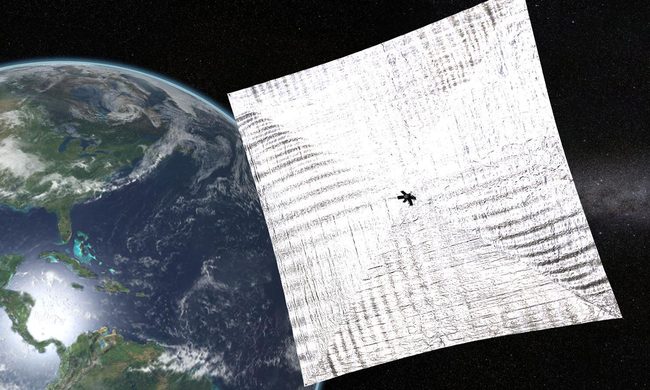
LightSail in Earth orbit

Laser-powered lightsails are one of the coolest answers to spaceflight. It might not be as sci-fi-sounding as a warp drive, but now, its practicality has also come under question. Using lightsails, a spacecraft could unfurl an ultra-thin reflective sail and let a powerful laser push it toward another star, without relying on fuel.

The tech was simple and elegant--except it's also more complicated than it sounds. A new preprint from researchers Chao Shen and Jiaze Li of the Harbin Institute of Technology suggests that relativistic lightsails may run into a hidden propulsion problem once they start moving extremely fast.

Read more
The galaxy has an exoplanet size mystery, and NASA’s EVE mission wants to solve it
This planet-hunting mission wants to catch baby worlds before they grow up
Artist’s Illustration of Exoplanets Orbiting Barnard’s Star

Mankind venturing into space ended up creating more questions than it answered, and one of the dilemmas is related to the planet sizes. Astronomers have found plenty of rocky super-Earths and plenty of puffier sub-Neptunes, but far fewer planets with a radius of about 1.8 times Earth’s.

That gap is known as the radius valley, and a proposed mission called the Early eVolution Explorer, or EVE, wants to figure out why it exists. NASA has a simple plan: look at planets while they are still young. The mission concept, detailed in a new arXiv preprint and covered by Phys.org, would focus on newly formed star clusters to see what small planets look like before billions of years of evolution.

Read more
We just got a hot signal that a Tesla and SpaceX merger could happen, after all
Tesla

For years, the idea of Tesla and SpaceX becoming a single company has lived somewhere between ambitious business theory and Elon Musk fan fiction. The two companies already share DNA, leadership influence, engineering talent, and long-term goals. But every time the topic surfaced, it felt more like an interesting thought experiment than a realistic possibility. Now, one of the most important people at SpaceX has added fresh fuel to the conversation.

Speaking in a recent CNBC interview, SpaceX President and COO Gwynne Shotwell was asked about the possibility of closer ties between Tesla and SpaceX. Her response wasn’t a flat-out denial. In fact, she suggested that bringing the two companies together could make life a little easier for Musk. That may sound like an offhand comment, but coming from Shotwell, it’s noteworthy. She’s been at SpaceX since its earliest days and remains one of the company's most influential executives.

Read more