  1. Home
  2. Emerging Tech
  3. News

NASA’s Mars 2020 rover will search for evidence of ancient life on red planet

Add as a preferred source on Google

NASA's Mars 2020 Rover
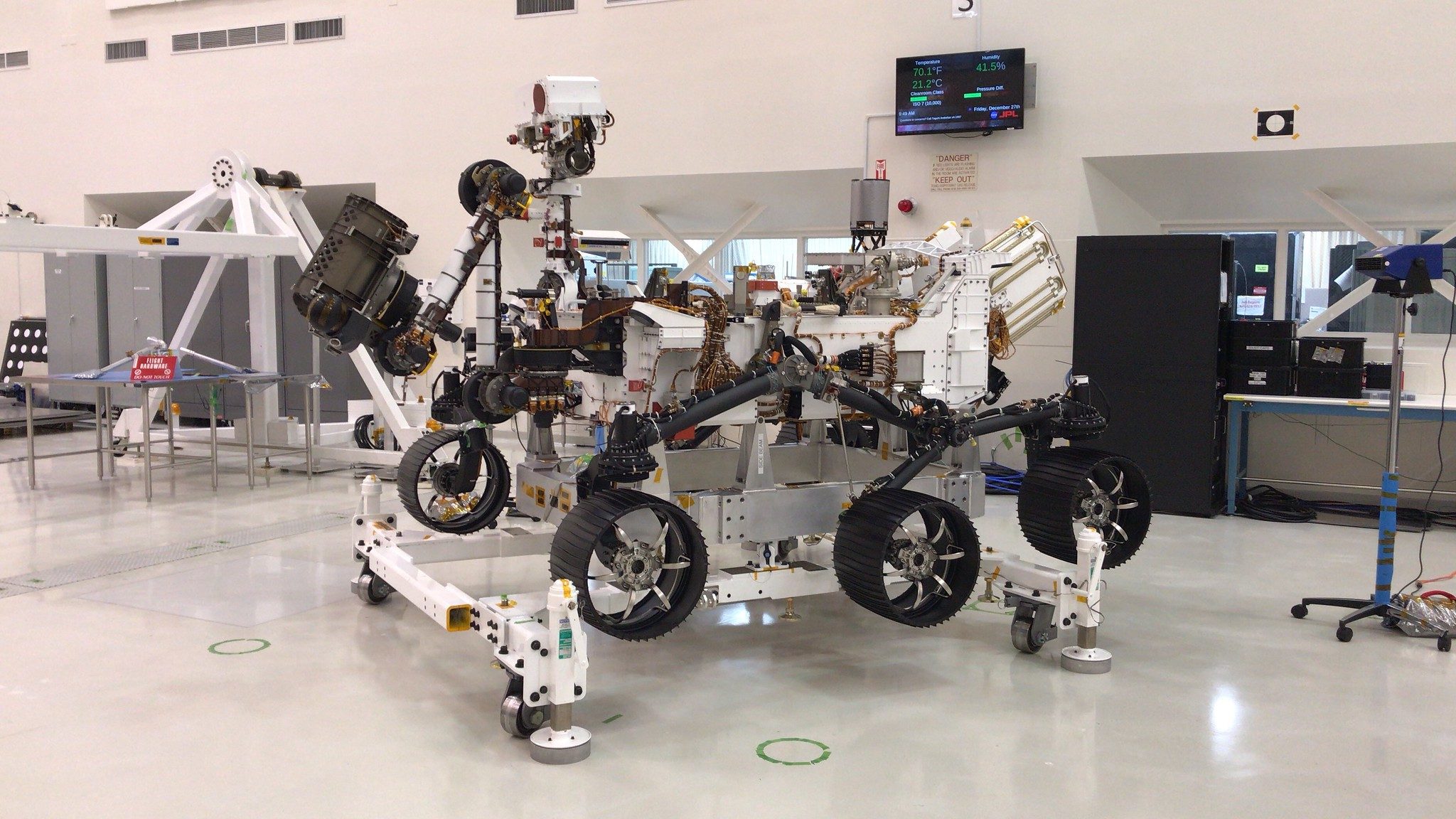
NASA’s Mars 2020 Rover is shown off to journalists at the Jet Propulsion Laboratory on December 27 2019. NASA/JPL-Caltech

After years of work, NASA’s Mars 2020 rover is ready to explore an alien world. With construction and testing at NASA’s clean room facility now completed, the rover will be packed up and shipped to Florida ahead of final testing before it is strapped to a rocket and launched on its journey to Mars in a few months’ time.

Recommended Videos

The rover has an ambitious mission: To search for evidence that life once existed on the red planet. “Mars 2020 is looking for signs of ancient life,” Zach Ousnamer, a Mechanical Engineer on the Mars 2020 Rover project at the Jet Propulsion Laboratory, said in an interview posted by NASA. “We’re going to land in the Jezero Crater which is an ancient river delta, and here on Earth, we know those are hot spots for life. So we’re going to go to one on Mars in hopes of finding life there.”

NASA already has a number of instruments on and around Mars, including the Curiosity rover, the InSight lander, and the Mars Reconnaissance Orbiter spacecraft. But the Mars 2020 rover will have new tools and updated instruments which allow it to perform tasks which existing explorers can’t.

When Ousnamer was asked how the instruments on the Mars 2020 rover compare to those on Curiosity, he pointed to several new features on the latest rover. “We’re flying seven new instruments,” he said. “Some of them are similar to those flown on Curiosity but upgraded. We have, for instance, a new instrument MOXIE, which is generating oxygen on the surface of Mars.”

Being able to generate oxygen on the planet is a vital part of preparing for an eventual manned mission to the surface, both for breathing and creating fuel, and MOXIE should be able to produce around 10 grams of oxygen per hour by converting the carbon dioxide which is abundant in the Martian atmosphere.

Other tools in the rover are focused on scientific discovery. “We have SuperCam on the top of the head of the remote sensing mast, doing laser-induced breakdown spectroscopy,” Ousnamer explained. That will allow scientists to identify the chemical composition of rocks and soil that the rover encounters in the Martian environment.

“And then the big thing that is different from Curiosity is that inside the rover is the Adaptive Caching Assembly. That’s a whole suite which takes samples of Mars, puts them in a canister, hermetically seals them, and leaves those on the surface in the hope that in a future mission, we can bring them back to study here on Earth.”

The Mars 2020 mission is set to launch between July 17 and August 5 next year.

Georgina Torbet
Georgina has been the space writer at Digital Trends space writer for six years, covering human space exploration, planetary…
Amazon thinks you love AI, so it has launched a special storefront for AI-powered gadgets
Google AI mode mockup showing new feature

You're browsing for a new laptop — one has a better processor, another has more RAM, a third says "AI-powered" in bold letters, and you're not entirely sure what that means. But Amazon has noticed you pausing on that third one, and it has thoughts. The company just launched an AI Store on Amazon.in — a dedicated storefront that rounds up AI-enabled gadgets across categories, from smartphones and laptops to refrigerators and washing machines. So, instead of you wading through spec sheets trying to figure out which "AI feature" actually does something useful, the store spells it out for you.

What the AI store actually is

Read more
Gemini now makes personalized images by understanding your taste from Photos library
Logo, Disk, Symbol

Up until now, using Google Gemini meant being very specific. If you wanted an image, you’d spell it all out, the mood, the lighting, the tiny details, just to get something close to what you had in mind. That’s still how most AI tools operate. But this is where things start to shift. With the integration of Nano Banana 2 and Google Photos, Gemini feels much more familiar. It leans on your preferences, what you like, what you usually capture, and the kind of visuals you gravitate towards, and uses that context to shape what it creates for you.

So instead of over-explaining every prompt, you’re nudging it in a direction, and it fills in the rest in a way that feels personal. The goal here is simple: spend less time describing and more time seeing your ideas come to life, almost the way you imagined them, without having to say everything out loud.

Read more
This AI lets self-driving cars “remember” past drives to plan safer routes
A memory of the past could make self-driving cars safer on the road
Self driving car from Waymo

One of the biggest problems with self-driving systems is that they can see the road perfectly well and still make shaky short-term decisions in messy city traffic. The advanced systems struggle to keep up with complex and fluctuating road situations. But a new study argues that these cars don't need better vision, but a better memory.

In the peer-reviewed paper KEPT (Knowledge-Enhanced Prediction of Trajectories from Consecutive Driving Frames with Vision-Language Models), researchers from Tongji University and collaborators developed a system that helps autonomous vehicles "remember" past driving scenes before choosing what to do next.

Read more