I just watched a 12K cinema camera get announced over a compressed, 1080p YouTube livestream. I had to chuckle as the host described the “subtle texture” and fine detail in the sample footage — what is the point of showing sample footage if it has to be annotated? If this doesn’t illustrate the disconnect between how video content is created and how it is consumed, I don’t know what does.
The camera in question is the new Blackmagic Ursa Mini Pro 12K, a $9,995 follow-up to the Ursa Mini Pro 4.6K, a camera I really liked. The new model offers, as you can see, 7.4 more Ks than the old one. But what does that even mean?
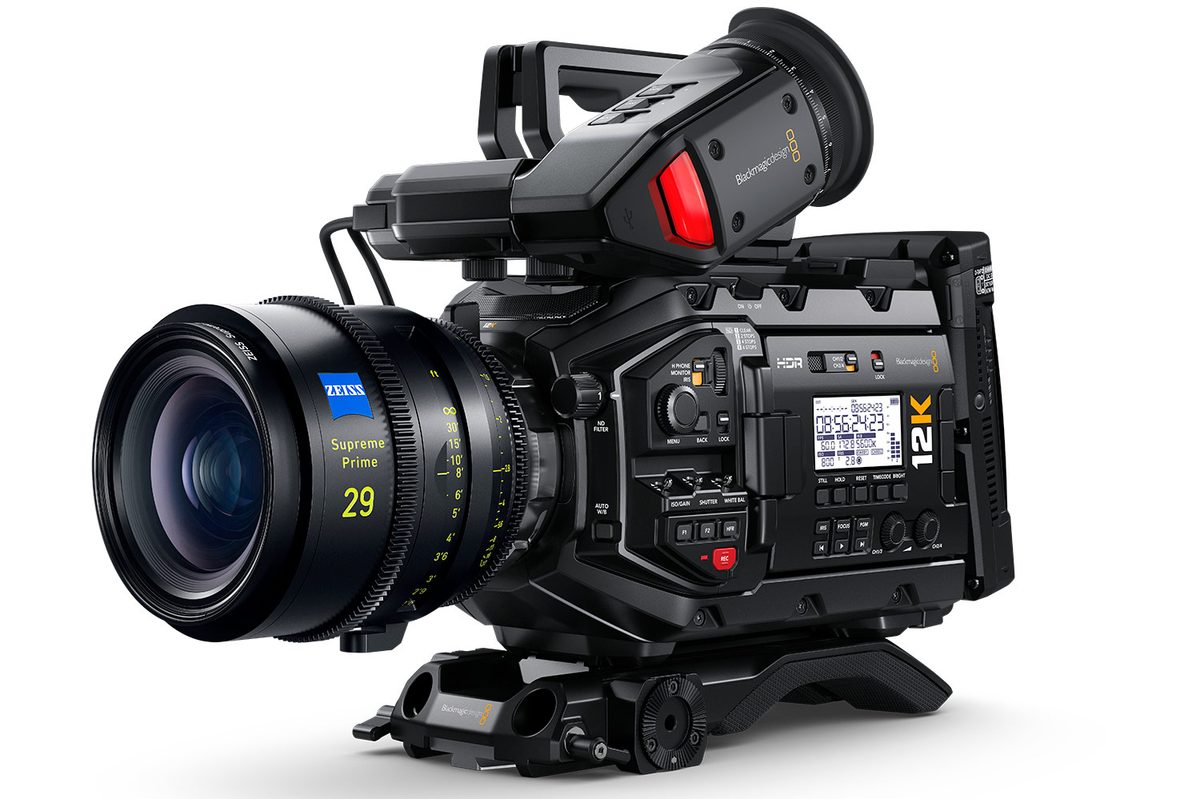
Given that 8K televisions are still an expensive rarity — and 8K content distribution is lagging even further behind — you might think that a 12K camera is borderline ridiculous, even in a professional cinema model that costs a few bucks shy of 10 grand (which is actually remarkably affordable). That was my first impression, too — until Blackmagic Design explained how this new sensor works.
Bye-bye Bayer array
The sensor in the Ursa Mini Pro 12K has a native resolution of 12,288 x 6,480 pixels, or 80 megapixels. Like the company’s 4.6K camera, it’s still a Super 35 sensor. There is often some confusion between Super 35 and what the photography world calls 35mm, or full-frame. Super 35 is smaller, roughly equivalent to the APS-C sensors used in some still cameras, although Blackmagic’s is a couple of millimeters wider, as it fits the 17:9 DCI aspect ratio.
No matter how you spin it, that is a lot of pixels crammed into a sensor of that size (the Canon EOS 90D, the highest-resolution still camera with an APS-C sensor, has 32MP). But actually recording 12K isn’t the primary purpose of this new sensor. Its goal is to provide oversampled 8K, 6K, or 4K with full RGB data for every pixel. And it can do that even when shooting RAW, without cropping.
That’s not exactly possible in most cameras, even the Ursa Mini Pro 4.6K. If you want to shoot RAW video at a lower resolution, say 1080p, the camera simply ignores all the pixels except the 1,920 x 1,080 in the center. Other cameras, like the new Canon EOS R5, can’t shoot RAW at anything less than their full resolution at all.
This has to do with how a traditional image sensor works. It uses what’s called a Bayer array to achieve color. The Bayer array puts a red, green, or blue filter over each individual pixel (the pixels themselves are otherwise color-blind), and then some math happens either in-camera or in editing software to create a full-color image.
Such a method works remarkably well, but it has some drawbacks. The Bayer filter doesn’t evenly divide the pixels into each color. For every four-pixel block, two pixels will be green while only one will be red and one blue. This unequal distribution makes it difficult to scale to a smaller resolution without processing the image into a non-RAW format.
But the Ursa Mini Pro 12K uses a symmetrical color filter that provides an equal number of red, green, and blue pixels. This allows for RAW resolution scaling on the sensor without cropping. Whether you choose 12K, 8K, 6K, or 4K, you will still get the full Super 35 sensor area.
Is there a case for shooting in 12K?
One way to look at 12K is from the perspective of future-proofing. One can imagine a future where 12K projectors exist in movie theaters, or where 12K televisions can be found in the home. But at least in the case of the latter, that resolution would be so far beyond what the human eye is capable of detecting at a comfortable viewing distance that it just doesn’t make sense.
The other perspective is cropping, which Blackmagic demonstrated in today’s livestream by slowly pulling out from 4K, to 8K, to 12K. Essentially, this allows one to zoom with the sensor, greatly increasing the reach of a given lens, which I imagine will be useful for things like nature documentaries.
There are issues with cropping, however. The image inevitably becomes noisier, and a 4K crop will certainly not be as sharp as the oversampled 4K that comes from the full sensor.
But the 12K workflow might not be as demanding as one would think, thanks to efficiency improvements in the Blackmagic RAW format. Blackmagic demonstrated a nine-angle, 12K RAW multi-cam clip running in real time on a new Mac Pro, and a single clip running in real time on a MacBook Pro. That’s, um, very impressive.
Still, just as the Mac Pro isn’t built for normal people, working with 12K will be limited to select professional studios that have the budget and time to handle it.
The beautiful thing is that the Ursa Mini Pro 12K isn’t just a 12K RAW camera the way the Canon EOS R5 is just an 8K RAW camera. Thanks to its novel sensor design, it can scale effortlessly to meet the demands of a given user or project. Yes, 12K is overkill — I even believe 8K is overkill — but at least Blackmagic implemented that overkill intelligently, in a way that doesn’t make sacrifices at lower resolutions.
But I still don’t see the point in showing that sample footage in a YouTube livestream.