  1. Home
  2. Computing
  3. News

I don’t want a touchscreen MacBook, but this feature could convince me

Add as a preferred source on Google

Rumors that Apple is making a touchscreen Mac are about as old as the Steve Jobs adage that touchscreen laptops suck and make your arm ache. But a fresh patent shows Apple is still working on the idea — and this time the company might have finally perfected it.

As spotted by Patently Apple, the patent describes how a touchscreen Mac could incorporate haptic feedback into its display. That means you could get small tactile taps every time you press on the screen, which would subtly let you know that your actions have been recognized.
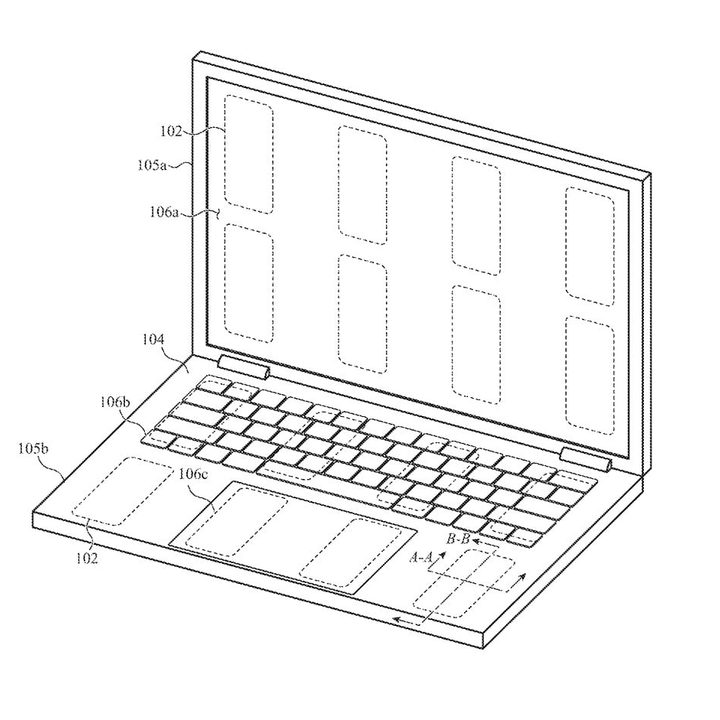
An image from an Apple patent showing a MacBook laptop equipped with various haptic sensors underneath the display, keyboard, trackpad and wrist rest area.
Apple

Apple also explains how the lower portion of a laptop — that is, the area containing the keyboard and trackpad — could also be outfitted with a haptic display. This display might be used to conjure up a virtual keyboard that could change its layout on the fly, an idea Apple has been tinkering with for years.

Recommended Videos

The patent also notes that the haptic system could detect varying degrees of force. This could provide different levels of response depending on how hard you press (something that you already get with the suitably named Force Touch trackpad in the latest MacBooks).

It’s not a well-known fact, but Apple devices already come with haptic touchscreens. Modern iPhones can enable haptic feedback, something that can greatly enhance the typing experience. If Apple were to implement a similar system in future MacBooks — as this patent implies — it might alleviate any fears users may have about uncomfortable typing on a smooth touchscreen surface.

A touch of innovation
A person typing on a MacBook Pro while sat on a wooden bench.
Bram Naus / Unsplash

As well as the display, Apple’s patent explains that the haptic feedback could be added to the wrist rest area and the trackpad, thereby providing more options for how Apple’s tactile system might work. As noted above, Apple’s laptops and standalone trackpads already have haptic feedback, so it’s possible that the patent is describing an improved system.

But there’s no such haptic feedback in the wrist rest area at the moment. Apple has explored this idea in the past, including in a patent that looked at how the entire bottom surface of a MacBook could be imbued with haptic tech, letting you change your keyboard layout or even add a dial if you needed it.

Interestingly, Apple’s patent suggests that the haptic system could be used in a car, including in the dashboard or steering wheel. While Apple may have just been illustrating possible uses for its idea, it could also be a hint pointing towards the long-rumored self-driving car — dubbed Project Titan — that Apple is supposedly working on.

That’s getting to the speculative end of an already speculative topic, though. There’s no guarantee Apple will put this patent into practice, and the company may simply be exploring ideas that never get built into a product. Still, it’s a useful indication of how Apple could implement haptic feedback into touchscreen Macs. If you’ve been waiting for just such a device, there may be exciting times ahead.

Alex Blake
Alex Blake has been working with Digital Trends since 2019, where he spends most of his time writing about Mac computers…
AI bots are a hit across the hotel biz, and if they feel creepy, you’re not alone: Study
Hotel booking chatbots are creeping out customers, but there's a simple fix that can make a difference.
Isometric Ai assistant and bubble speech, 3D illustration

If you have ever tried to book a hotel online and found yourself unsettled by the AI chatbot trying to help you, science has your back. New study from Texas A&M College of Agriculture and Life Sciences confirms that hotel booking chatbots are genuinely creeping people out, and it is actually hurting bookings.

What is giving hotel chatbots their creep factor?

Read more
Pope says AI must be disarmed and shouldn’t dominate humanity. We’re going the opposite way.
The Pope just dropped his first encyclical, and AI companies should probably read it.
Pope Leo XIV signing his first encyclical

Pope Leo XIV signed his first encyclical on May 15, the 135th anniversary of Pope Leo XIII's Rerum novarum. The document, Magnifica humanitas, was published on May 25 and addresses one of the defining challenges of our time: artificial intelligence and its impact on humanity.

The core message isn't anti-technology. The Pope is clear that technology is neither a threat nor inherently evil. However, he does say that technology is never neutral, because it takes on the values of those who build, fund, and control it. That's where things get interesting.

Read more
I built an offline Grammarly alternative and turned it into a Mac app without any coding
It lives in a browser tab. It's a Chrome extension. It's also a Mac app. Claude built it for me in all three flavors.
Grammarly alternative built using Claude.

I wrote this entire article while seated on an airplane experiencing unusually high turbulence. The software I used to spell-check and grammatically sanitize the draft was built at an airport. The language engine is running entirely on my Mac, fully offline, fixing all my typos and removing the double spaces while I mash the keyboard and sip a sugar-bomb coffee. 

Also, I don't know how to code. I didn't write a single line of code, and yet, the Mac software I am using right now looks classier and feels snappier than Grammarly ever did. Grammarly, if you don't know, is one of the most popular apps for spelling and grammar checking on the planet. So, how did I do it? I asked Claude. I narrated my wish, it asked my preferences, and in less than 30 minutes, I built myself a no-internet Grammarly replacement while also avoiding the "yet-another-subscription" curse.

Read more