  1. Home
  2. Computing
  3. News

Nearly six months later, you can finally try out Windows 11 Recall

Add as a preferred source on Google

After a tumultuous initial reaction and months of reworking, Microsoft is finally releasing the first preview of its controversial Recall feature today. If you’re a Windows Insider with a Qualcomm Copilot+ PC, you can install a new build of Windows 11 that includes both Recall and Click to Do.

If you’re not part of the Windows Insider Program but you want to try out this feature, it’s pretty easy to sign up on the Microsoft website. Recall was first announced back before any of the Copilot+ PCs were released and was meant to be available at launch, but an outcry of privacy and security concerns forced Microsoft to delay it.

Recommended Videos

The feature itself is meant to give your PC a “photographic memory,” allowing you to search for anything you’ve seen on your screen using natural language. To make it work, the feature takes constant snapshots of what you’re doing on your PC — and it was the security of these snapshots that got people worried.
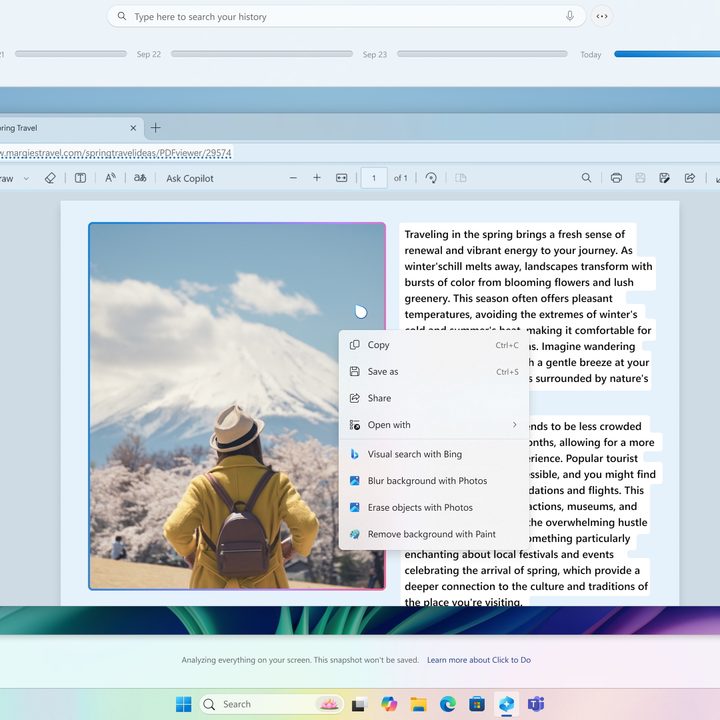
Recall screenshot.
Microsoft

According to the Windows Insider Blog, it seems you will have to authenticate with Windows Hello every time you open Recall — this will certainly make it “feel” secure, but could also get a little annoying. As for how secure it really is, there will hopefully be plenty of security professionals searching through the feature’s updated security and privacy architecture and sharing any issues they find through Microsoft’s Bug Bounty Program.

You can also control which snapshots are saved and which apps are allowed to take snapshots in the first place. Microsoft also claims that it can’t access your screenshots, doesn’t send them to the cloud, and won’t use them for AI training.

The Click to Do feature within Recall allows you to complete actions from the snapshots, such as copying text or saving images. If you don’t like the sound of Recall, you don’t need to worry about it coming to all Windows 11 PCs yet, but when it does, Microsoft promises that you’ll be able to fully uninstall the feature if you want to.

Willow Roberts
Willow Roberts has been a Computing Writer at Digital Trends for a year and has been writing for about a decade. She has a…
In a market where Mac has been aspirational, it’s somehow a better deal than windows machines now
Windows Laptops became so expensive that MacBooks look sensible now
Computer, Electronics, Laptop

For a long time, the laptop buying advice was simple enough. Windows had a more versatile portfolio that brought you affordable, mid-range, high-end, and even gaming options, while MacBooks were known as the easy premium recommendation.

But owing to the pricing circus caused by memory shortages and component price hikes, the equation makes no sense anymore.

Read more
HP’s new RTX 5070 laptop feels like the sweet spot between thin and bulky
The new HyperX Omen 15 combines AMD and Intel and targets portability without fully sacrificing performance.
HP HyperX OMEN 15 Gaming Laptop

Modern gaming laptops have largely drifted toward two extremes lately: massive 16-inch and 18-inch desktop replacements, or ultra-compact 14-inch machines that still feel slightly cramped for serious gaming sessions. That’s exactly why HP’s new HyperX Omen 15 feels refreshing, because it brings back the familiar 15-inch gaming laptop formula with a chassis that still feels portable without sacrificing proper gaming hardware underneath.

HP’s compact HyperX Omen 15 packs RTX 5070 graphics with AMD and Intel options

Read more
Corsair is putting Chinese RAM in mainstream market. It won’t quite end the crisis though
A cheaper DDR5 supplier could shake up the market, but it is not a magic fix
Samsung DDR4 RAM in hand

After months of painfully expensive RAM and SSD prices, the memory market may finally be showing signs of pressure from an unexpected direction: China. New reports suggest that Chinese memory manufacturers are rapidly expanding production of DRAM and NAND chips, and that major hardware brands are starting to take notice. The most notable example so far is Corsair, which has reportedly tested DDR5 memory modules using chips from Chinese DRAM giant ChangXin Memory Technologies, better known as CXMT.

This feels inevitable. Memory prices have remained frustratingly high across PCs, laptops, and storage devices for months. So when Chinese suppliers began offering RAM at nearly half the cost of some global competitors, manufacturers were always going to at least explore the option. According to market reports, some CXMT DDR5 modules are reportedly being sold near the $150 range, while equivalent products from larger global suppliers can hover between $300 and $400.

Read more