  1. Home
  2. Emerging Tech
  3. News

This absurdly cheap, cartwheeling humanoid robot may be heading to the US

Unitree's R1 humanoid robot pairs an unusually low price with impressive agility, and could soon expand beyond China to global markets.

Add as a preferred source on Google
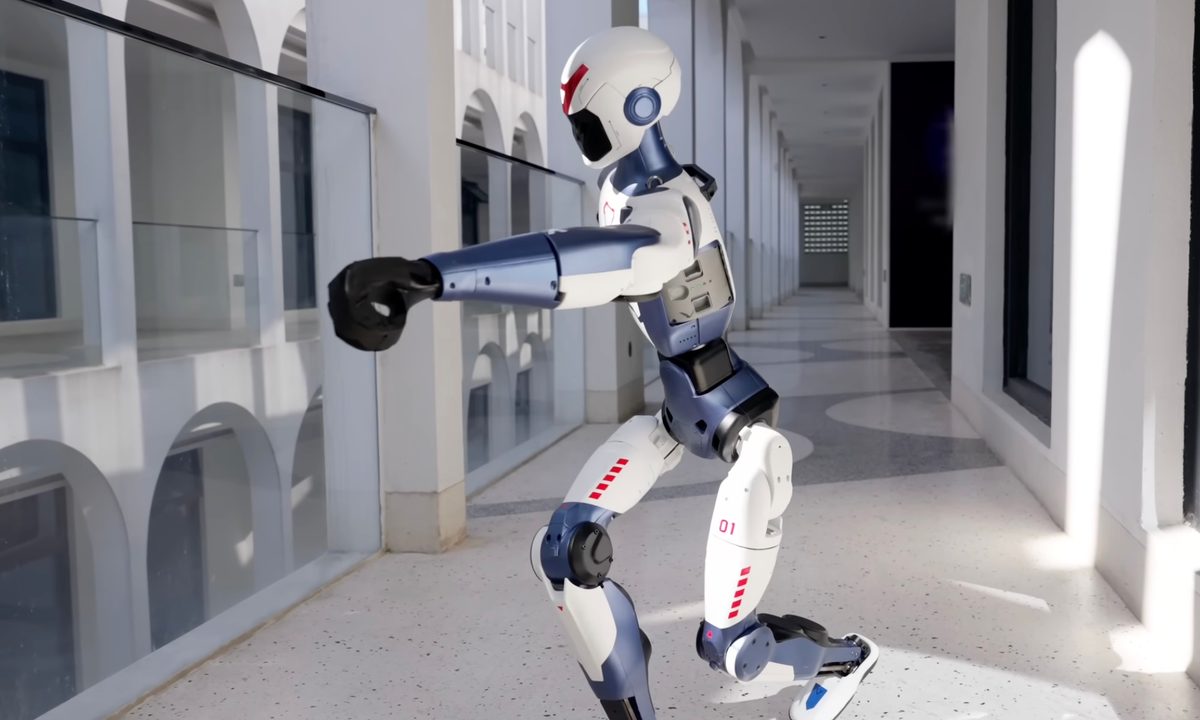
Unitree's R1 humanoid robot.
Unitree

China’s Unitree Robotics is reportedly preparing to take its most affordable humanoid robot global. Industry sources suggest an international rollout may be on the horizon, with a potential US launch also on the cards.

What does the Unitree R1 offer?

Launched last year, the Unitree R1 is one of the most affordable humanoid robots out there, with a starting price of around $4,900. That makes it significantly cheaper than most existing humanoid robots, which typically cost well into the five figures.

Recommended Videos

Despite its low price, the R1 is no slouch. It stands about 1.2 meters tall and weighs roughly 25-27 kg, making it relatively compact and lightweight for a humanoid machine. It features 26 joints for flexible movement and is powered by onboard computing capable of handling voice and image-based interactions.

Thanks to its lightweight design, the R1 is incredibly agile. Unitree has showcased it performing cartwheels, running, kicking, and even getting up from the ground without assistance, highlighting its focus on mobility and balance.

So far, the robot has been limited to the Chinese market. However, the South China Morning Post reports that Unitree may soon expand availability globally by listing the robot on AliExpress. The company has yet to disclose international pricing or regional availability details, but the report suggests the robot could reach several major markets, including the US, Europe, Japan, and Singapore.

Why could this global launch matter?

If Unitree moves ahead with an international rollout, the R1 could significantly lower the barrier to entry for humanoid robots. Bringing a relatively capable machine to global markets at this price point would make it far more accessible to developers, researchers, and even hobbyists.

Lower pricing combined with wider availability could encourage more real-world experimentation beyond controlled demos. However, even if Unitree opens sales to a broader audience, practical use cases for the average buyer remain limited. For now, the R1 is better suited for research and development than everyday tasks, meaning it may appeal more to early adopters than mainstream consumers.

Pranob Mehrotra
Pranob is a seasoned tech journalist with over eight years of experience covering consumer technology. His work has been…
Online payments are dimming the charm of one of America’s top tourist attractions
One of America's last analog tourist traditions just joined the cashless economy.
Photography, Binoculars, Camera

We all know those heavy, coin-operated binoculars perched on every scenic overlook in America, the ones you’ll find everywhere from the Empire State Building to the Grand Canyon. Turns out, they’ll soon start accepting tap-to-pay payments. 

This is great news, as you’ll no longer need to carry a quarter anymore, and making payments with your smartphone is much more convenient. However, I’d argue that the quarter was kind of the whole point.

Read more
The FBI secretly built an entire fake town just to practice cyberattacks
Hidden inside a warehouse in Alabama, the Kinetic Cyber Range recreates real-world digital attacks from start to finish.
FBI Kinetic Cyber Range Featured

While Hollywood has fake cities for filming movies, the FBI apparently has one for getting hacked. The agency has pulled back the curtain on its Kinetic Cyber Range, a 22,000-square-foot replica small town hidden inside its Huntsville, Alabama campus. But instead of training officers for shootouts or hostage rescues, the facility is designed to simulate realistic cyberattacks on homes, businesses, and critical infrastructure so investigators can practice responding to them in a controlled environment.

The FBI built an entire town just to simulate cybercrime

Read more
Brazil’s secret World Cup weapon taught the team when to ignore it
The data said he wasn't running enough. The footage said he was always in the “perfect tactical position.”
Soccer ball in net

Brazil has more World Cup titles than anyone, five of them to be precise, but after going through five straight tournaments without adding to that count, the team is leaning hard on data this time. 

Every player wears a sensor-packed "smart vest" tracking field position (via GPS), heart rate, and a stat called "player load," the same kind of numbers that your Whoop band or Apple Watch brags about, but tuned specifically for the sport.

Read more