  1. Home
  2. Cars
  3. News

Tesla’s Cybercab has entered production. Let’s hope it can actually drive itself this time

Tesla has crossed the manufacturing finish line on the Cybercab, but the autonomous driving race it needs to win is still very much in progress.

Add as a preferred source on Google
Tesla Cybercab at night
Tesla

Tesla has a long history of announcing things before they are ready. On April 24, 2026, Elon Musk posted a POV video of a steering-wheel-free Cybercab rolling out of Gigafactory Texas, and the internet seems to have lost its mind. 

Musk has confirmed that the volume manufacturing of the autonomous robotaxi has begun. However, the company still has to figure out the harder part. 

Cybercab has started production pic.twitter.com/MAeswanf96

— Elon Musk (@elonmusk) April 24, 2026

What exactly has Tesla built?

For those catching up, the Cybercab is a two-seat car featuring Tesla’s Full Self-Driving neural network. It’s intentionally built without a steering wheel or pedal. In place of side mirrors, the car features all-around cameras. 

Recommended Videos

First production units of the Cybercab rolled off the assembly line in February 2026. However, continuous-volume manufacturing began in April 2026. Pricing, on the other hand, is expected to come in under $30,000, which would position the car as an affordable entry in the robotaxi network. 

So, what’s the catch?

Cybercab’s existence is built on one thing: its ability to drive itself. However, Tesla hasn’t fully solved that (yet). The automaker’s current supervised robotaxi fleet crashes at around four times the rate of human drivers, which is about one incident per 57,000 miles rather than one per 229,000 miles. 

Musk has himself admitted that the software can sometimes get cars “scared to move” or stuck in infinite loops. For now, unsupervised FSD for consumer vehicles has been pushed to the fourth quarter of 2026, a deadline that is currently being treated with utmost caution. 

The product milestone has been announced at a moment when Tesla’s global sales have slumped for the second consecutive year. The Cybercab, for now, is the company’s biggest bet for turning things around. But even so, making it work autonomously and safely is the one part that millions of commuters actually care about.

Shikhar Mehrotra
For more than five years, Shikhar has consistently simplified developments in the field of consumer tech and presented them…
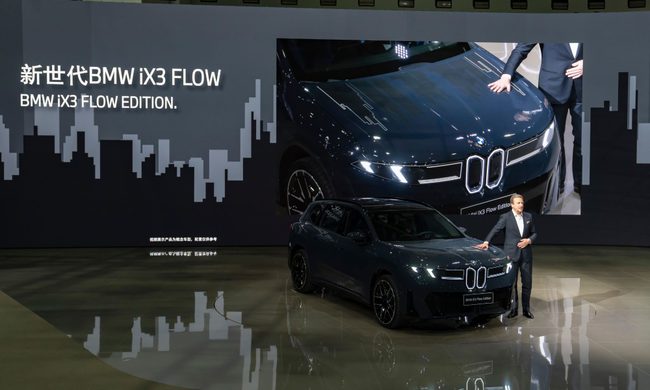
BMW debuts color-changing iX3 Flow Edition with E Ink exterior at Beijing Auto Show 2026
BMW iX3 Flow Edition brings E Ink Prism to production cars
BMW iX3 Flow Edition

At the Beijing Auto Show 2026, BMW unveiled the iX3 Flow Edition, marking the first time E Ink’s Prism technology has been integrated into a series-ready production vehicle. The announcement signals a major leap from experimental concept cars to real-world automotive applications, bringing dynamic, color-changing surfaces to everyday mobility.

From Concept To Production Reality

Read more
The ev range anxiety myth just got demolished by a billion miles of real-world data
A billion miles of real-world data show that modern EV batteries are holding up far better than the range-anxiety narrative ever gave them credit for.
2026 Ford Explorer EV.

One of the biggest reasons people hesitate to buy an electric vehicle is range anxiety. 

The assumption is quite simple: batteries age with time, resulting in a shorter range, and within a few years of purchase, your shiny new EV becomes a glorified city ride. 

Read more
Porsche reveals an all-electric Cayenne Coupe with a sweet power boost
Porsche Cayenne Coupe electric

The Porsche Cayenne Coupe has established itself as one of the best-selling Porsche cars. The car was first introduced in 2019, and since then, it has seen unprecedented growth in sales. In 2025 alone, it accounted for 40% of all Cayenne sales in the US. Building on the success, Porsche has announced a fully electric model.

The Cayenne Coupe electric gets its signature look from the sloping roofline that Porsche calls the "flyline," a design borrowed from the 911. It sits lower than the standard Cayenne SUV, has a flush rear window, and has a lower drag coefficient of 0.23, making it more efficient. 

Read more