
For the past year, the Kia EV6 has been making headline after headline, thanks to its stylish design, competitive price, spacious cabin, and superfast charging. That’s been the case to the point that Kia’s other EV efforts have been perhaps a little … buried. But the company is far from stepping back from its EV efforts. It’s developing new products to build out the EV line like the upcoming EV9. And it’s transitioning its current lineup to at least offer an EV option — which is exactly where the 2023 Kia Niro EV comes in.
The Niro EV is in a bit of a weird spot, thanks in large part to the EV6 itself. They’re both crossover EVs that occupy a similar spot in terms of pricing, and much of the same technology in terms of infotainment and driver-assist. And because of the fact that they’re both Kia EV crossovers, you might assume that it’s worth saving a few grand on the Niro EV over the EV6.

But that assumption would be incorrect. The Kia Niro EV has a slightly longer base-model range than the EV6. It has a little extra room thanks to the lack of sloped roofline. And it has that important slightly lower price tag. Most people, however, should spend that extra cash on the EV6.
After previously reviewing the EV6, and spending the last week driving the new 2023 Kia Niro EV, here are my thoughts on why the EV6 is truly a better buy.
Design is one thing
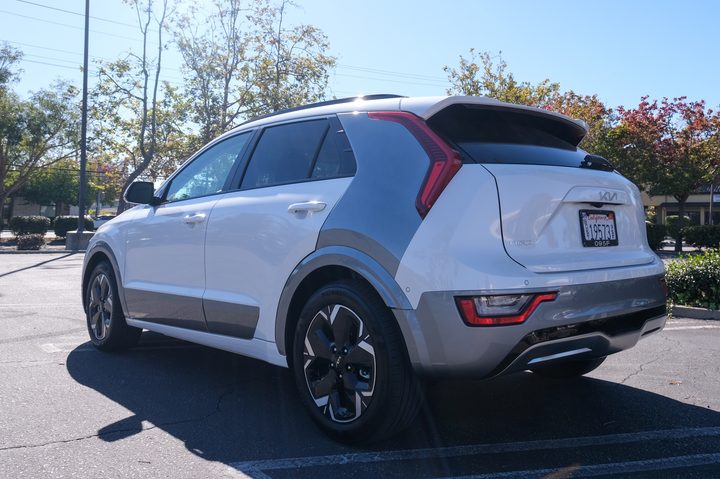
The Kia Niro EV is far from ugly. It’s just a little … normal — at least when you put it up against the EV6, which is one of the most interesting-looking EVs to date. Setting aside the fact that I prefer the design of the Hyundai Ioniq 5 to both of these, the fact is that the EV6 is sleeker, more modern-looking, and more unique.

Of course, not everyone wants a unique-looking car, and as a fellow introvert, I’m the first to understand why. The Kia Niro EV basically looks like a more modern take on all the other crossover SUV-type cars on the road right now. It’s good-looking — and safe-looking.
The EV6 does away with that. With the nicely curved lines along the body, the mean-looking front-end, and the huge brake bar along the back, it shows the direction that Kia should go with all of its new cars. If you want to play it safe, I get it — and you’ll like the Niro EV. But if you want sport, the EV6 should be at the top of your list.
Charging is just as important as range
At first glance, you might assume that the Kia Niro EV is better as an electric car, due to the fact that it has a slightly longer range in the base model. The EV6 Light offers up to 232 miles in its base model, on Kia’s E-GMP platform, while the Niro EV Wind stretches to 253 on the K3 platform. If you’re on a budget, an extra 21 miles for less money looks appealing.

But if you’ve ever been on a road trip with an electric car, you’ll know that being able to charge quickly makes a huge difference — and that’s one area where the Kia Niro EV seriously underperforms. The EV6 can charge at up to a whopping 350 kilowatts, which allows it to charge from 10% to 80% in under 20 minutes. That puts it among the fastest-charging EVs out there. But what about the Niro EV? It juices up at a much slower 85kW. That should bring it from 10% to 80% in around 45 minutes.
Now, it’s true that charging at those superfast speeds probably isn’t great for your car’s battery, and 45 minutes is still fast enough to get you charged up over a meal, when you’re on the road. And most people will use basic chargers at their homes anyway, and charge overnight. But simply having the ability to charge as quickly as the EV6 can charge is a seriously handy trick to have in your back pocket.
Flooring it
Then there’s the performance of the cars. The 2023 Kia Niro EV is able to deliver some of that quick electric car response that modern electric cars have become known for. Switch into sport mode and hit the accelerator, and you have a pretty zippy crossover. But if you really want to zip, then the Kia EV6 is the way to go.
Without getting too much into the nerdy details of the cars, the basic gist is that the 2023 Kia Niro EV gets to 60 miles per hour in a little under 7 seconds, while the EV6 can reach 60 mph in as little as 3.5 seconds. Sure, that time is in using the EV6 GT model, but even the other models can hit that speed in 5.2 seconds.
It may not sound like much, but those extra few seconds can really count. And sure, you may not feel the need to reach those speeds that quickly, but being able to quickly accelerate can help in split-second situations, and put simply, is super fun.
So who should buy the Kia Niro EV?
I’m not trying to argue that the 2023 Kia Niro EV is a bad car. It’s not. In fact, if the EV6 didn’t exist, it would be a compelling option from Kia. But the EV6 does exist, and it’s not all that much more expensive than the Niro EV.
So in what case should you buy the Niro EV? If you want a more understated design, could use those extra few inches of interior space, and plan on exclusively charging at home and using your car for day-to-day use, or don’t mind having to wait longer at charging stations, then the Niro EV is a great option. But all Kia EV buyers should keep in mind the fact that the EV6 is only a little more expensive, and easily the better electric car.


