
You might think Henrik Fisker’s best days are behind him, but he’ll tell you he’s just getting started. The 55-year old designer and automotive executive from Denmark has already had a stellar career, penning such memorable luxury and sports cars as the BMW Z8, Aston Martin’s DB9 and V8 Vantage, and his own Fisker Karma.
The story of Fisker as an automotive executive is a bit stormy. Founded in 2007, his namesake brand was early into the market of range-extended electric vehicles, and while the Karma was a breathtaking design, the company delivered just 1,800 cars before halting production due to battery supply issues. Like many fledgling automakers, Fisker battled reliability and safety issues, with several vehicles catching fire. The company went bankrupt in 2013 and was sold off to Chinese interests.
Five years later, Fisker is back, and his plans are bigger than ever. He has a new luxury car design, an autonomous shuttle bus, and plans for a high-volume electric vehicle. He has also filed for a patent on new high-density battery technology to power it all. Fisker sat down with Digital Trends recently to unpack it all for us.
The Future is Mobility
“My view is that in the future, car companies will change into mobility companies,” Fisker told Digital Trends. That’s hardly a controversial viewpoint. The largest automakers in the world are all on the “mobility company” bandwagon. But Fisker goes further, into less certain territory. “I believe that ten years from now, or maybe earlier, people will still own some private cars but we’ll use those cars for less than 50% of what we use our cars for today.”
“Ten years from now … people will still own private cars but we’ll use those cars less than 50% of what we do today.”
That’s a bold prediction, and we asked Fisker to detail his thoughts.
“We’ll have other mobility choices and other devices,” he replied. “Whether it’s car-sharing or ride-hailing or small autonomous shuttles. If an automotive company is not part of that business, what’s going to happen is that your revenue and market share will be dwindling, and somebody else is going to offer other mobility choices to your former customers.”
Fisker has a multi-front plan to be ahead of that curve.
“We’re a mobility and technology company because we’re also developing our own unique solid-state batteries,” he said. “At Fisker, we want to be part of several of these mobility choices. We want to offer Fisker customers the same brand value, the same exciting experience, even in autonomous shuttles.”
The Fisker ORBIT
One of the obvious first solution spaces for autonomous technology is in shuttle buses. They run in circles, generally stop at the same places on each loop, and no one expects them to go fast. Fisker’s differentiator in this market is size and convenience, and his company’s ORBIT shuttle design is futuristic inside and out. Fisker has partnered with the Hakim Unique Group of China to build this vehicle, and has announced that the shuttle will be deployed in 2019.
“I believe the fastest way to that level of autonomy will not be achieved by private vehicles, but by fleet-operated vehicles,” Fisker declared. “The original autonomous shuttles were very basic inside and boring; they all looked like fridges on wheels. There are customers out there who would like a better experience.”

Part of the difference with a Fisker shuttle is taking a bit of the autonomous control and putting it into the rider’s hands, literally.
“We are developing a Fisker app where you can hail the shuttle,” Fisker said. “This is a shuttle for about eight to 12 people, with standing and sitting room. The idea is to deploy more of these in place of larger buses, to make it more convenient. People can hail the shuttle and have virtual bus stops instead of set bus stops. You wouldn’t have to wait. We’re not going to give everything away about it, but we’re fine-tuning the business case and understanding consumer behavior. We think there’s quite a bit of market for that.”
Karmic redemption
Fisker is also working on his next generation of electric vehicles. In less than a decade, the tech and business landscape for EVs has changed almost completely, and Fisker has learned from his hard experience on the first attempt.
“There’s no more need to prove we can make a beautiful luxury vehicle”
“There’s no more need to prove we can make a beautiful luxury vehicle,” he stressed. “The first time we had to prove it, like Tesla had to prove it. Our main focus now is a high-volume vehicle, and the shuttle. The whole market has changed. Those are the lessons learned from the first time around.”
The E-Motion looks a lot like the original Karma, which was always a beautiful vehicle. It’s Fisker’s new halo car, but not his end game.
“The E-Motion is our high-tech private luxury vehicle,” Fisker said. “We spent a lot of money developing our first luxury vehicle, the Karma. Now we don’t want the main focus to be on the luxury vehicle. The Fisker E-Motion is going to become more of a niche vehicle, with very high-end materials and lower volume, so there’s less sales risk and less investment. Right now, we’re spending most of our time on a high-volume, more affordable vehicle program.”


Fisker won’t say much about the affordable vehicle yet, but it’s clear he wants to be in the mix as automakers plan to make high-volume, lower-cost EVs over the next decade. As with all automakers, Fisker has identified the critical obstacle to volume production as the battery.
“We have changed our strategy slightly by aligning the launch of the vehicle to our solid-state battery launch,” he explained. “We’ve been developing this solid-state battery technology that no one else has done before.”
Powering the revolution
In late October, Fisker announced new funding through Caterpillar Venture Capital, Inc. This is the investment arm of the same Caterpillar company that makes everything from bulldozers to diesel-electric locomotives. The money is going into development of a new proprietary battery.
Fisker’s new battery is a solid-state, lithium-metal design, featuring electrodes with vastly more surface area than flat thin-film solid-state electrodes and extremely high electronic and ionic conductivity that enables fast charging and cold temperature operation down to -20 Fahrenheit.
“There are four issues that everyone encounters,” Fisker said, “and we believe we have solved them. We have a three-dimensional bulk battery with more than three times the surface area of a conventional battery, so we have enough power. The second problem is that batteries don’t work below zero degrees, and ours does. The third issue has been scale-up. In our production method, we’ve discovered that we can scale and build these really fast. The fourth issue is cost, and we have found a way to eliminate that issue. In fact, we expect our price to be less than half of the traditional lithium-ion batteries, and less than $75 per Kilowatt-Hour.”
According to Fisker, these new batteries could deliver much greater vehicle range or greatly reduced charging times. Getting both is the current challenge.
Our technology will get twice the range for the same space occupied by the battery. It’s much lighter and much cheaper.”
“We can have extremely fast charging in a matter of minutes, but then you lose the energy density,” Fisker said. “Or you can have very high energy density but you lose charging time. We want to go for longer range, initially, and we’ll still have a very fast charge time. Our technology will get twice the range for the same space occupied by the battery. It’s much lighter and much cheaper.”
Fisker plans to begin testing those batteries in prototype vehicles in 2019, and expects that they will form the basis of the E-Motion, the ORBIT, and the projected high-volume car.
“We’ve had a lot of breakthroughs,” Fisker said, “but there are still challenges and problems to be solved, so although the target is 2020, we don’t have a definite launch date for this technology.”
Lessons learned
The mark of a serial entrepreneur is that they don’t give up. Many designers could be content with the career successes that Fisker has had, and many would be discouraged by the obstacles that brought his company down before. So, what’s different this time?
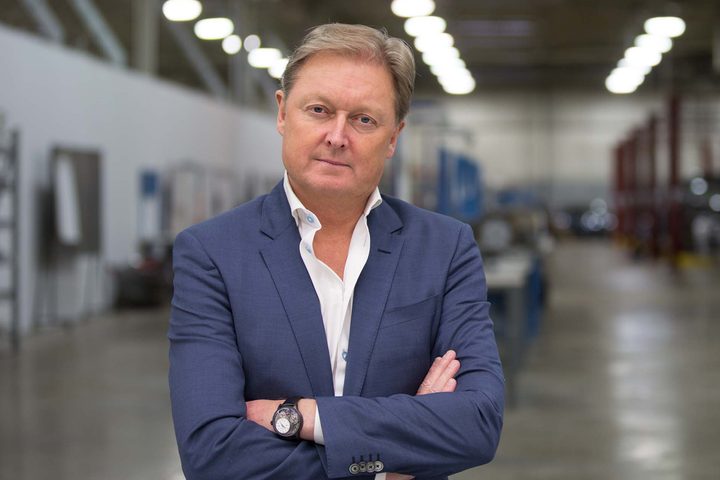
“There were many, many learnings,” Fisker insisted. “Part of it was the era. When Fisker and Tesla started, there weren’t any suppliers to support either of us. We had to do things ourselves and that was expensive. That’s all changed now. Secondly, we were stuck with a particular battery company that had recalls and went bankrupt. Obviously, that has changed and we have many battery companies.”
There’s one last piece of advice Fisker has to offer. It is perhaps the single most important insight he’s gained from his experience.
“Don’t let your investors run your company,” he stated. “That’s a big learning from the first time. Now the investors aren’t running the company. I’m still very impatient, so it’s frustrating to me that it takes several years to develop a car. But that’s just reality.”


