
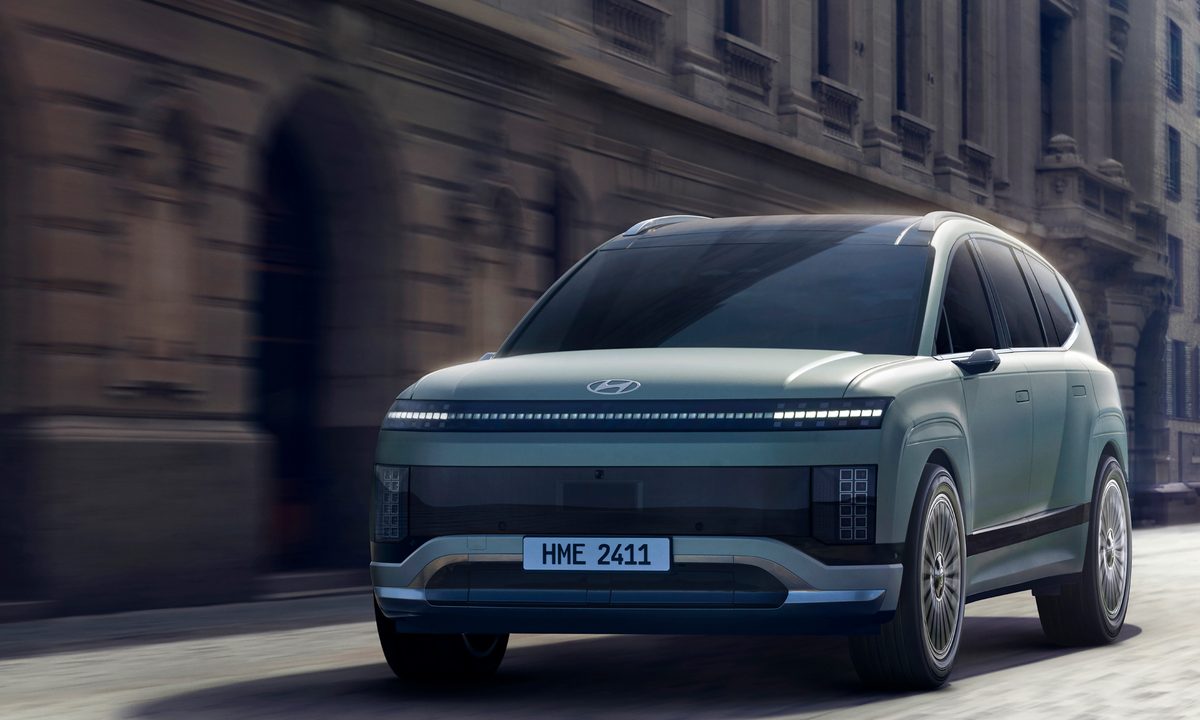
The long-awaited Hyundai Ioniq 9 is finally on its way. Hyundai has taken the wraps off a production-ready version of the electric SUV, showing a modern vehicle that could well be the electric SUV to beat when it finally rolls out to the public. But it will have to contend with Hyundai’s sister company in order to truly gain the title of best electric SUV in its price range. The Kia EV9 has been a go-to option for a few years now.
But is one of these SUVs actually better, or are they just different? We put the Hyundai Ioniq 9 and the Kia EV9 head to head to find out.
Design
There are some similarities in the designs of the Hyundai Ioniq 9 and the Kia EV9, but they also look a little different. First, the similarities. Both vehicles are clearly SUVs, with larger blocky shapes. But, while the Kia EV9 has straight lines and sharper angles, the Ioniq 9 is a little curvier, with a rounded roofline and sculpted curves in the side panels.

On the front, the EV9 has Kia’s so-called “Digital Tiger Face,” with Z-shaped headlights. On the back, the vehicle’s taillights extend down along the sides. The Hyundai Ioniq 9’s taillights also extend down along the two side edges, however on the front it has a light bar for the headlights, which curves along the front of the vehicle.
Both the Kia EV9 and Hyundai Ioniq 9 are good-looking vehicles, and neither looks better than the other — that’s down to personal preference.
Winner: Tie
Interior and tech
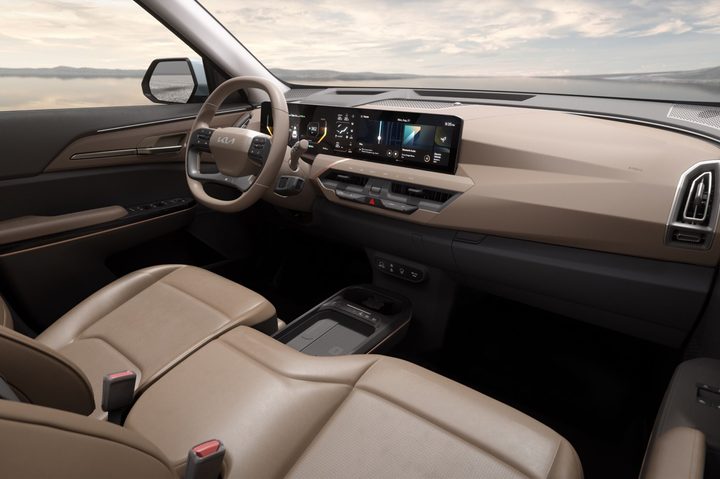
The concept version of the Hyundai Ioniq 9 showed off a “living room on wheels,” with bright lighting and seats that could swivel around to face each other. While much of this concept has been removed for the production version of the car, some elements of that idea are still present. For example, depending on the version of the car you go for, the second row seats will still be able to rotate around to face the third row, allowing for a more social setup. Behind the seats, the Ioniq 9 boasts 22 cubic feet of storage with the third row up, or 46 cubic feet with that row folded down.

Again, though, that depends on the configuration you get. The Ioniq 9 will be available in six- or seven-seat layouts — with the six-seat layout offering captain’s chairs for the second row, which can rotate, and the seven-seat option replacing those chairs with a bench seat. At the front of the vehicle can be found a dual-display setup, with the main infotainment display offering support for CarPlay and Android Auto. And, there are USB-C ports dotted around the cabin for both the driver and all of the passengers.
The Kia EV9 also has USB-C ports and a dual-display setup, plus it has options for six or seven seats. However the second-row seats can’t rotate, so you’ll have to decide if that’s important to you. The EV9 has slightly less cargo space than the Ioniq 9, with 20.2 cubic feet of space with the third row up, or 43.5 cubic feet with it down.
Regardless, both vehicles offer a spacious and comfortable interior. While extra storage is helpful, it’s close enough to where this one’s a tie.
Winner: Tie
Performance
When the Hyundai Ioniq 9 launches, it will be available with three different powertrain options. The base model will have a single 215-horsepower motor powering the rear wheels; however, an all-wheel-drive model will add a 94-hp motor on the front wheels. The Performance AWD variant will replace that front motor with a second 215-hp one, bringing up the total performance on offer by the vehicle. The Performance AWD variant will be able to accelerate from 0-60 miles per hour in 5.2 seconds, which is pretty quick for such a large vehicle; however, the base model will get a slightly slower acceleration time of 9.4 seconds.

The Kia EV9 is a little quicker than the Ioniq 9, at least with top specs. The base model of the EV9, the EV9 Light, has a single 215-hp motor, while the all-wheel drive models step total performance up to 379 hp. The 2026 EV9 is available as an EV9 GT, which offers an impressive 501 hp. Acceleration sits at 4.3 seconds for the fastest variant of the EV9 — even quicker than the Ioniq 9.
Because of that better performance, the Kia EV9 gets the win here.
Winner: Kia EV9
Range and charging
We still don’t yet know exactly what the range of all models of the Hyundai Ioniq 9 will be, but Hyundai has said that all variants of the vehicle will have a range of at least 300 miles — which is a great start. We also know that the Long Range RWD variant of the car has a 335-mile range, which isn’t bad at all.

If indeed all variants of the Ioniq 9 do have more than 300 miles of range, it’ll be quite a bit better than what’s on offer by the Kia EV9. The base model of the Kia EV9 has a range of 230 miles, but that’s for the relatively inexpensive Light model. Step up from there to the Light Long Range, and you’ll get a 304-mile range, while the higher-performance Wind and Land models have 280 miles of range.
Both the Kia EV9 and the Hyundai Ioniq 9 are built on an 800-volt architecture, and support charging speeds of 350kW. That’s very fast, and it means that the vehicles should be able to fully charge in under 25 minutes or so.
Still, with the better rated range, the Ioniq 9 is the winner here.
Winner: Hyundai Ioniq 9
Pricing and availability
The Kia EV9 has been available for some time now, with a starting price of $54,900 for the base model at the time of this writing. Keep in mind that the specs I’ve been discussing above are for the 2026 model, which isn’t out quite yet — but if you’re desperate for an electric SUV, you can buy the 2025 model, which has similar specs. We’re expecting the 2026 model to have a starting price of around $57,000 or so.
You can’t buy any variant of the Ioniq 9 though — it has been announced, and will start rolling out soon, but not just yet. Hyundai says that the vehicle will first roll out in the first half of 2025, in the United States and Korea. We don’t yet know how much it will cost, but we expect it’ll have a similar price as the Kia EV9.
The EV9 is the only vehicle that’s available right now, so it’s the winner here.
Winner: Kia EV9
Overall winner: Kia EV9
The Kia EV9 is the winner here, but really only for one reason — it’s the only vehicle that’s currently available. When the Ioniq 9 launches, at least initially, the decision you might need to make is between range and performance.
That said, based entirely on speculation, I expect the base Ioniq 9 will cost around the same as the Light Long Range EV9, and that Hyundai will eventually release a lower-range Ioniq 9 that will match a similar price as the EV9. We’ll have to wait and see if that happens, though.


