
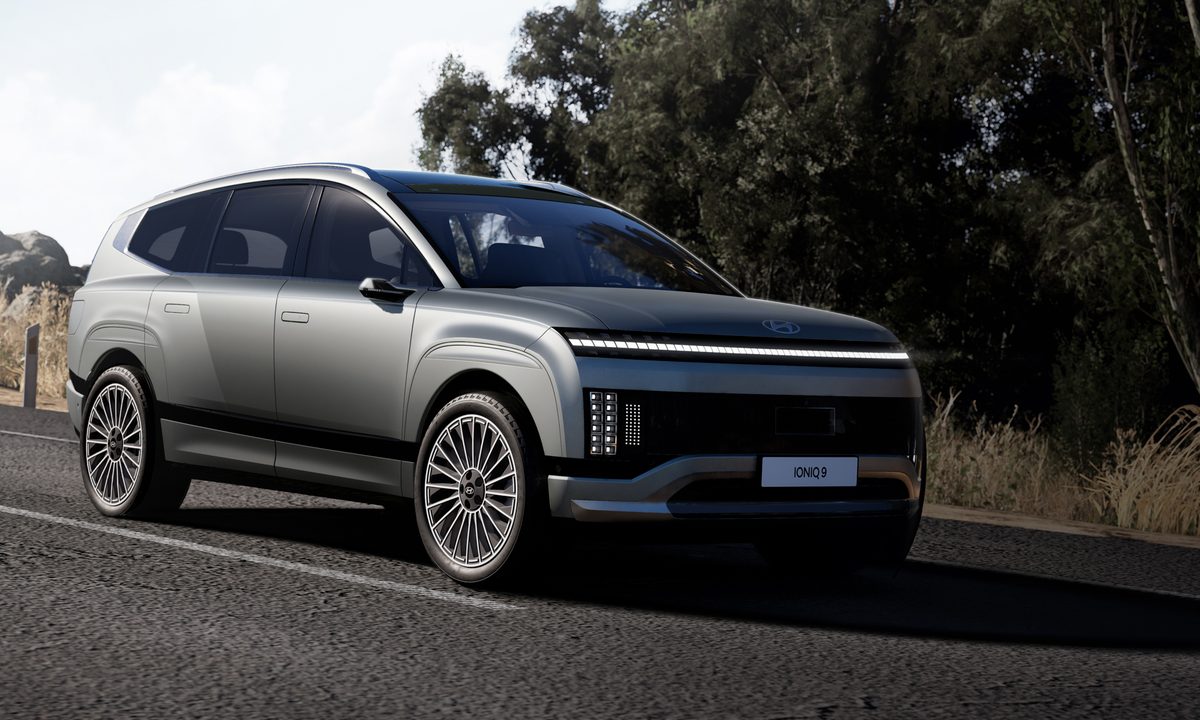
The Hyundai Ioniq 9 is finally set to roll out in the near future, with Hyundai claiming that it’ll launch the vehicle in the first half of 2025. But the electric SUV has some tough competition ahead of it. Sure, it has to compete with the Kia EV9, but it also has to compete with a more expensive, more premium electric SUV, in the form of the Rivian R1S, which is now in its second generation.
Perhaps we should get this out of the way right now — the Rivian R1S is likely a better vehicle than the Ioniq 9 will be, though to be fair, we haven’t tested the Ioniq 9 just yet. But how much better is it? Is it worth the extra cash?
Design
The designs of these vehicles is pretty different. They both look like SUVs, with large, blocky bodies. But while the Rivian R1S is a little blockier, the Ioniq 9 has a slightly more curved roofline and sculpted sides.

On the front of the Ioniq 9 can be found a long light bar that extends along the front of the car, while on the back, the vehicle has two vertically-aligned taillights. The Rivian R1S has a light bar on the front too, but it’s interrupted by Rivian’s now-signature oval headlights. On the back, the R1S has a long light bar for the taillights.
Both the Rivian R1S and the Hyundai Ioniq 9 look relatively modern. My preference is the R1S, which looks a little more put-together to my eyes, but design is subjective, and this category is a tie.
Winner: Tie
Interior and tech
The interiors of the vehicles are different too. We now have a good idea at what the interior of the vehicle will look like, and it’ll be different than what Hyundai showed off in the concept version of the car. Thankfully, there are aspects of it that are the same though. The Hyundai Ioniq 9 is available in six- or seven-seat configurations, and with the six-seat layout, the second-row seats can rotate and face the back — making for a more social setup. The Ioniq 9 has 22 cubic feet of cargo space with the third row up, and an impressive 46 cubic feet with the third row down.

The vehicle also has USB-C ports dotted around the inside of the cabin, and wireless chargers at the front. It also has a dual-display setup, with a main infotainment screen that supports CarPlay and Android Auto.
The interior of the Rivian R1S is plenty spacious too. It’s only available with seven seats, and will get 17.6 cubic feet of storage space with the third row up, and 46.7 cubic feet with it down. The R1S has a dual display setup too, but there’s no Android Auto or CarPlay. Thankfully, Rivian’s built-in software is pretty good, so you may or mat not miss it.
You’ll have to decide how many seats you want, and whether you prefer better built-in software, or support for CarPlay. This category is another tie.
Winner: Tie
Performance
The Hyundai Ioniq 9 will be available in three powertrains. There’s the base RWD model, which has a single 214-horsepower motor on the rear wheels. Then, there’s an AWD model that puts a less-powerful second-motor on the front wheels, which sits in at 94 hp. The Performance model replaces that motor with a second 214-hp motor, and it can accelerate from 0 to 60 miles per hour in 6.2 seconds.

The Rivian R1S steps things up a little though. All models of the Rivian R1S are all-wheel drive. The entry-level model of the R1S is a dual-motor vehicle that offers an impressive 533-hp and can get to 60mph in only 4.5 seconds — faster than the fastest Ioniq 9. Things range up from there to the R1S Ascend Tri Max, which boasts 850-hp and can reach speed in 2.9 seconds, and the not-yet-available R1S Ascend Quad Max, which will have four motors and the ability to get to 60mph in 2.6 seconds.
There’s really no competition here. The Rivian R1S is far more powerful than the Ioniq 9.
Winner: Rivian R1S
Range and charging
The Hyundai Ioniq 9 isn’t yet available, and we don’t know the exact range of all the models of the Ioniq 9 just yet. Hyundai has said, however, that all models of the vehicle will have over 300 miles of range, and we know that the Long-Range RWD base model will have a range of 335 miles. The Ioniq 9 will be able to charge at up to 350kW, which is very fast, and means that it should be able to fully charge at under 25 minutes or so.

The R1S sends things up in terms of range though. While the base model of the R1S has a 270-mile range, step up to the Large battery pack and you’ll get 330 miles, while the Max battery gets you to 410 miles. Higher-performance versions of the vehicle lower range a little, but not as low as the 270 miles on the base version. Unfortunately, the R1S doesn’t charge as quickly as the EV9, sitting in at 220kW.
That said, for most, range is more important than charging, and with options for a higher range, the R1S gets the win.
Winner: Rivian R1S
Pricing and availability
There’s only one vehicle that’s available right now — the Rivian R1S. Hyundai has announced the Ioniq 9, but it says that it’ll start rolling out in the United States and Korea in the first half of 2025. We don’t yet know exactly how much it will cost, but we’re expecting its price to be similar to the Kia EV9, at around $57,000.

The Rivian R1S is available for order right now, but it’s a little more expensive than that. It starts at $75,900 at the time of this writing, or a good $20,000 more than the Ioniq 9.
Once the Ioniq 9 is available, it’ll likely win this category. But it’s not yet — so this one goes to Rivian.
Winner: Rivian R1S
Overall winner: Rivian R1S
The Rivian R1S has better performance, a longer range if you upgrade batteries, and is the only one that’s actually available. When the Ioniq 9 is on the market, you’ll have to decide for yourself if the longer range and better performance are worth that extra cash. We would argue that if you can afford the Rivian R1S without it taking a major hit to your finances, it likely will be worth the extra money — but rest assured that if you could stand to save some money, the Ioniq 9 will have a lot to offer.


