
For three years, Tesla’s Model X has run unopposed in the all-electric SUV race. Established automakers have shown concepts and promised production models to unseat the upstart EV, but we have yet to see a finished challenger – until now.
At last month’s Geneva Motor Show, Jaguar unveiled its 2019 I-Pace – a 240-mile, all-electric SUV slated for production later this year. Jaguar’s first EV will also be the first vehicle of its kind to be sold through traditional dealer networks. Like the Model X, the I-Pace features a low-slung silhouette that loosely satisfies the “SUV” or “crossover” ride height requirements. Jaguar says the I-Pace can replenish 80 percent of its 90 kWh battery in just 40 minutes via DC fast charging.
With 394 horsepower and 512 pound-feet of torque, the dual-motor, all-wheel drive I-Pace surges to 60 mph in a F-Type-rivaling 4.5 seconds. Thanks to its low center of gravity, it handles exceptionally well, too (something we confirmed with a few minutes of seat time at Jaguar Land Rover’s new headquarters in Mahwah, New Jersey).
At a starting price of $69,500 before federal, state, and local incentives ($10,000 cheaper than the entry level Tesla Model X 75D), the Jaguar I-Pace looks pretty darn appealing. To dive a bit deeper in to the I-Pace’s story, we sat down with Jaguar’s Design Director, Ian Callum, and Technical Design Director, Dr. Wolfgang Ziebart, at the 2018 New York Auto Show. Here’s what we learned:
Digital Trends: Tell us a little about your role with Jaguar
“Communication was easy and development was quick – from a clean sheet of paper to a customer car in four years.”
Dr. Wolfgang Ziebart (Dr. Z): I was heading up Jaguar Engineering and product development until two years ago. During that time, we kicked off the I-Pace Concept. Since then, I have been fully focused on getting the car ready for production. In my past, I was CEO of semiconductor manufacturer, Infineon. Before that, I was heading up the non-rubber part of Continental Tire, and before that I was a board member for BMW R&D.
When and why did Jaguar decide to build an all-electric vehicle?
Dr. Z: The decision was made at a point in time when the future of electrification was not as clear as it is today. Yes, everyone knew that sooner or later, we would drive electric vehicles, but it wasn’t clear when that day would come.
It was a visionary decision from my boss, Ralf Speth, to produce such a car. We then developed it in an unconventional way. We took out a team of 50 very qualified people, relocated 20 miles away from the headquarters, and set to work. The group grew to 150 people and became like a startup. Communication was easy and development was quick – from a clean sheet of paper to a customer car in four years.

How does the I-Pace fit in with Jaguar’s current lineup of internal combustion offerings? Is an EV just the brand’s efficient alternative, or do you see it as the brand’s future performance and styling benchmark?
Dr. Z: In terms of the product itself, electric cars will gain market share at the top end of the market rather soon – perhaps more than the low end. This is adverse to how most have thought of electric cars — as small cars, driving short distances, and being inexpensive. We think the I-Pace is very well positioned in the electric market as a real alternative to Tesla.
Why make it an SUV and not a sedan or hatchback? Did Jaguar just want to be first among the established automakers in that segment?
Dr. Z: We didn’t decide to make an SUV and then electrify it; it was the other way around. We considered how the optimal electric vehicle looks, and then designed around that. The battery has to go under the floor for safety and a low center of gravity. The next question is drivetrain: one or two motors? The decision for us was clear from the beginning – only a two-motor configuration. We did this so as not to worry about load on the driven axle and to move the wheels to the outmost position within the body.
“The I-Pace’s long wheelbase leads to two things: first, huge interior space (effectively the space of a class above); second, superb handling characteristics.”
The I-Pace’s long wheelbase leads to two things: first, huge interior space (effectively the space of a class above); second, superb handling characteristics. The reaction from steering input is instantaneous, the comfort is great, and you can shift the torque continuously from front to rear. In a normal internal combustion engine (ICE) car, every manufacturer must come up with a solution to move torque between axles, but here with the I-Pace, you are fully independent and the torque distribution is much faster than any ICE car.
For example: stability control. Say you’re driving an ICE car on a low friction surface and lose traction. The fastest response of a typical brake-based stability control system is still much slower than using electric motors to shift torque and regain traction. The electric car offers opportunities in driving characteristics that are unachievable by a traditional car.
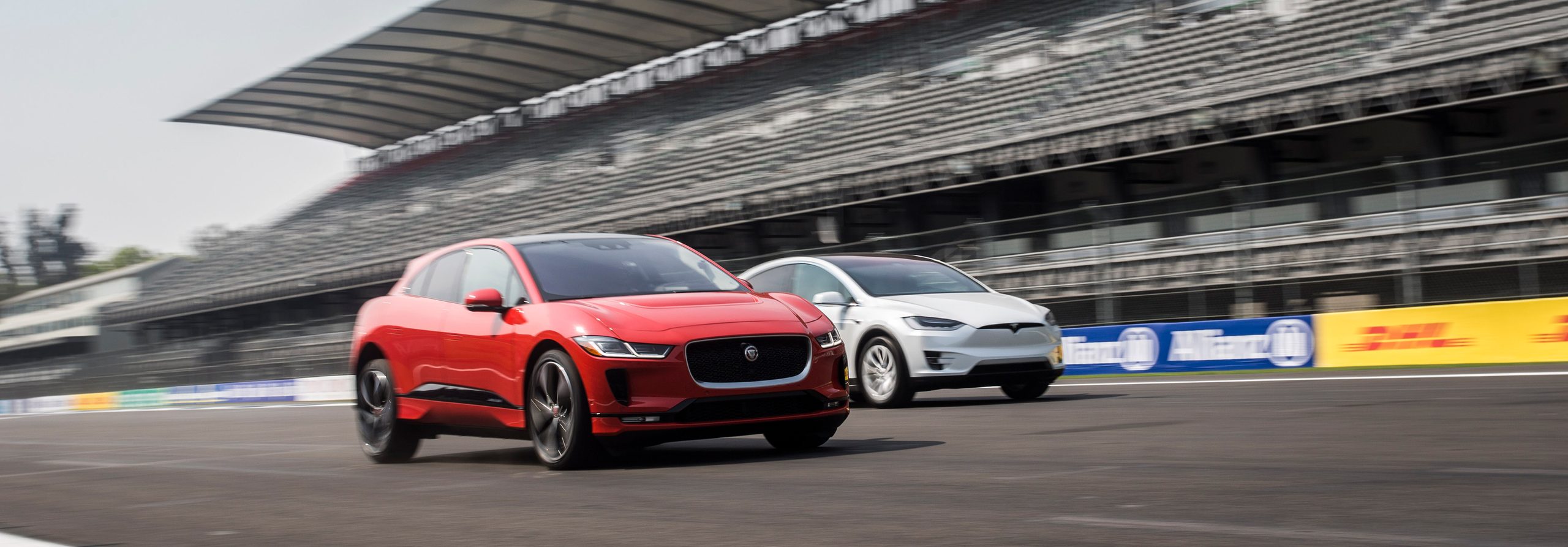
Digital Trends: Jaguar is clearly targeting the Tesla Model X with the I-Pace. How did you benchmark the I-Pace to its main rival?
Dr. Z: Yes, we are benchmarking the Model X, but you don’t design a car against competition, you design it for a customer. That’s why we thought this car would be ideal. It is slightly smaller than the Model X, but has the same range, power, acceleration, and interior space. We believe the I-Pace is just right.
Digital Trends: Is Jaguar thinking about additional I-Pace variants with more range or power?
Dr. Z: What you can imagine is that the platform is quite flexible. If you see the announcements of other automakers, they sell their single platform as the ultimate thing that covers every segment. If you go into detail, it’s not that easy. For instance, you can’t just reduce the battery pack at random – you have to care for the voltage level and other things. Nevertheless, it’s very flexible.
We will benefit from further battery technology, more energy density. This is increasing roughly by five to six percent per year. Regarding range, I’m not sure whether there is an infinite range race. For the time being, the range is perfect. In the future, when we have more infrastructure, with faster charging, then the need for a very large battery will decline. In five to ten years, a range of under 200 miles might be sufficient.
Digital Trends: Is Jaguar considering its own charging infrastructure similar to Tesla’s Supercharger network?
Dr. Z: No, we are not. It doesn’t make sense for us. It made sense for Tesla, because there was no one around – no infrastructure. Today, we have some infrastructure in place with much more to come. You may have heard that European manufacturers have joined up and will build a grid charging network in Europe. Jaguar Land Rover being a small company, we will now benefit from these increases. We will have a preferred supplier for a home charger. Home charging accounts for 95 percent of charging events. Charging at work is second.

Digital Trends: You’ve said the I-Pace has been your most exciting project thus far. Why is that?
Ian Callum (IC): I’ve been working on these things for 30-40 years now. Apart from when you have the odd opportunity to make a mid-engine car, they’re fairly generic – the engine, gearbox, and dimensions. In design, you can influence the placing and packaging, but fundamentally, things are pre-determined. The I-Pace, however: if you take anything from the middle of the wheels up, it’s free space. The inverter has to go somewhere, but it can go anywhere, connected by wires (we put it in the front).
The opportunity to do something with all this space was really quite exciting. The first time we started making models of it, there was even a lot of controversy within the design studio. The aesthetic for anyone, let alone Jag people, is quite different. You have limitations of safety and visibility, but it’s an incredible opportunity.
Digital Trends: Were there any specific challenges that came with packaging the batteries?
“At no point did I say, ‘This has to look different because it’s electric.’ What I said was, ‘this is electric – let’s see where we go.’ “
IC: One of the reasons we decided to go with an SUV was because the height was challenging. If you’re going to put seven batteries in the floor of a sedan, it becomes quite difficult to achieve a low ride height. For this platform, we decided to go with the SUV to avoid those obstacles. The other big challenge was to design something that was aerodynamically efficient. With cars that tall and far off the ground, that’s difficult. We knew we needed a square back end for better aero, so we didn’t cling to the notion that we have to be curvaceous everywhere. I think too many people consider too many elements to find a solution for something that doesn’t need to be solved. We just came up with the right answers.
The I-Pace vaguely resembles other Jaguar models (the grille, headlights, and taillights being some of the biggest giveaways), but is definitely a new design direction. Is this just to distinguish Jaguar’s first all-electric model, or is the I-Pace pioneering styling for all future Jag’s?
IC: It looks different because if you take the aerodynamic rules from the ground up, that’s what turns out. At no point did I say, “This has to look different because it’s electric.” What I said was, “this is electric – let’s see where we go.” The curvaceous waistline is pure Jaguar, it’s just cab forward instead of cab rearward. I remember the excitement of a mid-engine car (I grew up when Ferrari came out with the LM250); it was so rebellious.

I tried to do a mid-engine Aston once. I almost got a mid-engine Jaguar – almost (referencing the C-X75 Concept). Now I’ve finally got my cab-forward car. We did decide to put a familiar front end on the car because we didn’t want to completely dislodge the I-Pace from the rest of the Jaguar family. We may well change the face of it in time, who knows? One of the great myths about electric cars is that they don’t need radiators. They actually do need them to cool the battery packs and to operate the air conditions system.
What was the primary goal for the interior — space, futuristic look, or something else?
IC: The design of the car gave us space, but my team is brilliant at finding more. That’s very difficult, as space in a car is always at a premium.
The dashboard layout (what’s behind it) is actually quite conventional because despite how innovative the car is, we still have to live with airbags, HVAC systems, etc. The freedom was the lower part of the dash. The big debate was: do we put a big touchscreen in there? I don’t really feel comfortable with that, because I still think cars need to be subdivided into primary and secondary information. We ended up splitting it into two screens plus the TFT screen, plus the head-up display.
It also has rotaries, because they’re just great to use and have a lovely tactile feel. Replacing all that with anonymous touchscreens is a bit soulless. The other reason is, when you’re doing 70 mph, you don’t want to be looking for stuff on a touchscreen – you just want to feel your way through it. Voice commands will become more commonplace, with Amazon Alexa and the like, but it’s not perfect yet.
What’s the right color combination for the car?
IC: Actually, I don’t know yet. I’m getting a pre-production car in gray, and if I don’t like something about it, I can probably find some way of changing it. But here’s the interesting thing: a car designer knows his color palette, but he’s always worked with just two or three colors — usually for launches, red, gray, and white. Then suddenly, you’ll see one in bright blue and it completely changes your perspective. I don’t see that, though, until after they come off the production line. The first time I will see a lot of colors is when I see them on the road.


