  1. Home
  2. Computing
  3. News

Gemini 3.5 Flash is Google’s new default AI model, and it’s built to act, not just answer

Announced at I/O 2026, the model is designed to handle complex, multi-step workflows and is now live across Google's consumer, developer, and enterprise platforms.

Add as a preferred source on Google
Gemini 3.5 Flash banner image
Google
Sundar Pichai stands in front of a Google logo at Google I/O 2021.
This story is part of our complete Google I/O coverage

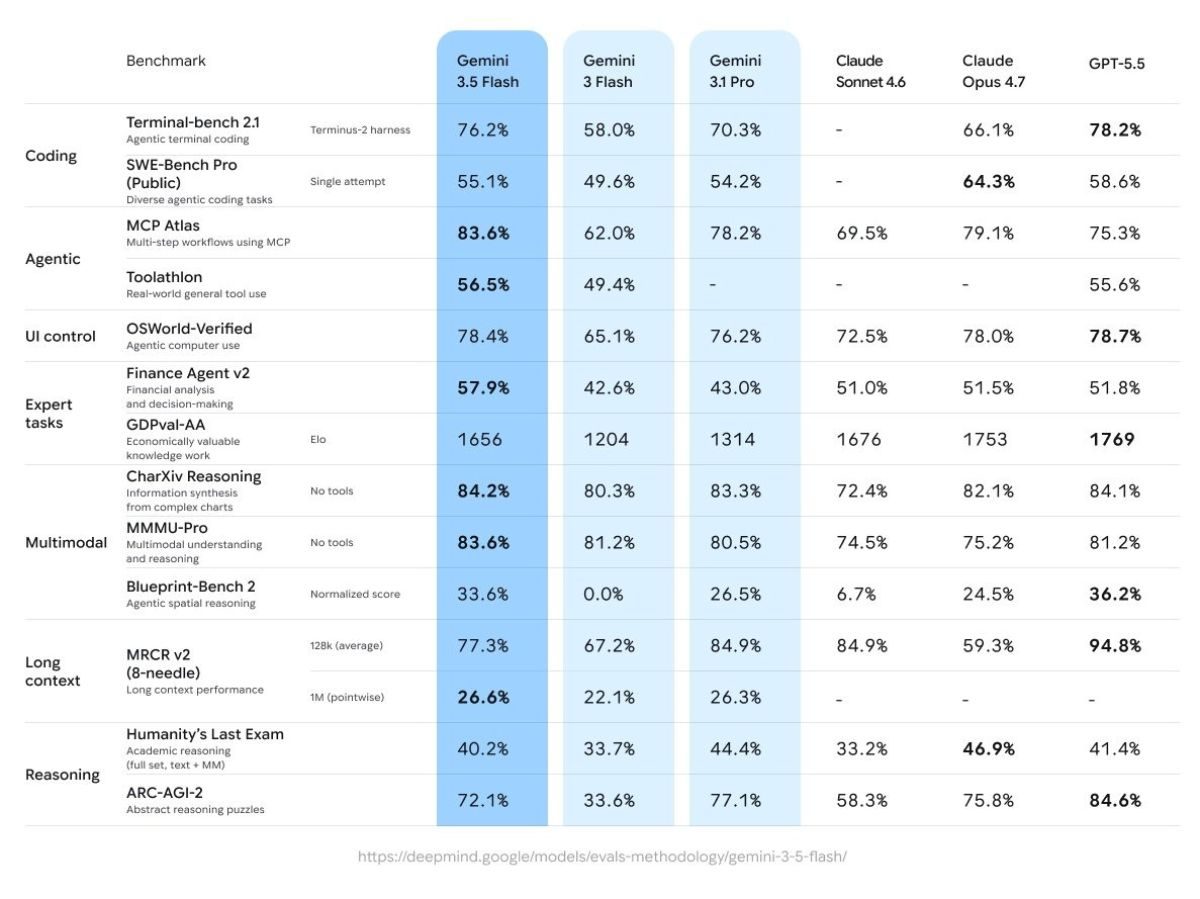
Google has long positioned Gemini‘s Flash models as the faster, cheaper alternative to its flagship Pro tier. However, that changes with Gemini 3.5 Flash. Announced at I/O 2026, the new model outperforms Gemini 3.1 Pro on coding and agentic benchmarks, with Google claiming that it delivers four times the speed of comparable frontier models, “often at less than half the cost.”

Built for agents

Gemini 3.5 Flash is designed for long-horizon agentic tasks, i.e., workflows that require AI to plan, build, and iterate across multiple steps. Google says it can handle tasks that previously took developers days or auditors weeks, in a fraction of the time.

Meet Gemini 3.5 Flash — our strongest agentic and coding model yet.

It delivers frontier-level performance at 4x the speed of comparable frontier models — often at less than half the cost.

Generally available, starting today. 🧵#GoogleIO pic.twitter.com/jLhqozutwG

— Google (@Google) May 19, 2026

Specific benchmark scores include 76.2% on Terminal-bench 2.1, 1656 Elo on GDPval-AA, and 83.6% on MCP Atlas. The model also scores 84.2% on CharXiv Reasoning, a multimodal understanding benchmark.
The model works with Google’s Antigravity, an agent-first development platform, to deploy multiple subagents in parallel, enabling it to tackle more demanding workloads. On the consumer side, 3.5 Flash is now the default model powering the Gemini app and AI Mode in Google Search.

Recommended Videos

It also powers Gemini Spark, a new personal AI agent Google announced at I/O that runs around the clock to take action on a user’s behalf. Google is rolling Spark out to trusted testers now, with a broader beta planned for Google AI Ultra subscribers in the US next week.

Rollout and availability

Gemini 3.5 Flash is available now globally in the Gemini app and AI Mode in Search for consumers, and through Google AI Studio, the Gemini API, and Android Studio for developers. Enterprise customers can access it via both the Gemini Enterprise Agent Platform and Gemini Enterprise. Google has also confirmed that Gemini 3.5 Pro is in internal testing and expected to roll out next month.

The release puts agentic capability at the center of Google’s AI roadmap. Rather than competing purely on which model can answer questions more accurately, Google is betting that the next stage of AI is about models that can take actions like booking appointments, writing and running code, managing workflows, and more, all with minimal input from the user. With Gemini 3.5 Pro due next month, it’ll be great to see how far Google plans to push that vision.

Pranob Mehrotra
Pranob is a seasoned tech journalist with over eight years of experience covering consumer technology. His work has been…
Microsoft Edge is about to get more frequent updates, but don’t expect more features
Starting with Edge 152 on August 27, Microsoft is cutting its release cycle in half, with smaller but more frequent updates for Stable channel users.
Microsoft Edge illustration official

Microsoft is accelerating updates to its Edge browser, switching from a monthly release schedule to a biweekly one. The change takes effect with Edge 152, due on August 27, and puts the browser on the same cadence as Google Chrome.

More updates, not more features

Read more
What makes a laptop good for both work and entertainment?
Computer, Electronics, Laptop

This post is brought to you in paid partnership with HP.

The HP OmniBook X Flip is designed as an all‑day AI PC that adapts seamlessly from productivity to entertainment without switching devices.

Read more
Your Windows 11 PC can now natively run AI workloads, even if it lacks the Copilot+ badge
Windows 11 laptop on a table

For the better part of a year, Microsoft has been telling us that the future of AI on Windows belongs to Copilot+ PCs. If you wanted Microsoft’s most advanced local AI features, you needed a machine with a dedicated Neural Processing Unit (NPU). That was the deal. Now, Microsoft appears to be rewriting the rules.

According to updated documentation, Windows 11’s local Language Model APIs can now run on non-Copilot+ PCs, provided they have an Nvidia GeForce RTX 30-series GPU (or newer) with at least 6GB of VRAM. On the surface, this sounds like a developer-focused update. In reality, it could be one of the most significant shifts in Microsoft’s AI PC strategy since Copilot+ PCs launched last year. More importantly, it raises a question that has been lingering ever since the AI PC era began: Did we really need NPUs for all of this in the first place?

Read more