  1. Home
  2. Computing
  3. News

A new test shows Microsoft Recall’s continued security problems

Add as a preferred source on Google
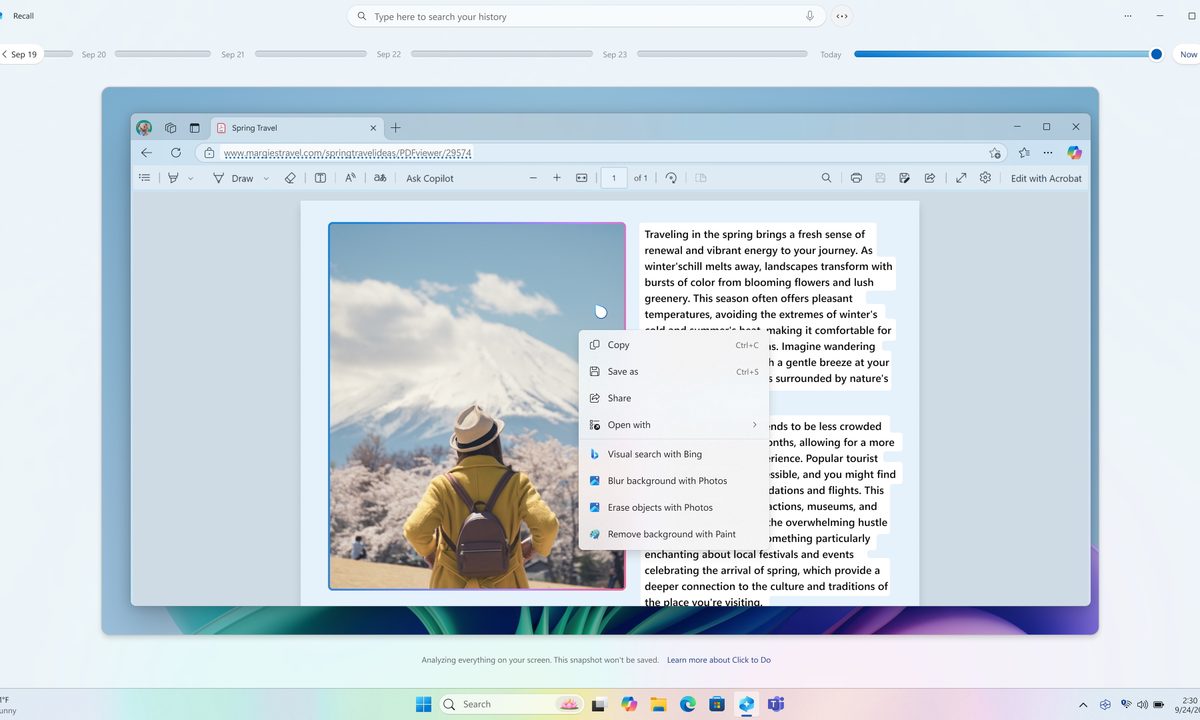
Recall screenshot.
Microsoft

Microsoft is currently previewing its latest version of Recall to Windows Insiders on Snapdragon-, Intel-, and AMD-based Copilot+ PCs — and the topic on most users’ minds is security. The company updated its security and privacy architecture for the feature in September, but, according to tests run by Tom’s Hardware, it still might not be good enough.

The new version of Recall includes a sensitive information filter that’s supposed to detect when there’s information like credit card numbers and Social Security numbers on the screen. If it detects them, it will avoid taking a screenshot. When Tom’s Hardware put this filter to the test, however, it failed in a number of situations.

Recommended Videos

It seems that right now at least, Recall is best at detecting standard checkout pages where people input their payment details — and as for everything else, it’s not very good. Recall captured card numbers and passwords typed into a Notepad window, Social Security information on a PDF loan application, and payment info typed into a simple HTML page.
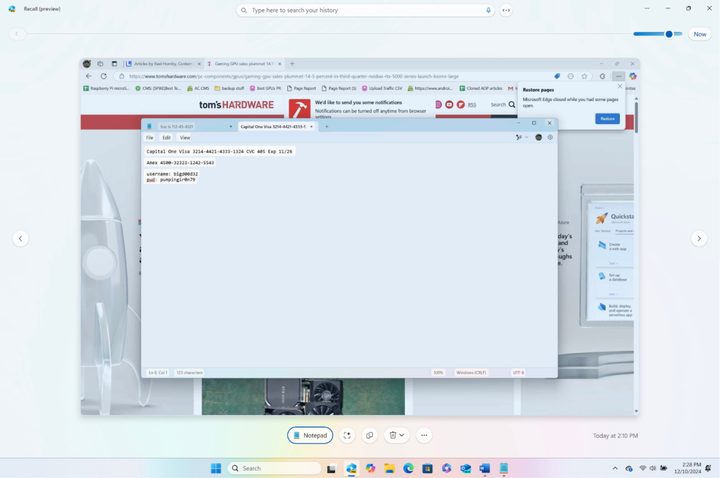
Microsoft recall capturing credit card info.
Tom's Hardware

Granted, these tests were designed to push the limits — but the filter probably ought to work in more than a single situation. Microsoft made sure not to promise any particular results, however. Its blog post on the updated architecture simply says the sensitive content filtering “helps reduce” the number of passwords, national ID numbers, and credit card numbers being stored in Recall.

In response to the Tom’s Hardware tests, the company pointed out that it plans to “improve this functionality” and encourages people to send examples to the Feedback Hub. Because the discourse around Recall is all about security, there really is no room for mistakes.

If you’re going to make a feature that screenshots everything everyone does on their PCs, you’ve got to make it airtight. We’ll see in the coming weeks if Recall’s encryption and everything going on under the hood is as secure as Microsoft claims it is. Hopefully, the company can get things sorted before its time for the larger rollout.

Willow Roberts
Willow Roberts has been a Computing Writer at Digital Trends for a year and has been writing for about a decade. She has a…
In a market where Mac has been aspirational, it’s somehow a better deal than windows machines now
Windows Laptops became so expensive that MacBooks look sensible now
Computer, Electronics, Laptop

For a long time, the laptop buying advice was simple enough. Windows had a more versatile portfolio that brought you affordable, mid-range, high-end, and even gaming options, while MacBooks were known as the easy premium recommendation.

But owing to the pricing circus caused by memory shortages and component price hikes, the equation makes no sense anymore.

Read more
HP’s new RTX 5070 laptop feels like the sweet spot between thin and bulky
The new HyperX Omen 15 combines AMD and Intel and targets portability without fully sacrificing performance.
HP HyperX OMEN 15 Gaming Laptop

Modern gaming laptops have largely drifted toward two extremes lately: massive 16-inch and 18-inch desktop replacements, or ultra-compact 14-inch machines that still feel slightly cramped for serious gaming sessions. That’s exactly why HP’s new HyperX Omen 15 feels refreshing, because it brings back the familiar 15-inch gaming laptop formula with a chassis that still feels portable without sacrificing proper gaming hardware underneath.

HP’s compact HyperX Omen 15 packs RTX 5070 graphics with AMD and Intel options

Read more
Corsair is putting Chinese RAM in mainstream market. It won’t quite end the crisis though
A cheaper DDR5 supplier could shake up the market, but it is not a magic fix
Samsung DDR4 RAM in hand

After months of painfully expensive RAM and SSD prices, the memory market may finally be showing signs of pressure from an unexpected direction: China. New reports suggest that Chinese memory manufacturers are rapidly expanding production of DRAM and NAND chips, and that major hardware brands are starting to take notice. The most notable example so far is Corsair, which has reportedly tested DDR5 memory modules using chips from Chinese DRAM giant ChangXin Memory Technologies, better known as CXMT.

This feels inevitable. Memory prices have remained frustratingly high across PCs, laptops, and storage devices for months. So when Chinese suppliers began offering RAM at nearly half the cost of some global competitors, manufacturers were always going to at least explore the option. According to market reports, some CXMT DDR5 modules are reportedly being sold near the $150 range, while equivalent products from larger global suppliers can hover between $300 and $400.

Read more