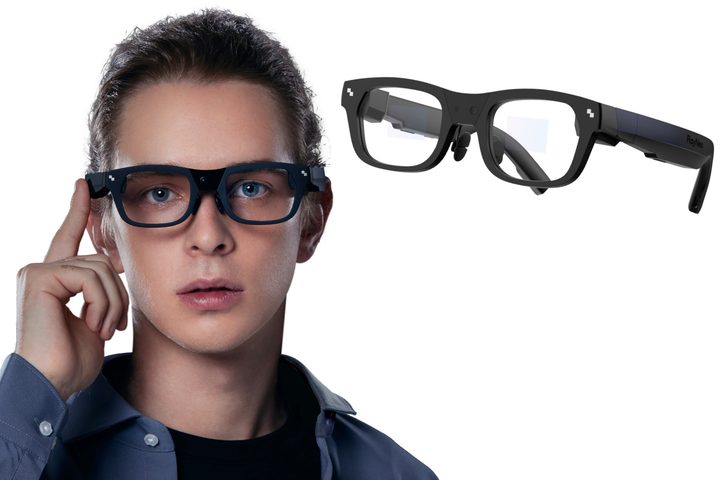
It’s been a long time since Google Glass fell on its face, but at CES 2024, some advanced AR companies are attempting a revival of sorts.
TCL-backed RayNeo showcased its latest breakthrough in AR glasses with two new pairs: the RayNeo X2 and RayNeo X2 Lite, a two-ounce (60g) wearable that includes 1,500-nit displays, a 12MP camera, and AI with voice and image input.
The RayNeo X2 will be available to consumers via Indiegogo in February, but the company brought it to CES early for show-and-tell. This model runs a Qualcomm Snapdragon XR2 Gen 1, a processor used in many VR headsets, and was among the first AR glasses to support Qualcomm’s Snapdragon Spaces platform.
The X2 Lite is a newer, lighter, and lower-cost model shipping in the fall. The latest AR glasses feature bright, micro-LED optical waveguide technology that allows a much slimmer look, a lighter design, and clear lenses. The twin displays are bright enough that there’s no need for tinting or covers to make images viewable and text readable.
Most display smart glasses use birdbath optics, named after the curved reflectors that make lenses thick and dim ambient light. The tradeoff with current waveguide displays is a smaller field of view (FoV). The RayNeo X2 Lite has a 30-degree FoV, so there’s still a place for birdbath smart glasses like RayNeo’s Air 2 with a 46-degree FoV.
The camera, mounted between the eyes, allows hands-free 12MP photos and video recording at 1080p, providing a first-person perspective. That unique capability has proven to be buzz-worthy on TikTok, with millions of followers expressing interest in videos recorded with Ray-Ban Meta Smart Glasses.
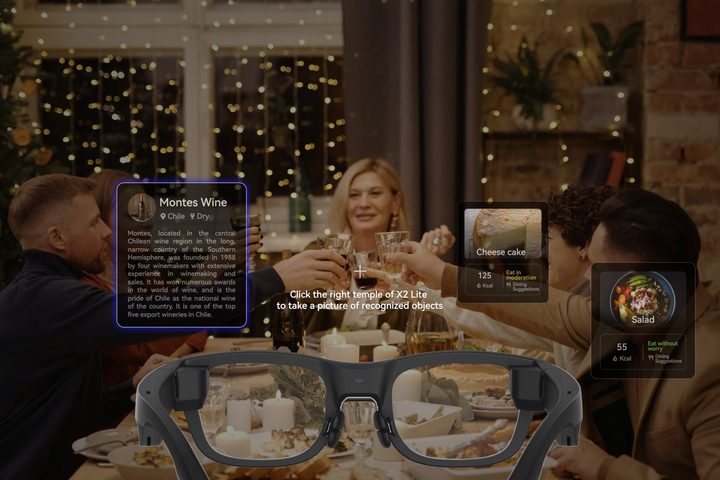
Another similarity to Ray-Ban’s smart glasses is the use of an AI assistant. RayNeo will use a GPT variant for image and voice recognition, replies, and assistance with the operation of the RayNeo X2 Lite. Ray-Ban Meta Smart Glasses have a camera and AI but lack displays.
Qualcomm’s Snapdragon AR1 Gen 1 processor powers the RayNeo X2 Lite to provide some features without a phone, like the built-in AI assistant providing turn-by-turn directions with arrows that hover in front of you, reminding you of upcoming meetings, and alerting you to notifications. The RayNeo X2 lite uses face-tracking to translate foreign languages and position the transcription near the speaker’s face. RayNeo says live translation superimposed over text is also possible.
The displays have a 640-by-480 resolution, which should be sufficient for readable text given the limited field of view. There’s 32GB of storage on the glasses to store photos and videos. The RayNeo X2 Lite also contains three mics, stereo speakers, and a touchpad on the earpiece.

The new wearable is compatible with Wi-Fi 6E and Bluetooth 5.3. An optional control ring accessory will facilitate silent and discrete operation. RayNeo’s X2 Lite will also support prescription lenses. The device has IP52 water and dust resistance to protect the hardware, so you won’t run into trouble if caught in the rain.
A companion app will be available for Android and iOS. You can take calls, check notifications, get directions, access AI, listen to music, and take photos and videos without picking up your phone. That’s an intriguing proposition, depending on the price.
We’ll keep you posted on developments at RayNeo and other leading AR and smart glasses manufacturers. It will be interesting to see what AR apps become available to add value to this growing array of compelling hardware. It seems like 2024 will be an exciting year for augmented reality and spatial computing, hopefully kickstarting a new trend in a way Google Glass never could.