
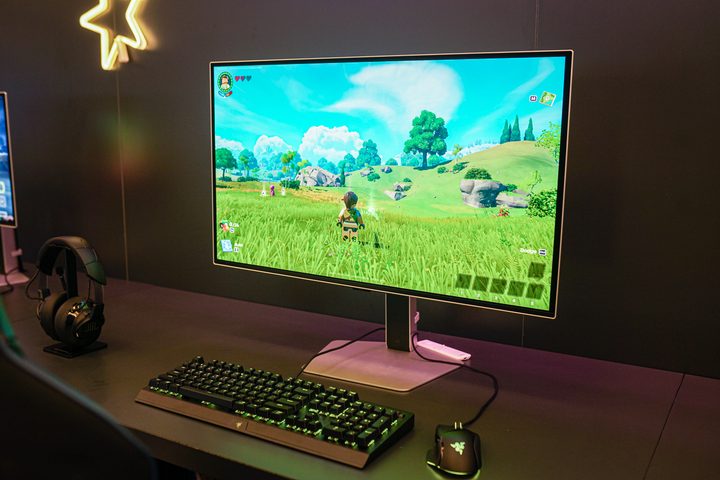

Samsung is gearing up to release two new QD-OLED gaming monitors at CES 2024. We already knew about the 2024 Odyssey OLED G8 and Odyssey OLED G6 thanks to an announcement from Samsung last week, but I wasn’t expecting to be so impressed by them. It’s Samsung’s first attempt at a traditional 16:9 QD-OLED monitor after the excellent Odyssey OLED G8 and Odyssey OLED G9 last year, and Samsung is coming out of the gates swinging.
If you missed the announcement, there are two monitors here. The Odyssey OLED G8 is a 32-inch display with a 4K resolution and a 240Hz refresh rate. The Odyssey OLED G6 is smaller at 27 inches but has a 1440p resolution and a speedy 360Hz refresh rate. Both are using a second-gen QD-OLED panel from Samsung Display that’s certified with VESA’s DisplayHDR True Black 400 and use a new anti-reflective coating.
It’s hard to assess reflection in a bright demo room, but I definitely didn’t notice the typically harsh reflections you see on a glossy display. Samsung isn’t going the matte route here. These are still glossy monitors, but they seem to handle reflections a bit better.

As for what second-gen QD-OLED tech brings, we’ll have to wait until we’ve had a chance to test the monitors properly. The big pain point in the first generation was color accuracy, as we saw on the Alienware 34 QD-OLED, so hopefully, we’ll see that area addressed this year. Brightness was already great, and it seems these new monitors are carrying the over — though, once again, I can’t pull out my luminance meter and get to testing in a CES demo.
What was most striking about the two monitors was the design. Samsung really elevated its Odyssey lineup last year with a sleek metal frame, and 2024’s design piles on top of that. The frame is even thinner this time around, all while sporting that sleek silver frame. The base is slightly smaller too, and it’s monolithic, so it doesn’t take up too much desk space.

The stand now has a textured finish on it, and the CoreSync lighting ring no longer has a smokey diffusion layer on top of it. It’s still diffused bias lighting, but Samsung doesn’t kill the brightness. It looks much more vibrant than last year’s design.
Samsung is carrying over some elements of the design I don’t love, though. The cable management solution is once again a small rubber ring near the base of the stand. The connections are straight, too, so you’ll need to tie down your cables with several zip-ties to get a clean look.
In addition to the design changes, Samsung added a new AI processor to these two displays. Like last year, you get the Tizen operating system that opens up smart apps, Samsung Game Hub, and a slew of additional features. Now, it’s bolstered by an AI chip that can automatically adjust your picture setting depending on the content.
Samsung is talking about this in the context of gaming, where the settings for an FPS or RPG might be different. Instead of manually toggling over to a different picture mode, the AI processor supposedly picks up on the content on-screen and changes the picture settings automatically. I didn’t have a chance to demo this, and frankly, I can imagine most users wanting to turn it off. Still, it’s one of the more useful applications of AI we’ve seen so far at CES.
Even after a couple of hours going back and forth playing rounds of Fortnite, the displays still managed to stun me. The Odyssey OLED G8 and Odyssey OLED G6 look incredible, and if Samsung can nail the price, they are strong contenders for the best gaming monitor this year.
Price is a big factor, however. We’ve seen several times over the past couple of years where Samsung will release a new gaming monitor at a high price before dialing it back. We don’t have any pricing details quite yet, but they will be a vital component in the growing marketing of OLED gaming options.


