

Starfield is a great change of pace for PC releases in 2023. The game is very stable, relatively bug free, and it’s optimized to run on a wide range of hardware. That doesn’t mean the game isn’t demanding. It is very demanding, and it’s clear Starfield leans on AMD’s FidelityFX Super Resolution 2 (FSR 2) to push frame rates higher.
As I was gathering my best settings for Starfield on PC, it became clear that the game is designed around having FSR 2 turned on. That’s not inherently a problem. For a game as demanding and visually impressive as Starfield, though, leaning too heavily on a singular feature can make some players, especially those on less powerful hardware, choose between performance and image quality. And in the case of Starfield, that’s not a decision they should need to make.
The reality of the situation
Let me catch you up to speed on the saga with FSR 2, AMD, and Starfield up to this point. About a month ago, AMD announced it was the “exclusive PC partner” for Starfield, confirming the game would support AMD’s FSR 2 at launch. It makes sense, too. FSR 2 is supported on consoles and PCs, and it can massively improve performance for a game as ambitious as Starfield.
There were concerns, though. Some speculated AMD’s partnership meant the company would block Nvidia’s Deep Learning Super Sampling (DLSS) from being in the game on PC. Since then, AMD has confirmed it didn’t block DLSS, saying that Bethesda Game Studios is free to implement the feature if it wishes. The company admits that “money absolutely exchanges hands” with these partnerships, though says that it provides full support for developers if they wish to implement DLSS.
But DLSS isn’t in the game, nor is Intel’s XeSS. That’s a problem, mainly because FSR 2 isn’t nearly as good as DLSS is. It’s a great performer, and the image quality holds up well in some situations. When FSR 2 is pushed, however, it falls short of DLSS when it comes to image quality.
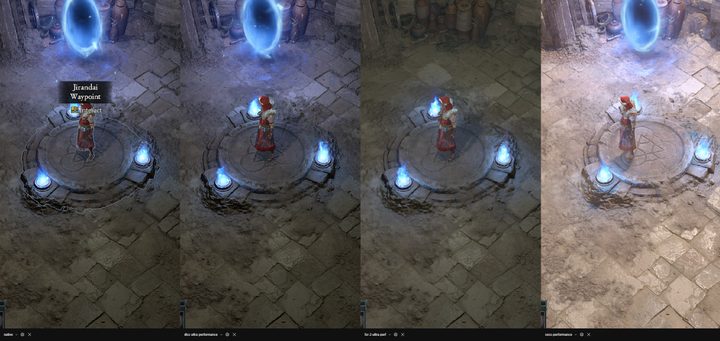
Obviously, I can’t do a direct comparison in Starfield, but you can see how FSR 2 falls apart in a game like Diablo 4 at its Ultra Performance mode. DLSS maintains much more detail, while offering a similar level of performance. It’s worth noting that Starfield only goes down to 50% resolution scaling, otherwise known as the Performance mode of DLSS and FSR. The Ultra Performance mode of DLSS could help bring some less powerful GPUs up to an acceptable level of performance, but it’s not an option in Starfield unfortunately.

Similarly, in Hogwarts Legacy, you can see a clear drop-off in detail with FSR 2 compared to DLSS in their Performance modes. There are certainly games where FSR 2 looks acceptable, but when they’re pushed, DLSS almost always wins. For a more in-depth comparison, I recommend watching Hardware Unboxed’s analysis of 26 games with both features.
A mod exists that adds DLSS into Starfield currently, but I didn’t observe a significant difference in image quality in the limited time I had to mess around with it. This is par for the course with these types of upscaling mods, and there are usually far more significant differences with native implementations of FSR and DLSS, as you can see in both Hogwarts Legacy and Diablo 4.
There’s no doubt that FSR 2 is a great piece of kit from AMD. It offers huge performance gains and solid image quality, and it works with nearly any GPU. The problem for Starfield is both that it exclusively supports FSR 2, and that it was designed around the feature.
Designed around upscaling
Over the past couple of months, the PC gaming community has been in an uproar over features like FSR and DLSS. Makers of games like Remnant 2 have confirmed they rely on the features to push visual quality on PC, rather than leveraging them to improve performance on less powerful systems. Starfield takes that idea to the extreme.
The game isn’t just designed around upscaling features, but exclusively around FSR 2. All four of the graphics presets enable FSR 2 by default, ranging from 75% render resolution at the Ultra preset to 50% render resolution at the Medium and Low presets. For context, that 50% render resolution is the equivalent of FSR 2’s Performance mode in other games. As you can see in my benchmarks below, that makes a massive difference in performance.
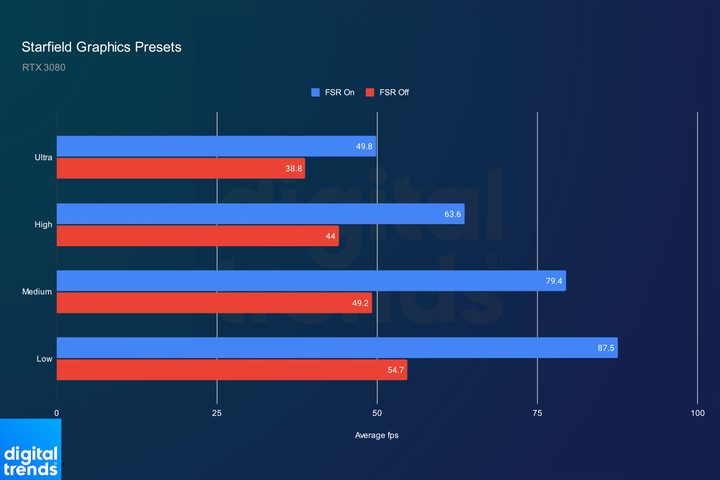
That’s with the RTX 3080, but the performance gain from FSR 2 applies to less and more powerful GPUs, as well. If we look at AMD’s recommendations as the partner for the game, it says the RX 7600 delivers “great visuals and frame rates” at 1080p. Similarly, the RX 7900 XT provides a “no-compromise” 4K experience. I translate that into 1080p High for the RX 7600 and 4K Ultra for the RX 7900 XT.

And sure enough, in both cases, the graphics cards can’t maintain a solid 60 fps in demanding areas of the game like New Atlantis. You need FSR at High and Ultra, with 62% and 75% render resolution respectively, to bump the cards over that fated mark. You can turn graphics settings down, but that’s not a position you want to be in with AMD’s latest and greatest 1080p and 4K graphics cards.
If you don’t have a current-gen GPU, FSR 2 can be the difference between playable and unplayable, especially if you have a lower-end card. I usually set my recommended settings for a game around turning upscaling off, but with Starfield, I recommend keeping it on because the game can be so demanding.

Despite being designed around upscaling, Starfield doesn’t look great at its lower graphics presets. As you can see in the image above, the Low and Medium presets lose a ton of detail and wash out in a mess of aliasing. That’s not coming from the lowered graphics settings; it’s coming from the fact that FSR 2 is struggling to keep up with a 50% internal render resolution.

That screenshot was taken at 4K, as well. If we step down to 1080p with the RX 7600, you lose even more detail. Above, you can see the High preset, which comes with a 62% render resolution. The only difference between the images is FSR 2.

As I’ve established, this is a fine way to play the game with the RX 7600. If you step down to the Medium preset, the situation is much worse, though, as you can see above.
Unlike much of the internet, I’m not against developers designing their games around upscaling, especially releases as ambitious as Starfield. It’s vital, however, to support as many upscaling features as possible if that’s the goal. Cyberpunk 2077, for example, can bring even the most powerful PCs to their knees. But it also supports just about every flavor of PC tech you could ask for.
Starfield hangs its hat exclusively on FSR 2, all while asking to push the same level of visual fidelity. The feature works across all GPUs, but the exclusivity means the vast majority of the PC market — who use Nvidia GPUs — can’t use the feature they probably bought their graphics card for in the first place: DLSS. According to the latest Steam hardware survey, 38% of players have a graphics card capable of using DLSS in their system. That’s probably a low number, as well, considering the Steam hardware survey factors in machines with integrated graphics who definitely won’t be playing Starfield.
This isn’t to bash on AMD, either. In an alternate reality where the game was exclusively designed around DLSS, there would be similar concerns, as a chunk of gamers are locked out of having the best experience their hardware is capable of. Even games like Remnant 2, which are designed around these features, support DLSS and FSR. It’s fair to ask a game as big as Starfield to have that same attention to detail.
No FSR 3 in sight

When AMD announced that it would be the exclusive PC partner for Starfield, online forums and subreddits lit up, speculating that the game would launch alongside AMD’s hotly anticipated FSR 3. This feature, similar to DLSS 3, uses frame interpolation to massively boost performance, and it works across PCs and consoles.
FSR 3 isn’t supported in Starfield, and it might never be. AMD has finally revealed that FSR 3 is coming in September through updates to Forspoken and Immortals of Aveum, and it laid out a list of partners and games that will support the feature in the future. Starfield was surprisingly absent from that list.
Considering the close marketing partnership between AMD and Bethesda for Starfield — I mean, AMD even released an exclusive Starfield graphics card — you would think that either party would say something if FSR 3 was coming to the game shortly. It’s still possible FSR 3 will come eventually, but I don’t suspect it to be any time soon. There’s definitely a better argument for exclusively supporting FSR if Starfield did indeed launch with FSR 3.

Instead, we have FSR 2. It’s by no means a bad feature, but it’s definitely a measurable distance behind DLSS in terms of image quality, and the studio’s decision to design its game around one upscaling feature locks out the majority of PC players from having the best experience their hardware is capable of.
The intent isn’t the problem here; it’s the execution. With a game as visually impressive as Starfield — and very taxing as a consequence — there needs to be careful consideration to provide PC players as many options as possible to optimize their performance and image quality. Unfortunately, Starfield dropped the ball on that front.
Thankfully, the PC release is excellent otherwise. I’ve experienced no hitching throughout my experience, and it scales very well to higher-end CPUs. There’s already a mod that adds DLSS into the game, as well. Hopefully we’ll get an official release some time soon. It might take some time, or we might not see it at all. After all, Starfield lacks some basic PC options like an FOV slider, brightness/gamma adjustment, and HDR.


