  1. Home
  2. Emerging Tech
  3. News

1X shows off Neo humanoid robot helping humans make more of its kind

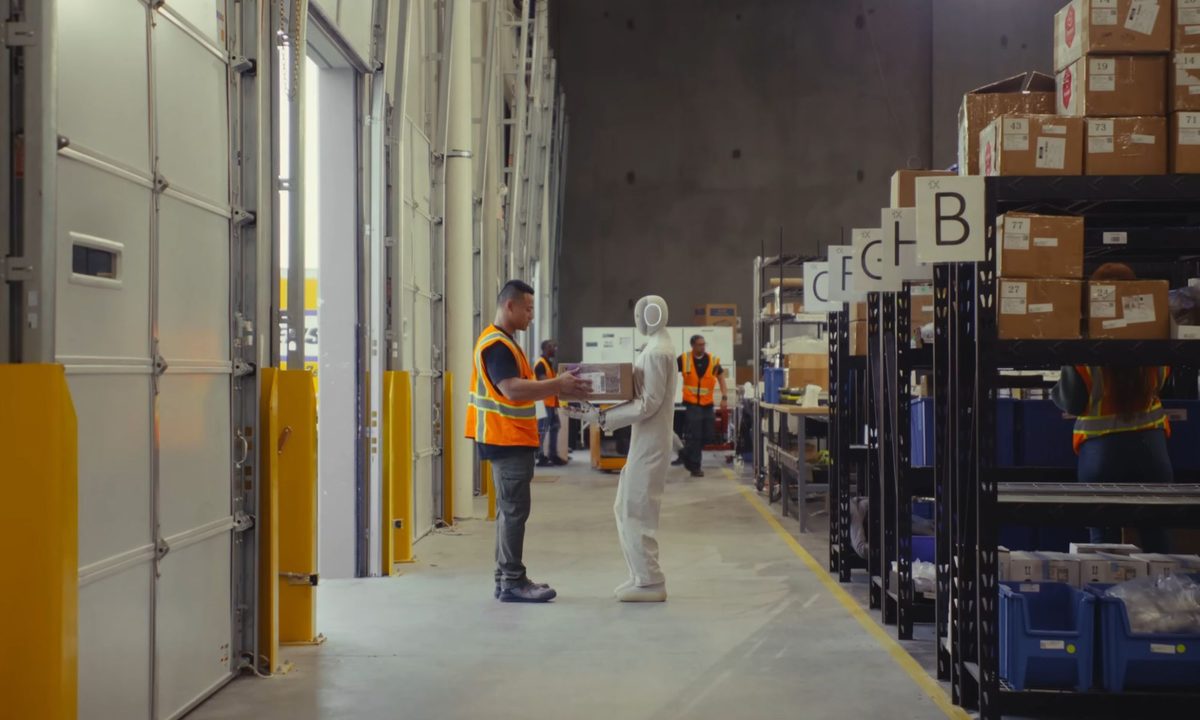
A new factory demo shows 1X's Neo robot assisting human works on the assembly line, offering a glimpse at how the company plans to scale robot production by putting its own machines to work.

Add as a preferred source on Google
1X Neo robot helping on the factory floor.
1X

Norwegian-American robotics firm 1X Technologies has offered a glimpse into what scaled humanoid robot production looks like, and it’s surprisingly circular. In a newly released demo, its Neo robot is shown assisting humans on the factory floor, helping build more Neo units as the company moves toward full-scale manufacturing.

Robots helping build more robots

At the center of the demo is 1X’s Neo humanoid robot, a bipedal machine designed primarily for domestic environments that is now stepping into early manufacturing workflows. The footage shows Neo performing repetitive, assistive tasks alongside human workers, effectively becoming part of the assembly process.

The setup shows how 1X is approaching production at its Neo Factory, where robots are involved in close collaboration with humans. The company has also emphasized a vertically integrated model that involves designing and manufacturing core components in-house, including motors, batteries, sensors, and structural parts.

Recommended Videos

This end-to-end control allows 1X to iterate quickly on both hardware and manufacturing processes, while scaling output as demand grows. The factory has already begun full-scale production, with plans to deliver thousands of units following strong early interest and pre-orders.

Scaling a still-evolving product

Despite the polished demo, Neo remains a work in progress. The robot is designed to operate autonomously, but it’s not quite there yet. So 1X is relying on guided assistance from human operators to supervise and help the robot complete unfamiliar tasks, which also enables it to learn over time.

This learning loop is central to how Neo improves, combining real-world deployment with continuous training. Early versions are expected to expand their capabilities gradually as they gain more experience in both factory and home environments.

With production now underway, 1X is effectively turning Neo into both the product and part of the process. If this model is successful, future iterations may not just assist humans in daily life but also play a direct role in building the next generation of 1X robots.

Pranob Mehrotra
Pranob is a seasoned tech journalist with over eight years of experience covering consumer technology. His work has been…
The FBI secretly built an entire fake town just to practice cyberattacks
Hidden inside a warehouse in Alabama, the Kinetic Cyber Range recreates real-world digital attacks from start to finish.
FBI Kinetic Cyber Range Featured

While Hollywood has fake cities for filming movies, the FBI apparently has one for getting hacked. The agency has pulled back the curtain on its Kinetic Cyber Range, a 22,000-square-foot replica small town hidden inside its Huntsville, Alabama campus. But instead of training officers for shootouts or hostage rescues, the facility is designed to simulate realistic cyberattacks on homes, businesses, and critical infrastructure so investigators can practice responding to them in a controlled environment.

The FBI built an entire town just to simulate cybercrime

Read more
Brazil’s secret World Cup weapon taught the team when to ignore it
The data said he wasn't running enough. The footage said he was always in the “perfect tactical position.”
Soccer ball in net

Brazil has more World Cup titles than anyone, five of them to be precise, but after going through five straight tournaments without adding to that count, the team is leaning hard on data this time. 

Every player wears a sensor-packed "smart vest" tracking field position (via GPS), heart rate, and a stat called "player load," the same kind of numbers that your Whoop band or Apple Watch brags about, but tuned specifically for the sport.

Read more
New OLED breakthrough could make the next see-through screen actually worth using
The electrode fix that could finally make see-through screens worth looking at.
Computer Hardware, Electronics, Hardware

Every transparent OLED demo I’ve seen so far looks amazing for about ten seconds, right before I notice how dim or smudgy it actually looks. A big part of the problem is the role that electrodes play in the design. 

A transparent display requires a see-through electrode that sits on top of incredibly delicate organic light-emitting layers. However, most of the usual options either conduct electricity poorly or risk damaging those layers during manufacturing. 

Read more