1. Home
  2. Emerging Tech
  3. News

Water-based fuel cell converts carbon emissions to electricity

Add as a preferred source on Google

Carbon emissions are one of the big concerns impacting climate change, with projects from the development of carbon dioxide-scrubbing plants to businesses pledging to offset their carbon emissions being suggested as ways to reduce our carbon footprint. Now scientists from South Korea have come up with a breakthrough concept which can turn carbon emissions into usable energy.

Scientists from the Ulsan National Institute of Science and Technology (UNIST) developed a system which can continuously produce electrical energy and hydrogen by dissolving carbon dioxide in an aqueous solution. The inspiration came from the fact that much of the carbon dioxide produced by humans is absorbed by the oceans, where it raises the level of acidity in the water. Researchers used this concept to “melt” carbon dioxide in water in order to induce an electrochemical reaction. When acidity rises, the number of protons increases, and these protons attract electrons at a high rate. This can be used to create a battery system where electricity is produced by removing carbon dioxide.
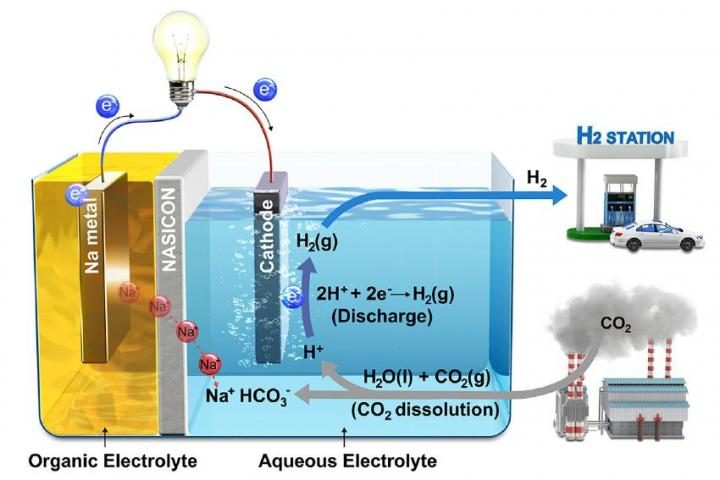
This is a schematic illustration of Hybrid Na-CO2 System and its reaction mechanism. UNIST

The elements of the battery system are similar to a fuel cell, and include a cathode (sodium metal), a separator (NASICON), and an anode (catalyst). In this case, the catalysts are contained in the water and are connected to the cathode through a lead wire. The reaction begins when carbon dioxide is injected into the water and begins to break down into electricity and hydrogen. Not only is the electricity generated obviously useful, but the produced hydrogen could be used to fuel vehicles as well. The current efficiency of the system is up to 50 percent of the carbon dioxide being converted, which is impressive, although the system only operates on a small scale.

Recommended Videos

“Carbon capture, utilization, and sequestration (CCUS) technologies have recently received a great deal of attention for providing a pathway in dealing with global climate change,” Professor Guntae Kim of the School of Energy and Chemical Engineering at UNIST said in a statement. “The key to that technology is the easy conversion of chemically stable CO2 molecules to other materials. Our new system has solved this problem with [the] CO2 dissolution mechanism.”

Georgina Torbet
Georgina has been the space writer at Digital Trends space writer for six years, covering human space exploration, planetary…
The FBI secretly built an entire fake town just to practice cyberattacks
Hidden inside a warehouse in Alabama, the Kinetic Cyber Range recreates real-world digital attacks from start to finish.
FBI Kinetic Cyber Range Featured

While Hollywood has fake cities for filming movies, the FBI apparently has one for getting hacked. The agency has pulled back the curtain on its Kinetic Cyber Range, a 22,000-square-foot replica small town hidden inside its Huntsville, Alabama campus. But instead of training officers for shootouts or hostage rescues, the facility is designed to simulate realistic cyberattacks on homes, businesses, and critical infrastructure so investigators can practice responding to them in a controlled environment.

The FBI built an entire town just to simulate cybercrime

Read more
Brazil’s secret World Cup weapon taught the team when to ignore it
The data said he wasn't running enough. The footage said he was always in the “perfect tactical position.”
Soccer ball in net

Brazil has more World Cup titles than anyone, five of them to be precise, but after going through five straight tournaments without adding to that count, the team is leaning hard on data this time. 

Every player wears a sensor-packed "smart vest" tracking field position (via GPS), heart rate, and a stat called "player load," the same kind of numbers that your Whoop band or Apple Watch brags about, but tuned specifically for the sport.

Read more
New OLED breakthrough could make the next see-through screen actually worth using
The electrode fix that could finally make see-through screens worth looking at.
Computer Hardware, Electronics, Hardware

Every transparent OLED demo I’ve seen so far looks amazing for about ten seconds, right before I notice how dim or smudgy it actually looks. A big part of the problem is the role that electrodes play in the design. 

A transparent display requires a see-through electrode that sits on top of incredibly delicate organic light-emitting layers. However, most of the usual options either conduct electricity poorly or risk damaging those layers during manufacturing. 

Read more