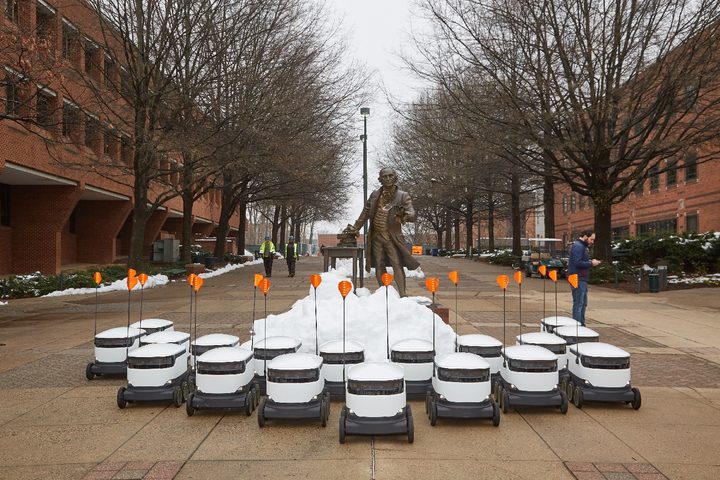
Whether it’s dropping off our mail or bringing snacks on demand, delivery robots are fast moving from novelty concept to real world game changer. Now things are taking the next step with the world’s largest fleet of delivery robots on a university campus arriving at Fairfax County, Virginia’s George Mason University. Starting today, January 22, Mason’s 40,000 students, faculty, and staff can get meals delivered, courtesy of a collaboration between food services giant Sodexo and delivery robot pioneer Starship Technologies.
The new delivery service, which costs just $1.99 per delivery, will transport Blaze Pizza, Starbucks, and Dunkin’ Donuts takeouts anywhere on campus. Additional retailers are set to be announced in the coming weeks. In total, 25 robots are included in the fleet, which represents a new benchmark in the size of a delivery robot rollout.
“Not only will this be the largest fleet of delivery robots on any university campus, but it is also the first delivery system to be compatible with students’ meal plans,” Jeff McKinley, Sodexo district manager for George Mason University, told Digital Trends. “That component itself elevates the value of the program tremendously, because meal plans at GMU are tax exempt, thus saving the students not only time but money by ordering via robot.”

The robots are described as being “99-percent autonomous” — capable of driving themselves around campus, including checking both ways before crossing a street, and even changing their own batteries. “It’s quite amazing, actually,” McKinley said.
To order their food, students and faculty use the Starship Deliveries app, select their items, and drop a pin on a map to show where the food should be sent. The app then allows them to track the robot’s progress. When it arrives, the customer receives an alert, after which they can obtain their food by unlocking the robot with an in-app command. The process takes an average of 15 minutes or less, depending on which food is ordered.
“This program is at the forefront of changing trends, so of course, everyone is going to be excited to have a robot deliver their favorite food or beverage item to them,” McKinley said. “While that excitement is certainly a plus, we believe the program as a whole absolutely has staying power. Delivery services are everywhere, and are truly being driven by demand from this younger generation — and yet it is something that isn’t being done on many university campuses. You can get food delivered from off campus, but what about the food on campus? This program is the answer to that question.”