  1. Home
  2. Emerging Tech
  3. Web
  4. Legacy Archives

Japanese spacecraft misses target, fails to orbit Venus

Add as a preferred source on Google

You know what they say, if you spend $300 million to shoot a research vessel to Venus and completely miss the planet, try try again. Japan’s Akatsuki spacecraft has missed its opportunity to enter orbit around Venus and won’t be able to try again for six years, says the Japan Aerospace Exploration Agency.
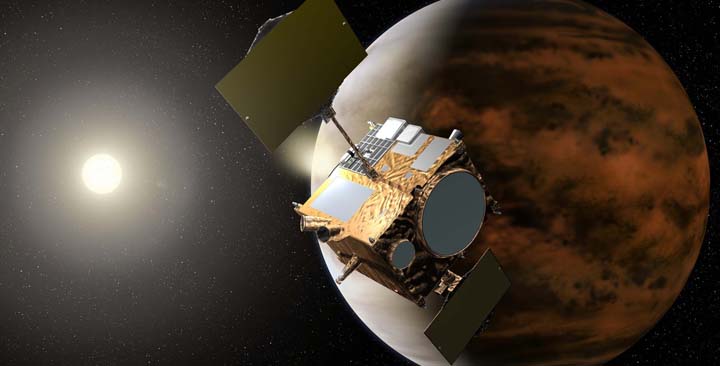
akatsuki_venus-failed-to-orbit
Image used with permission by copyright holder

The 1,000 Lb. probe attempted to enter orbit Monday by firing its main engine, but after struggling, it failed to latch onto the planet. Akatsuki was supposed to fire its engines at 6:49 p.m. EST Monday for about 12 minutes in an attempt to slow the probe down enough to be pulled into orbit by Venus’s gravity, but shortly after the spacecraft’s thrusters ignited it passed behind Venus, blocking communication for nearly 90 minutes, far longer than the 22 minutes of outage scientists expected. When communication was regained, they discovered it had not entered orbit.

Recommended Videos

The spacecraft has been rocketing toward Venus since its launch from the Tenegashima Space Center on May 20. The orbiting craft’s two year mission was to collect data on the planet’s atmosphere and runaway greenhouse effect. It also has sensors that can detect active volcanoes and hunt for lightning storms. Venus’s atmosphere is made up of carbon dioxide, clouds of sulfuric acid, and 225 mph winds. Because of the greenhouse effect of the CO2, the planet’s surface reaches temperatures of almost 900 degrees Fahrenheit. These are a few of the odd things about Venus Japanese scientists hoped to study.

“Although Venus is believed to have formed under similar conditions to Earth, it is a completely different world from our planet, with extremely high temperatures due to the greenhouse effect of carbon dioxide and a super-rotating atmosphere blanketed by thick clouds of sulfuric acid,” said Takeshi Imamura, Akatsuki’s project scientist (Spaceflight Now).

Akatsuki is Japan’s second failure to enter a planet’s orbit. In 1999 and 2003, the country’s Nozomi robotic orbiter missed its opportunities to enter orbit around Mars. Akatsuki will have one final chance at entering orbit when it is in position again in about six years.

Jeffrey Van Camp
As DT's Deputy Editor, Jeff helps oversee editorial operations at Digital Trends. Previously, he ran the site's…
This jacket pulls drinking water straight from the air
Engineers at UT Austin have developed a wearable textile that harvests ambient moisture into drinkable water.
Image showing person wearing a jacket with special fiber that pulls water from air

Engineers at the University of Texas at Austin have built a jacket that pulls drinkable water directly from the air, offering a potential solution for hikers, soldiers, agricultural workers, and emergency responders who operate far from reliable water sources.

How the jacket collects water

Read more
Google built an AI that can see football plays before they happen
DeepMind’s latest research predicts player movement up to eight seconds into the future
Google Deepmind TacticAI Featured

Football managers spend countless hours analyzing corners, free kicks, and player positioning in search of tiny competitive advantages. Google DeepMind believes artificial intelligence can make that process significantly faster, and its latest project, TacticAI, is designed to do exactly that. TacticAI is a football-specific AI assistant capable of modeling player movement, forecasting future play dynamics, and even recommending tactical adjustments for corner kicks. One of its standout abilities is predicting player trajectories up to eight seconds into the future using only broadcast-style visual data.

TacticAI was built with Liverpool FC and validated by football experts

Read more
Radical new coffee-making method uses sound, skips hot water and reduces energy bills
UNSW reserachers brewed espresso with room-temperature water and ultrasonic sound waves, cutting energy use by 75% in blind tests that fooled 100 regular drinkers.
Person brewing espresso in a lab with a modified ultrasonic espresso machine

Researchers at UNSW Sydney have figured out how to brew espresso-strength coffee without heating any water. The method replaces hot water and high pressure with ultrasonic sound waves, and in blind taste tests involving 100 regular coffee drinkers, participants could not tell the two apart.

How it works

Read more