
Like many folks, we were super excited about this week’s Falcon Heavy rocket static-fire engine test. Unfortunately, the demonstration of the SpaceX rocket which Elon Musk hopes will one day wing its way to Mars was cancelled at the eleventh hour due to logistical and safety concerns.
While no new date has yet been announced, you can entertain yourself in the meantime by feasting on some of these astonishing stats about Musk’s red planet rocket.
It’s the world’s most powerful operational rocket

Essentially three Falcon 9 rockets strapped together (a single Falcon 9 with two additional Falcon 9 first stages acting as boosters), the Falcon Heavy promises to bat aside the pesky confines of gravity like a giant swatting a fly.
SpaceX hails it as the “world’s most powerful rocket,” and that’s no exaggeration. In fact, it is the most powerful operational rocket in the world by a factor of two, boasting more than 5 million pounds of thrust. To put that figure in perspective, it’s the equivalent of eighteen 747 airplanes firing at once.
Its maiden flight will carry a fairly unusual payload

You know Elon Musk is deadly serious about the success of his Falcon Heavy maiden flight when he promises that its cargo will include his personal Tesla Roadster as a dummy payload.
As Musk wrote on Twitter, the first Falcon Heavy’s “payload will be my midnight cherry Tesla Roadster playing ‘Space Oddity.’ Destination is Mars orbit. Will be in deep space for a billion years or so if it doesn’t blow up on ascent.” We totally hope he’s not kidding. At any rate, it beats firing monkeys and dogs into space.
It can carry a whole lot more than just a Tesla Roadster

The Falcon Heavy’s 27 engines and three cores are capable of transporting more than 54 metric tons (119,000 lb), including passengers, luggage, crew and fuel.
That’s equivalent to a 737 jetliner and more than twice the payload of the next closest operational vehicle, the Delta IV Heavy. Only the Saturn V moon rocket, which was last flown in 1973, was able to deliver more payload to orbit.
It has taken longer than planned
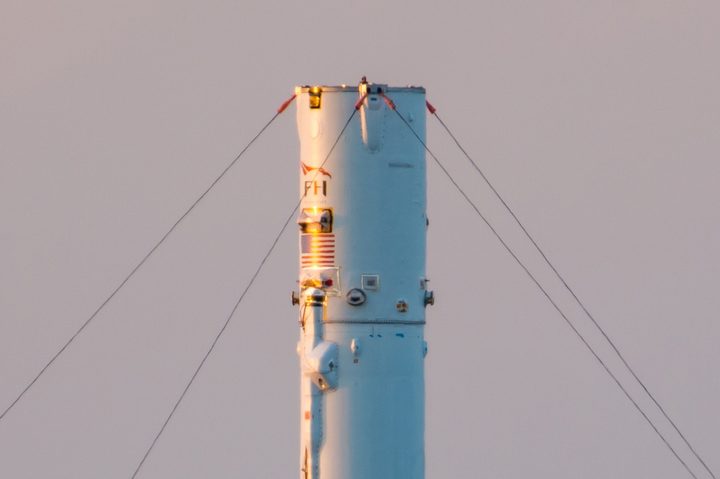
Even before its recent delay, the Falcon Heavy was running late. Announced in 2011, it was originally supposed to have its maiden voyage back in 2013 or 2014, only for that date to be pushed back.
In 2015, SpaceX said the first rocket launch would happen in early 2016. When no launch transpired, that date was pushed back to late 2016. Then, after one of SpaceX’s rockets exploded on a Florida launchpad in 2016, that date was put on hold until 2017. In the middle of the year, Musk tweeted that this would happen in November, before delaying it once more to January — and now beyond that as well.
“It actually ended up being way harder to do Falcon Heavy than we thought,” Musk said last year. “Really way, way more difficult than we originally thought. We were pretty naive about that.”
Given the scale of the undertaking, delays are no great surprise, of course. With a test fire planned for Jan. 22, early 2018 should see this eagerly anticipated launch finally happen — for real this time!
It is “competitively priced”

Everyone’s idea of affordable is a bit different, but SpaceX is confident that the Falcon Heavy offers “competitive pricing.” A fully kitted-out version will set you back $90 million on a standard payment plan.
Too rich for your blood? SpaceX will offer “modest discounts,” although you’ll probably need to buy a few rockets to secure this. Or arrive at the showroom in a brand new Tesla Model X.
It has impressive fuel economy (although not as good as Elon Musk wants)

Unlike the Tesla, Falcon Heavy needs actual honest-to-goodness fuel to power it, but at least it promises pretty good fuel economy. Not only does it (as mentioned) claim 2× the payload of the next closest operation vehicle, the Delta IV Heavy, but also that it will deliver this at just one-third the cost.
As of April 2016, the idea is that Falcon Heavy will be able to lift 2,268 kg to GTO (geostationary transfer orbit) for a cost of $3,968.25 per kilo. That’s more than 3.5× the $1,100 per kg that Musk stated was his ultimate goal with SpaceX when appearing before the U.S. Senate Committee on Commerce, Science and Transportation in May 2004.
Still, it’s an impressive step in the right direction — and the plan to have a recoverable upper stage should lead to a further reduction in cost for subsequent missions.
There’s something bigger coming down the track
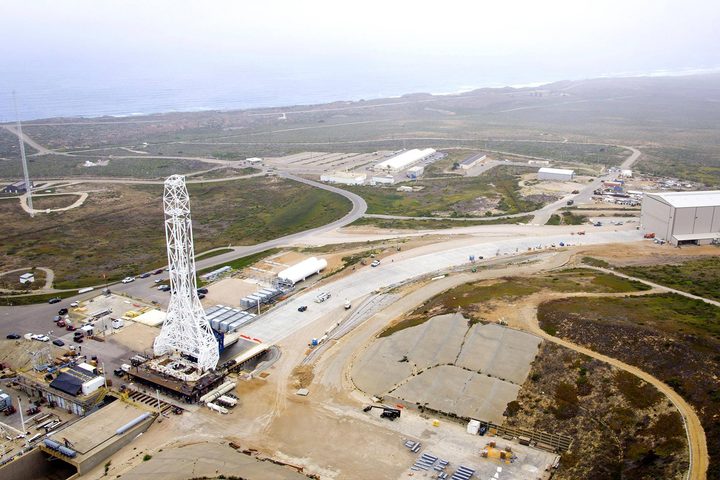
The Falcon Heavy was designed from day one with the mission of playing a key role in Musk’s dream of carrying humans to Mars. But it won’t be the final piece in the puzzle.
As Gwynne Shotwell, president and COO of SpaceX, told Ashlee Vance, author of Elon Musk: How The Billionaire CEO of SpaceX and Tesla is Shaping Our Future: “Our Falcon Heavy will not take a busload of people to Mars. So, there’s something after Heavy. We’re working on it.”
As has since been revealed, that “something” would be the Interplanetary Transport System, a.k.a. The Big F***ing Rocket.


