As people grow more concerned about the impacts of the meat industry both on the environment and the animals involved, fake meats have experienced a boom in popularity. Products like Beyond Burger and Impossible Pork, for example, have captured the attention of vegans and vegetarians across the globe for their astonishingly meat-like tastes and textures. But while ground meat substitutes have made big strides in recent years, plant based versions of more choice cuts aren’t yet on the menu. Whole cuts of meat are the next milestone for the fake meat business, and companies around the world are sprinting to replicate the most iconic cut of all: Steak.
And they’re doing it through 3D printing.
Steak: Nature’s meaty masterpiece
Even the tastiest ground beef arrives in your kitchen as a mass of reddish flesh pressed into plastic or wax paper. Next to that, a good steak is a Michelangelo fresco, with layers of muscle fiber and fat.
Those layers are what make replicating it a daunting task, but it’s a task 3D printing is suited for. A 3D printer builds objects by extruding material (usually plastic) through a nozzle, building layer upon layer. To 3D print a steak, companies do the same thing with edible ingredients.
What is missing is a variety, and to give you variety, you need to include fibrous meat, whole muscle cuts.”
“We think the future of meat, it’s going to go beyond burger, beyond ground meat analogs,” says Giuseppe Scionti, CEO of NovaMeat. “Going beyond burgers, beyond sausages and beyond even the ground meat from, you know, Impossible or Beyond meat. What is missing is a variety, and to give you variety, you need to include fibrous meat, whole muscle cuts.”
There are a few companies involved in the 3D printed steak business. In addition to NovaMeat, Redefine Meat and Savor Eat also make plant-based steaks, while a company called MeaTech is taking a cellular approach.
The plant-based approach
NovaMeat’s plant-based approach uses a process called “micro extrusion,” which Scionti says allows the company to make “microscopic fibers which replicate the fibers of the actual muscle of the animals.” The idea evolved out of Scitonti’s time working in biomedicine, where he developed tissues for the purpose of regenerating animal organs.
There are four pillars to making a good replica of a steak: Taste, texture, appearance, and nutrition. Although a lot of consumers might wonder first about the taste of a plant-based steak, for NovaMeat the primary goal has been texture and appearance. Scionti says that, after talking with top chefs and other people in the industry, it became clear that if they could make something that looked and felt like steak, flavor could be added later.
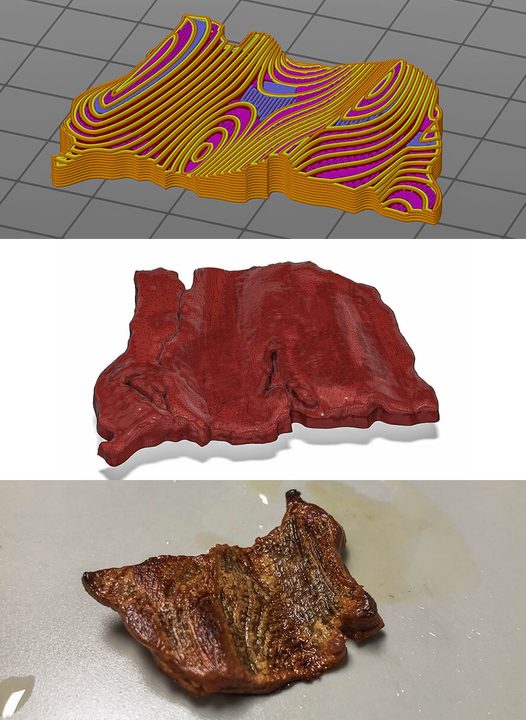
To the eye at least, NovaNeat’s latest design, dubbed Steak 2.0, is a stunning replica, with nuanced coloring and a fibrous texture.
Beyond improving the taste, the next step for NovaMeat is scaling up production. For 2021, Scionti wants to demonstrate production with a larger machine and then license the process to manufacturers who can print steaks at a massive scale. Scionti also mentions that there have been talks of developing the “Tesla Roadster of plant-based, whole muscle cuts” by providing top chefs in Barcelona with a smaller printer more suited to a restaurant kitchen.
Scionti also hopes to push the plant-based meat industry beyond soy and wheat gluten. “2020 is the year of biodiversity,” he says. “We have already demonstrated that we don’t use soy or wheat gluten, but we can use a variety of proteins: Peas, rice, hemp, etc. But I really would like to collaborate with other companies that are working in other countries where they add ingredients from their own countries.”
He imagines working with companies in India and Africa, for example, using protein crops specific to those regions. This would help the plant-based protein industry become less dependent on single crops like soy, encouraging biodiversity around the world.
NovaMeat is at the forefront of 3D printing meat, and Scionti thinks the company’s plant-based approach is “superior to cell-based meat … you don’t need bioreactors, you don’t need sterile conditions. You don’t need to wait for cells to grow, differentiate, proliferate.”
Scionti does add, however, that there is a lot of potential in a hybrid approach, adding cells to plant-based structures to achieve different functions.
The cellular approach
Cell-based (or “cultured) meat is another approach to the world’s meat problem, in which stem cells are harvested from an animal such as a cow. The cells are added to a cultured medium and directed to develop into tissue. An Israeli company called MeaTech is combining cultured meat with 3D printing in an attempt to make a truly lifelike, more animal-friendly steak.
The company uses cells extracted from umbilical cords, develops them in bioreactors, and then differentiates them into “cellular inks” for different structures like fat and muscle. These inks are then used to print the cut of meat.
While cultured meat offers the tantalizing promise of authentic meat without animal cruelty, it may not pan out. In a study published by Frontiers in Nutrition, Sghaier Chriki and Jean-Francoise Hocquette reviewed recent developments in the field, concluding that the technology is “Still in its infancy.”
“Unlike conventional meat, cultured muscle cells may be safer, without any adjacent digestive organs,” the researchers say. “On the other hand, with this high level of cell multiplication, some dysregulation is likely as happens in cancer cells. Likewise, the control of its nutritional composition is still unclear, especially for micronutrients and iron.”
The paper also notes that cell cultures require certain hormones and growth factors that run afoul of European Union regulations, and that currently “It is also almost impossible to reproduce the diversity of meats derived from various species, breeds and cuts.”
MeaTech is up-front about the fact that its steaks are far from appearing on any menus. In an interview with Haaretz, CEO Sharon Fima said “We’ve created tissue the thickness of paper, but in laboratory conditions, not by machine,” adding that the company expects to have a product on the market “in six to eight years. We know what needs to be done to make it happen, the big question is whether we will be able to lower the cost and grow meat in industrial-sized quantities.”
Get your forks ready
Still, regardless of the potentially long road ahead for cell-cultured steaks, the coming year looks to be a great one for fans of fake meat. NovaMeat is poised to bring its plant-based steak to fruition, and new approaches like MeaTech’s mean the industry could go any number of directions. Siconti also looks forward to advances in fermentation, as companies get better at using bacteria to develop alternative proteins.
So while the future of fake meat is far from set in stone, one thing is for certain: Vegans may want to invest in a set of steak knives.