1. Home
  2. Emerging Tech
  3. Cars
  4. News

Toyota shoots for the moon with its new lunar rover concept

Add as a preferred source on Google
Pressurized Rover Movie

Toyota announced it will be teaming up with the Japan Aerospace Exploration Agency (JAXA) to design and built a lunar rover. The two organizations aim to collaborate to create a manned, pressurized rover that would be suitable for mobility on the moon.

Recommended Videos

A big challenge in the design of such rovers is power consumption, as power must either be sent with the rover in the form of heavy fuel, or it must be collected from the lunar environment. The visualization released by Toyota shows a rover with an expandable solar panel for recharging using energy from the sun, and the announcement also made mention of “fuel cell vehicle technologies.”
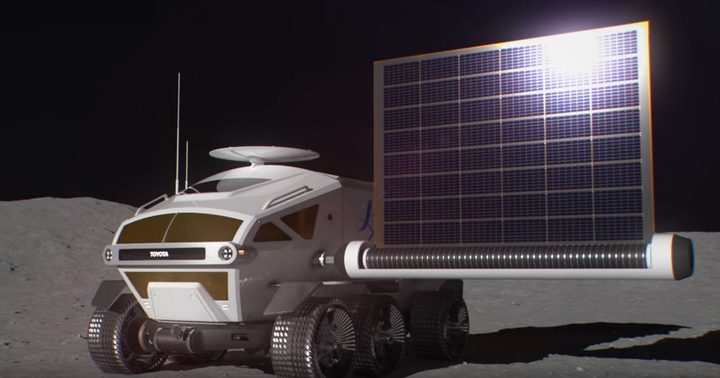
A visualization of the Toyota moon rover deploying its solar panel. Image used with permission by copyright holder

The use of efficient fuel cells would allow the rover to cruise more than 10,000 kilometers (6,200 miles) across the lunar surface, and the cells are a clean form of power generation which emit only water. The fuel cell technology ties in to Toyota’s ambition to achieve sustainable technologies for Earth-based vehicles as well: “Toyota believes that achieving a sustainable society of mobility on Earth will involve the coexistence and widespread use of electrified vehicles, such as hybrid vehicles, plug-in hybrid vehicles, electric vehicles, and fuel cell vehicles,” Toyota Executive Vice President Shigeki Terashi said in a statement. “For electrification, fuel cell batteries represent an indispensable technology.”

Another challenge faced by the designers of moon rovers is the inhospitable lunar environment, as JAXA Vice President Koichi Wakata commented in the same statement: “Lunar gravity is one-sixth of that on Earth. Meanwhile, the moon has a complex terrain with craters, cliffs, and hills. Moreover, it is exposed to radiation and temperature conditions that are much harsher than those on Earth, as well as an ultra-high vacuum environment. For wide-ranging human exploration of the moon, a pressurized rover that can travel more than 10,000 km in such environments is a necessity.”
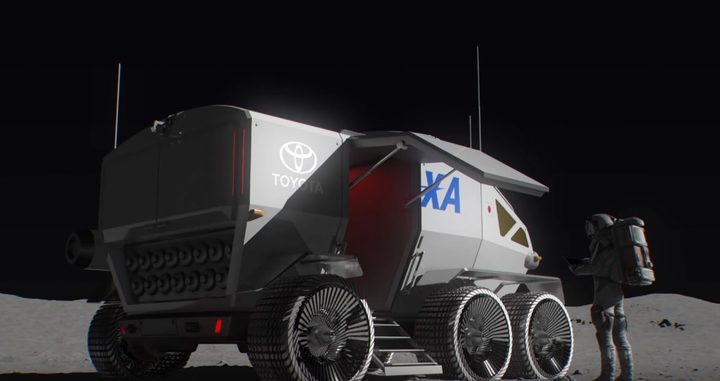
Remote controls would make the rover easy to operate for astronauts in suits with limited dexterity. Image used with permission by copyright holder

The specifications of the rover released so far indicate that it would be 6 meters (20 feet) in length and 5.2 meters (17 feet) wide, making it about twice the size of a Volkswagen camper van, and much bigger than Toyota’s Supra coupe. Inside will be a total of 13 square meters (140 square feet) of living space, which is fairly generous and is enough to accommodate two people comfortably or four in an emergency. The aim is to launch the rover into space in 2029.

Georgina Torbet
Georgina has been the space writer at Digital Trends space writer for six years, covering human space exploration, planetary…
The FBI secretly built an entire fake town just to practice cyberattacks
Hidden inside a warehouse in Alabama, the Kinetic Cyber Range recreates real-world digital attacks from start to finish.
FBI Kinetic Cyber Range Featured

While Hollywood has fake cities for filming movies, the FBI apparently has one for getting hacked. The agency has pulled back the curtain on its Kinetic Cyber Range, a 22,000-square-foot replica small town hidden inside its Huntsville, Alabama campus. But instead of training officers for shootouts or hostage rescues, the facility is designed to simulate realistic cyberattacks on homes, businesses, and critical infrastructure so investigators can practice responding to them in a controlled environment.

The FBI built an entire town just to simulate cybercrime

Read more
Brazil’s secret World Cup weapon taught the team when to ignore it
The data said he wasn't running enough. The footage said he was always in the “perfect tactical position.”
Soccer ball in net

Brazil has more World Cup titles than anyone, five of them to be precise, but after going through five straight tournaments without adding to that count, the team is leaning hard on data this time. 

Every player wears a sensor-packed "smart vest" tracking field position (via GPS), heart rate, and a stat called "player load," the same kind of numbers that your Whoop band or Apple Watch brags about, but tuned specifically for the sport.

Read more
New OLED breakthrough could make the next see-through screen actually worth using
The electrode fix that could finally make see-through screens worth looking at.
Computer Hardware, Electronics, Hardware

Every transparent OLED demo I’ve seen so far looks amazing for about ten seconds, right before I notice how dim or smudgy it actually looks. A big part of the problem is the role that electrodes play in the design. 

A transparent display requires a see-through electrode that sits on top of incredibly delicate organic light-emitting layers. However, most of the usual options either conduct electricity poorly or risk damaging those layers during manufacturing. 

Read more