
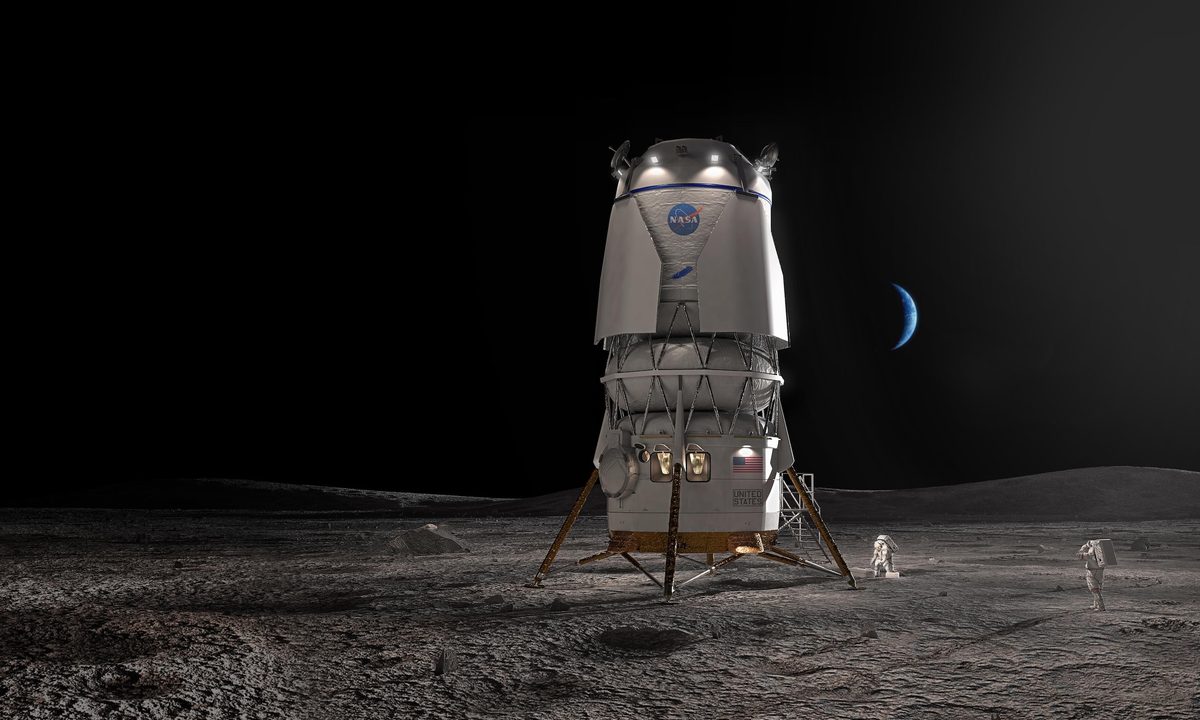
Acting NASA chief Sean Duffy surprised many people earlier this week when he said the space agency was intending to reopen the contracts for the Artemis III lunar lander that will return astronauts to the moon for the first time in five decades.
The target date for the ambitious mission has slipped many times over the years, and NASA is currently eyeing 2027 for launch.
But the SpaceX Starship spacecraft that NASA is hoping to use to transfer the astronauts from lunar orbit to the surface of the moon is still under development and so may not be ready in time.
“The problem is, they’re behind,” Duffy said in a TV interview on Monday. “They’ve pushed their timelines out, and we’re in a race against China.”
The NASA boss added that “the president and I want to get to the moon in this president’s term, so I’m going to open up the contract. I’m going to let other space companies compete with SpaceX, like Blue Origin.”
Blue Moon
While SpaceX powerful Starship rocket tends to get all the headlines with its 11 test flights to date, Blue Origin has been quietly working on its Blue Moon lunar lander.
The Blue Moon actually comprises two separate landers — Mark 1 for cargo, and Mark 2 for astronauts.
The uncrewed Mark 1 lander can deliver up to 3 metric tons of payload to the lunar surface and could one day be used to deliver infrastructure for a moon base where astronauts would live and work for extended periods.
The lander is equipped with LIDAR technology that allows precise autonomous landing within 23 meters of a pre-planned spot by scanning the lunar surface to avoid hazards.
The Blue Moon vehicle can also release microsatellites into lunar orbit and deploy other equipment such as moon rovers from its top deck, making it useful for a range of missions.
The Blue Moon Mark 2, on the other hand, is designed to land four astronauts on the moon in missions lasting up to 30 days. The lander works with a Lockheed Martin-built Cislunar Transporter for lunar orbit rendezvous and refueling.
The Cislunar Transporter will launch in two parts — a tug and a tanker — on a Blue Origin New Glenn rocket. The two parts will come together and refuel in low-Earth orbit before traveling to lunar orbit. There it’ll refuel the Blue Moon Mark 2 lander, giving it enough propellant to descend to the lunar surface with the crew and also to bring them back.
As things stand, NASA has selected the Blue Moon Mark 2 to provide a crewed landing system for the Artemis V mission, which has an estimated launch date of 2030.
But with Blue Origin yet to test the Blue Moon and Cislunar Transporter, and having only flown the New Glenn heavy-lift rocket once up to now, it would do well to beat SpaceX in having the hardware ready in time.
Duffy’s comments on Monday appear to suggest that everything is up for grabs, and it could just be that his words focus minds at SpaceX and push the engineers to double their efforts to prepare the Starship for prime time.
SpaceX chief Elon Musk, for one, is adamant that SpaceX will return NASA astronauts to the moon.
“Starship will end up doing the whole moon mission. Mark my words,” he posted on social media on Monday in response to Duffy’s comments.


