1. Home
  2. Space
  3. Emerging Tech
  4. News

ExoMars mission delay means no launch until at least 2022

Add as a preferred source on Google
 

The ExoMars rover mission has been delayed until 2022, ending hopes of a launch this summer.

Recommended Videos

The European Space Agency (ESA) and Russia’s Roscosmos space agency said in a message posted on Thursday, March 12, that it needs more time to complete all of the necessary tests on its spacecraft and related equipment. For example, it wants to perform additional testing on the all-important parachutes designed to slow the descent of the rover as it enters Mars’ atmosphere at speeds of up to 13,000 mph. Several other issues with hardware and software also need to be resolved.

Unsurprisingly, the coronavirus is also impacting preparations “because people from different places of industry in Russia, in Italy, and France cannot move easily as in the past,” ESA director general Jan Wörner told reporters this week.

This is the second major delay in the project’s lifetime after the originally planned 2018 launch date slipped to 2020 due to various issues.

Similar to NASA’s upcoming Mars 2020 mission, the ExoMars mission goals include finding out if life of some form or another ever existed on Mars, and to better understand the history of water on the Red Planet. The ExoMars rover (below) — named Rosalind Franklin after the pioneering DNA scientist — includes a miniature life-search laboratory and a drill to access the subsurface of Mars.

A revised timeline (below) from ESA and Roscosmos shows a planned launch window from August through October 2022, with the rover arriving on the Martian surface between April and July 2023.
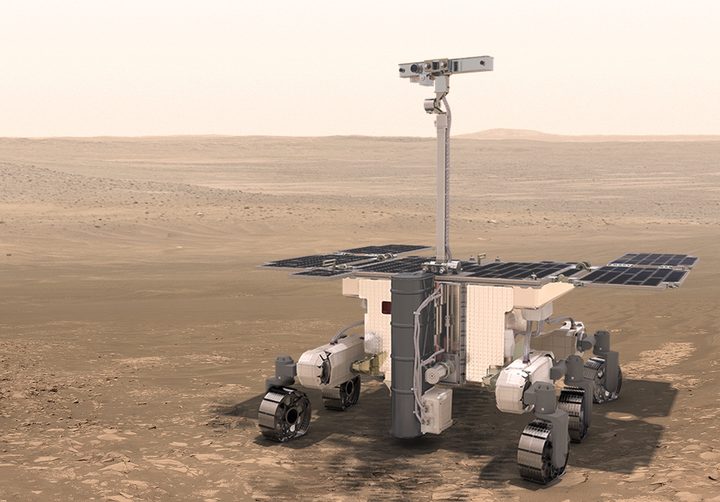
ExoMars Rosalind Franklin rover
The ExoMars Rosalind Franklin rover. ESA/Roscosmos

Roscosmos director general Dmitry Rogozin said in a statement that the decision to postpone the mission by two years was “difficult but well-weighed,” while Wörner commented: “We want to make ourselves 100% sure of a successful mission. We cannot allow ourselves any margin of error. More verification activities will ensure a safe trip and the best scientific results on Mars.”

Counterparts from across the pond expressed understanding, with NASA associate administrator Thomas Zurbuchen, for one, calling it a “tough decision” considering the complex challenges presented by such a mission, adding that the team was “inspiring everyone to do hard things.”

When it finally reaches Mars, the rover will join the ExoMars Trace Gas Orbiter (TGO), which has been performing scientific research since entering Mars’ orbit in October 2016, and which will also function as a communication link for the ExoMars rover when it finally arrives. It’s perhaps worth noting that the TGO mission’s Schiaparelli lander crashed on the Martian surface after a sensor malfunction during descent in 2016, an incident that is no doubt at the forefront of the minds of the current ESA/Roscosmos team.

Trevor Mogg
Contributing Editor
Not so many moons ago, Trevor moved from one tea-loving island nation that drives on the left (Britain) to another (Japan)…
Astronauts reportedly took shelter after work on Russia’s leaky ISS module triggered concerns
The ISS really picked a stressful time to start leaking again
The International Space Station.

Astronauts aboard the International Space Station reportedly took precautionary shelter measures after maintenance work on a long-troubled Russian module raised fresh safety concerns about air leaks aboard the orbiting laboratory.

According to reports, the incident involved Russia’s Zvezda service module, which has experienced recurring air leak problems for several years. During repair work and pressure tests connected to the leak investigation, astronauts were instructed to isolate themselves in safer sections of the ISS as engineers monitored the station’s integrity and pressure stability.

Read more
Blue Origin’s massive New Glenn rocket explodes in a fiery blaze during tests
The incident leaves NASA's Moon Base ambitions and Amazon's Kuiper constellation without their primary launch vehicle at the worst possible moment.
Explosion, Fire, Nuclear Explosion

Blue Origin's New Glenn rocket exploded during a static fire test at Launch Complex 36 in Cape Canaveral, Florida. The incident took place on the night of May 28, 2026. 

The explosion was captured on a live stream by NASASpaceflight.com and footage of the explosion spread rapidly across X. The Space Launch Complex 45 has confirmed in an official statement (shared by Spaceflight Now on X) that all personnel have been accounted for and there have been no injuries or fatalities.

Read more
Orbot Robotics’ space robot has four arms, but its Goro physique has a purpose
This four-armed robot could make routine space-station work easier for astronauts
Robot with four arms

Helios is a new four-armed robot from Zurich-based Orbit Robotics, and at first glance, it reminded me of Goro from Mortal Kombat. But unlike the prince from Outworld, Helios is not built for combat. It is designed to help astronauts on space stations with the repetitive, time-consuming work that keeps life in space running.

Orbit Robotics says that in microgravity, legs are not much help. Instead of walking or standing, Helios needs to move through tight station interiors, hold itself steady, and handle cargo, tools, or equipment. Its four-arm design turns extra limbs into both mobility aids and working hands.

Read more