  1. Home
  2. Space
  3. News

See the mighty James Webb Space Telescope being unboxed in a cleanroom

Add as a preferred source on Google

The largest space telescope in the world, the James Webb Space Telescope, will soon be launching to study the wonders of the cosmos and to hunt for habitable exoplanets. But before it can be launched there’s a whole lot of preparation required, and a new video from the European Space Agency (ESA) shows the telescope being unboxed from its shipping container.


Last month, James Webb was packed up in California and shipped through the Panama Canal to French Guiana in South America, from where it will be launched next month. But it’s no simple matter to pack up a delicate telescope this large, so it had to be carefully folded away into a specially built case to keep it safe on its journey.
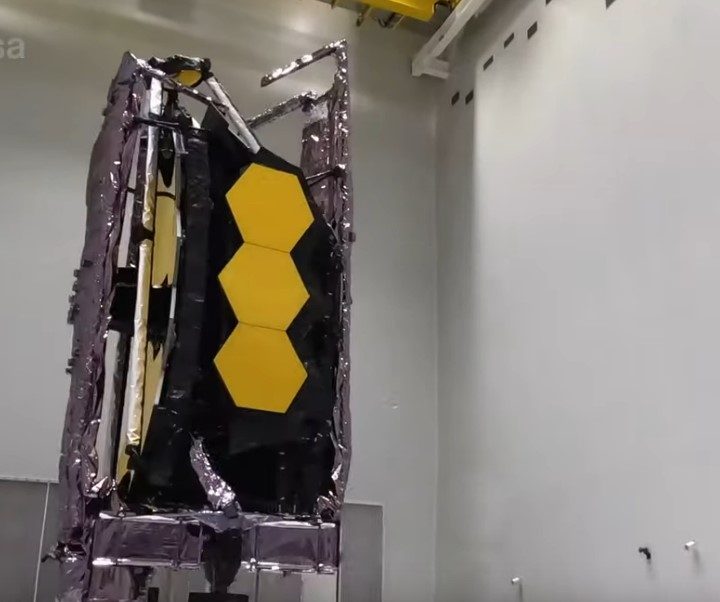
The James Webb Space Telescope is unboxed in the cleanroom at Europe’s Spaceport in French Guiana.
The James Webb Space Telescope is unboxed in the cleanroom at Europe’s Spaceport in French Guiana. ESA/CNES/Arianespace/NASA's Goddard Space Flight Center

“After its arrival at Pariacabo harbor in French Guiana on 12 October 2021, the James Webb Space Telescope was transported to Europe’s Spaceport and unboxed in the cleanroom. It is now being prepared for its launch on an Ariane 5 rocket in December,” the European Space Agency (ESA) writes.

Recommended Videos

“Though the telescope weighs only six tonnes, it is more than 10.5 meters high and almost 4.5 meters wide when folded. It was shipped in its folded position in a 30 m long container which, with auxiliary equipment, weighed more than 70 tonnes.”

Having arrived safely at its destination on a heavy-load tractor, the telescope then had to be unpacked in the cleanroom at Europe’s Spaceport.

A cleanroom is a carefully controlled environment that keeps out dust and grime, to avoid contaminating any part of the telescope. To enter the cleanroom, engineers have to go through a series of lobbies to remove any loose particles from their shoes and hair and skin, and don sterile overclothes affectionately called “bunny suits.” All of this is to ensure that no speck of dust is left on the telescope which could impede its functioning once it is launched.

Within the cleanroom, the outer casing is removed and the telescope is carefully hoisted out and fully unpacked. It is placed onto a mechanism called a rollover fixture, which allows the telescope to be raised onto its end and stand vertical, in the same position it will be loaded into the rocket for its launch on December 18.

Georgina Torbet
Georgina has been the space writer at Digital Trends space writer for six years, covering human space exploration, planetary…
Scientists have found a hidden galaxy inside the Milky Way, and they’re calling it Loki
A lost dwarf galaxy may be hiding inside the Milky Way.
milky-way-hidden-galaxy-loki

Our home galaxy has a secret buried inside. A new study published in the Monthly Notices of the Royal Astronomical Society suggests that the Milky Way swallowed an ancient dwarf galaxy billions of years ago, and its stellar remains are still embedded within ours.

Researchers have named this lost galaxy Loki, after the Norse trickster god, and the name is quite fitting because it remained hidden in plain sight for a very long time.

Read more
NASA aims September launch for Roman space telescope and it’s going to be a huge shift
An earlier target for Roman means one of NASA’s most ambitious observatories is getting close, with the potential to open a huge new era in space discovery
Machine, Wheel, Astronomy

NASA is now aiming to launch the Nancy Grace Roman Space Telescope as soon as early September 2026, a faster timeline than its earlier commitment to fly no later than May 2027. That alone makes this one of the agency’s most important missions to watch over the next few months.

The reason is simple, Roman is built to scan vast parts of the sky with sharp infrared vision.

Read more
Blue Origin successfully re-uses a New Glenn rocket for the first time ever
Blue Origin achieves first New Glenn reflight despite payload setback
Blue Origin

Blue Origin has achieved a major milestone in its spaceflight ambitions by successfully reusing a booster from its heavy-lift New Glenn rocket for the first time. The historic launch, conducted on April 19, marks a significant step forward for Jeff Bezos’ space company as it seeks to compete with rivals like SpaceX in the rapidly evolving commercial launch market.

A Milestone With A Mixed Outcome

Read more