  1. Home
  2. Space
  3. News

Juno spacecraft peers into the strange atmosphere of Jupiter

Add as a preferred source on Google
Cyclones at Jupiter's South Pole

Jupiter may be renowned as our solar system’s most beautiful planet, but there are still plenty of things we don’t understand about what makes this stunning place tick. One long-standing mystery is about the temperature of its atmosphere, which turns out to be much denser and hotter than was expected in certain places.

Recommended Videos

Now, data from NASA’s Juno probe has been used to uncover more information about how atmospheric hot spots spread and interact with the rest of the atmosphere.

“Giant planets have deep atmospheres without a solid or liquid base like Earth,” explained Scott Bolton, principal investigator of Juno at the Southwest Research Institute in San Antonio, in a statement. “To better understand what is happening deep into one of these worlds, you need to look below the cloud layer. Juno, which recently completed its 29th close-up science pass of Jupiter, does just that. The spacecraft’s observations are shedding light on old mysteries and posing new questions — not only about Jupiter, but about all gas giant worlds.”

The data suggests that there are hot spot regions in the atmosphere, but that these are not small, isolated pockets as previously thought. Instead, they are “windows” peeking into large swaths of the atmosphere that are hotter and drier than other areas, like one such dry area which seems to cover the entire northern equatorial belt of the planet. These spots are associated with breaks in the clouds which allow researchers to peer into the deeper layers of the atmosphere below.
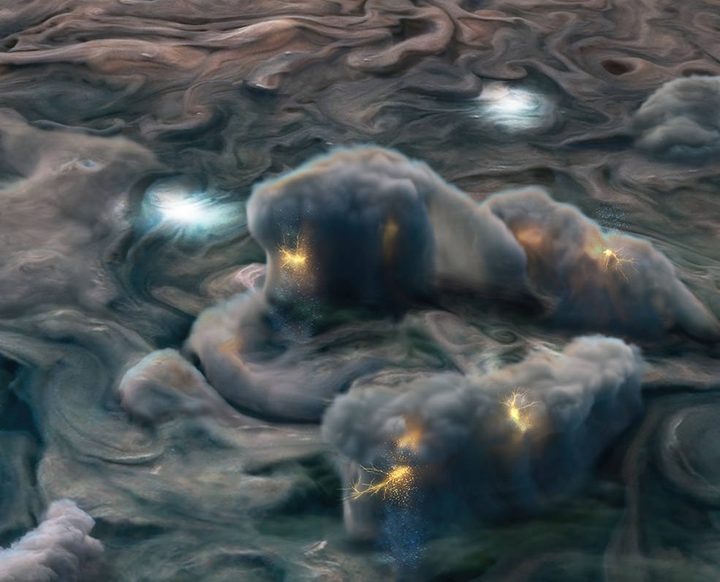
This illustration uses data obtained by NASA's Juno mission to depict high-altitude electrical storms on Jupiter
This illustration uses data obtained by NASA’s Juno mission to depict high-altitude electrical storms on Jupiter. Juno’s sensitive Stellar Reference Unit camera detected unusual lightning flashes on Jupiter’s dark side during the spacecraft’s close flybys of the planet. NASA/JPL-Caltech/SwRI/MSSS/Gerald Eichstädt/Heidi N. Becker/Koji Kuramura

It is also these hot regions that may power the exotic lightning and slushy mushballs found in Jupiter’s atmosphere.

“High up in the atmosphere, where shallow lightning is seen, water and ammonia are combined and become invisible to Juno’s microwave instrument. This is where a special kind of hailstone that we call ‘mushballs’ are forming,” said Tristan Guillot, a Juno co-investigator at the Université Côte d’Azur in Nice, France, in the statement. “These mushballs get heavy and fall deep into the atmosphere, creating a large region that is depleted of both ammonia and water. Once the mushballs melt and evaporate, the ammonia and water change back to a gaseous state and are visible to Juno again.”

The Juno mission will continue to orbit Jupiter for a planned 37 orbits of the planet, collecting more data as it goes. It can help peel back the layers of this extraordinary place to learn more about its complex atmosphere and what lies beneath.

Georgina Torbet
Georgina has been the space writer at Digital Trends space writer for six years, covering human space exploration, planetary…
Scientists have found a hidden galaxy inside the Milky Way, and they’re calling it Loki
A lost dwarf galaxy may be hiding inside the Milky Way.
milky-way-hidden-galaxy-loki

Our home galaxy has a secret buried inside. A new study published in the Monthly Notices of the Royal Astronomical Society suggests that the Milky Way swallowed an ancient dwarf galaxy billions of years ago, and its stellar remains are still embedded within ours.

Researchers have named this lost galaxy Loki, after the Norse trickster god, and the name is quite fitting because it remained hidden in plain sight for a very long time.

Read more
NASA aims September launch for Roman space telescope and it’s going to be a huge shift
An earlier target for Roman means one of NASA’s most ambitious observatories is getting close, with the potential to open a huge new era in space discovery
Machine, Wheel, Astronomy

NASA is now aiming to launch the Nancy Grace Roman Space Telescope as soon as early September 2026, a faster timeline than its earlier commitment to fly no later than May 2027. That alone makes this one of the agency’s most important missions to watch over the next few months.

The reason is simple, Roman is built to scan vast parts of the sky with sharp infrared vision.

Read more
Blue Origin successfully re-uses a New Glenn rocket for the first time ever
Blue Origin achieves first New Glenn reflight despite payload setback
Blue Origin

Blue Origin has achieved a major milestone in its spaceflight ambitions by successfully reusing a booster from its heavy-lift New Glenn rocket for the first time. The historic launch, conducted on April 19, marks a significant step forward for Jeff Bezos’ space company as it seeks to compete with rivals like SpaceX in the rapidly evolving commercial launch market.

A Milestone With A Mixed Outcome

Read more