  1. Home
  2. Space
  3. News

NASA’s massive James Webb telescope is folded down to launch size for first time

Add as a preferred source on Google
Folding the James Webb Space Telescope to Fit Inside the Ariane V Rocket Fairing

NASA’S James Webb Space Telescope has achieved a milestone in preparations for its upcoming launch, despite work on the project being limited due to the coronavirus pandemic. The entire telescope has been folded down and stowed into the configuration that will be used for its launch, currently scheduled for next year.

Recommended Videos

The telescope includes a massive origami mirror which folds out to be 6.5 meters (over 21 feet) across, but has to fold down small enough to fit inside a rocket payload fairing so it can be launched into orbit. It also has a tennis court-sized sunshield that needs to be folded and stowed to fit in the limited space in the fairing.
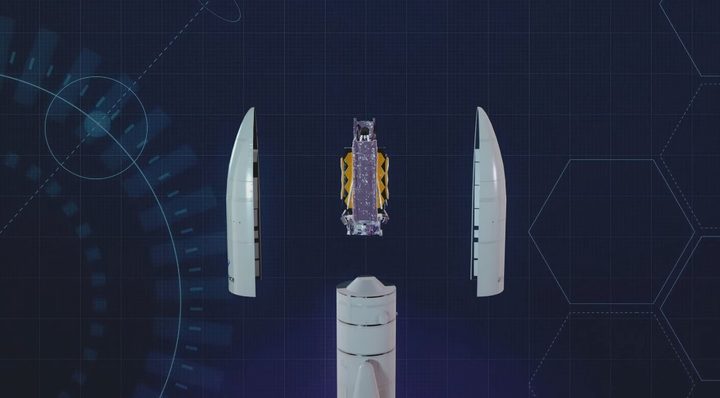
Visualization of the James Webb Space Telescope folding up to be stowed inside an Ariane V rocket. NASA

With such large and delicate components needing to be stowed, getting them to fold down correctly is a big step in preparing the telescope for its eventual launch.

“The James Webb Space Telescope achieved another significant milestone with the entire observatory in its launch configuration for the first time, in preparation for environmental testing,” Bill Ochs, Webb project manager for NASA Goddard Space Flight Center, said in a statement.

“I am very proud of the entire Northrop Grumman and NASA integration and test team. This accomplishment demonstrates the outstanding dedication and diligence of the team in such trying times due to COVID-19.”
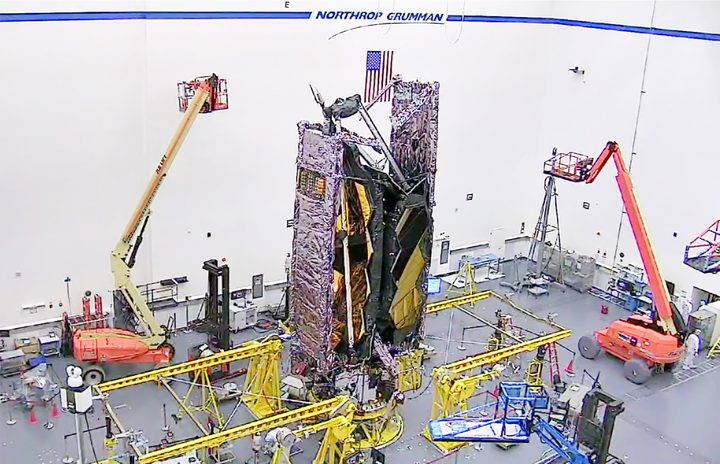
first look at NASA's James Webb Space Telescope fully stowed
A first look at NASA’s James Webb Space Telescope fully stowed into the same configuration it will have when loaded into an Ariane V rocket for launch. The image was taken from a webcam in the clean room at Northrop Grumman, in Redondo Beach, California. With staffing restrictions in place due to COVID-19, only essential staff are allowed in the clean room. Northrop Grumman

With the global pandemic of the coronavirus, NASA employees are working from home and many projects have had to be suspended, including the announcement that integration and testing operations on the James Webb would be suspended. But NASA says that progress is still being made on the telescope, albeit with a reduced team.

“While operating under augmented personal safety measures because of the novel coronavirus (COVID-19), the project continues to make good progress and achieve significant milestones in preparation for upcoming environmental testing,” Gregory L. Robinson, the Webb program director at NASA Headquarters said in the statement.

“Team member safety continues to be our highest priority as the project takes precautions to protect Webb’s hardware and continue with integration and testing. NASA will continually assess the project’s schedule and adjust decisions as the situation evolves.”

Georgina Torbet
Georgina has been the space writer at Digital Trends space writer for six years, covering human space exploration, planetary…
Blue Origin successfully re-uses a New Glenn rocket for the first time ever
Blue Origin achieves first New Glenn reflight despite payload setback
Blue Origin

Blue Origin has achieved a major milestone in its spaceflight ambitions by successfully reusing a booster from its heavy-lift New Glenn rocket for the first time. The historic launch, conducted on April 19, marks a significant step forward for Jeff Bezos’ space company as it seeks to compete with rivals like SpaceX in the rapidly evolving commercial launch market.

A Milestone With A Mixed Outcome

Read more
Stunning close-up footage shows NASA’s moon rocket roaring to space
On its first crewed flight, NASA's lunar rocket displays its awesome power.
NASA's SLS rocket roars skyward at the start of the Artemis II mission on April 1, 2026.

As NASA’s Artemis II astronauts journey back to Earth following their breathtaking close encounter with the moon earlier this week, the space agency has just shared some stunning footage (below) of the rocket launch that sent the crew on its way on April 1.

The close-up tracking shot shows the awesome power of the Space Launch System (SLS) rocket’s four core RS-25 engines together and its two solid rocket boosters as the 98-meter-tall vehicle roars away from the launchpad at the Kennedy Space Center in Florida.

Read more
How to watch NASA’s moon crew splash down at end of historic mission
The Orion spacecraft's final moments before splashdown will be the most perilous of the entire mission.
Earth and the moon as seen from the Orion spacecraft during the Artemis II mission in April 2026.

The Artemis II astronauts have looped around the moon, captured some extraordinary imagery (above), set a slew of records, and are now on their way back to Earth.

The 10-day mission will reach its climax on Friday, April 10, during a dramatic homecoming that will see the Orion spacecraft enter our planet’s atmosphere at a speed of nearly 25,000 miles per hour.

Read more