  1. Home
  2. Space
  3. News

NASA renames planet-finding telescope after woman trailblazer

Add as a preferred source on Google

NASA has renamed the Wide Field Infrared Survey Telescope mission after one of the agency’s trailblazing women. 

The Nancy Grace Roman Space Telescope — which will search for planets outside our solar system — is named after the first chief of astronomy in NASA’s Office of Space Science, She was also the first woman to hold an executive position at NASA.

Recommended Videos

Roman worked at NASA for 21 years and helped to plan the Hubble telescope, including establishing the Hubble program’s structure. She is known as “the mother of Hubble” because of her advocacy and extensive work with the telescope. 

“She believed she could be an astronomer during a time when there were so many barriers for women in science,” said Elisa Quintana, an astrophysicist at NASA, during a NASA livestream announcing the telescope’s new name. “She believed in investing in missions that would be useful for future generations.”

Roman began working at NASA in 1959. She died in 2018.
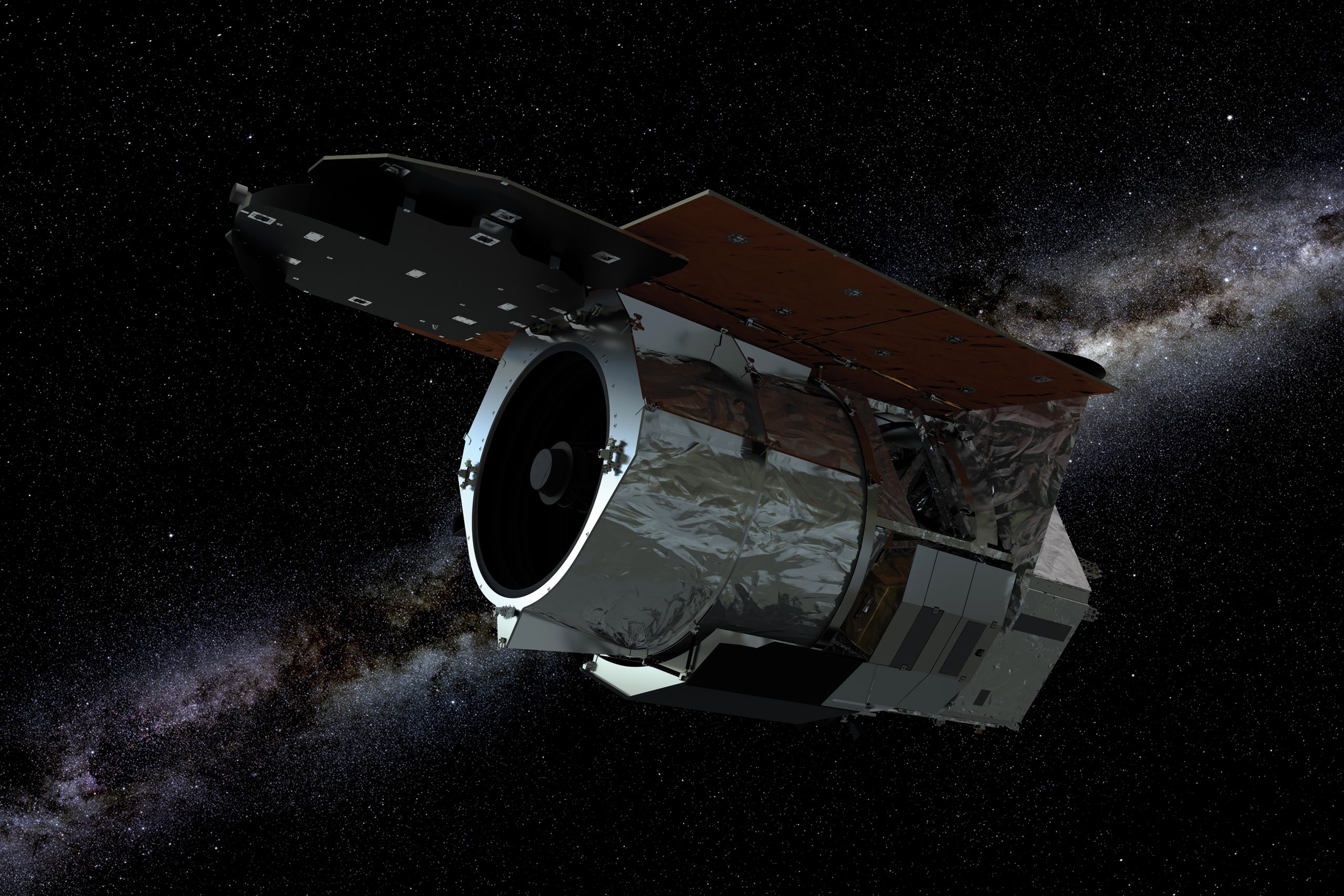
Artist’s illustration of the WFIRST spacecraft.
Artist’s illustration of the Nancy Grace Roman Space Telescope. NASA’s Goddard Space Flight Center

The Nancy Grace Roman Space Telescope will launch in the mid-2020s to help astronomers try to understand dark energy, which makes up about two-thirds of the entire universe but is a mystery to astronomers. 

The telescope will also search for exoplanets by measuring light from a billion galaxies throughout the mission’s lifetime. It has the technology to capture a sky area over 100 times larger than the Hubble telescope, which will allow it to discover more exoplanets than we ever have before.

This tool could be used to identify not only small, distant planets, but also other cosmic bodies like brown dwarfs and black holes.

The Nancy Grace Roman Telescope joins other space telescopes and instruments named after women, including the Vera C. Rubin Observatory, the Annie Maunder Astrographic Telescope, and the Scope telescope named after Henrietta Scope. NASA’s GRAIL lunar impact site is named after Sally Ride, America’s first woman in space. 

NASA plans to send the first woman to the moon by 2024 as part of its Artemis mission. 

Allison Matyus
Former Digital Trends Contributor
Allison Matyus is a general news reporter at Digital Trends. She covers any and all tech news, including issues around social…
Blue Origin successfully re-uses a New Glenn rocket for the first time ever
Blue Origin achieves first New Glenn reflight despite payload setback
Blue Origin

Blue Origin has achieved a major milestone in its spaceflight ambitions by successfully reusing a booster from its heavy-lift New Glenn rocket for the first time. The historic launch, conducted on April 19, marks a significant step forward for Jeff Bezos’ space company as it seeks to compete with rivals like SpaceX in the rapidly evolving commercial launch market.

A Milestone With A Mixed Outcome

Read more
Stunning close-up footage shows NASA’s moon rocket roaring to space
On its first crewed flight, NASA's lunar rocket displays its awesome power.
NASA's SLS rocket roars skyward at the start of the Artemis II mission on April 1, 2026.

As NASA’s Artemis II astronauts journey back to Earth following their breathtaking close encounter with the moon earlier this week, the space agency has just shared some stunning footage (below) of the rocket launch that sent the crew on its way on April 1.

The close-up tracking shot shows the awesome power of the Space Launch System (SLS) rocket’s four core RS-25 engines together and its two solid rocket boosters as the 98-meter-tall vehicle roars away from the launchpad at the Kennedy Space Center in Florida.

Read more
How to watch NASA’s moon crew splash down at end of historic mission
The Orion spacecraft's final moments before splashdown will be the most perilous of the entire mission.
Earth and the moon as seen from the Orion spacecraft during the Artemis II mission in April 2026.

The Artemis II astronauts have looped around the moon, captured some extraordinary imagery (above), set a slew of records, and are now on their way back to Earth.

The 10-day mission will reach its climax on Friday, April 10, during a dramatic homecoming that will see the Orion spacecraft enter our planet’s atmosphere at a speed of nearly 25,000 miles per hour.

Read more