  1. Home
  2. Space
  3. News

NASA will survey the entire sky with its SPHEREx observatory

Add as a preferred source on Google

NASA is ramping up plans for a new sky survey tool that could help unravel some of the biggest mysteries about the origin of the universe.

Exploring Cosmic Origins with NASA’s SPHEREx

The mission, called SPHEREx or Spectro-Photometer for the History of the Universe, Epoch of Reionization and Ices Explorer, is set to launch by April 2025 and will investigate big questions in cosmology, such as what happened in the first few seconds after the Big Bang and how the universe developed and evolved. To investigate these issues, the mission is different from telescopes like Hubble which look at individual stars or galaxies. Instead, SPHEREx is a type of mission called a survey telescope, which looks at the entire sky. That enables it to see information about the universe on a large scale.
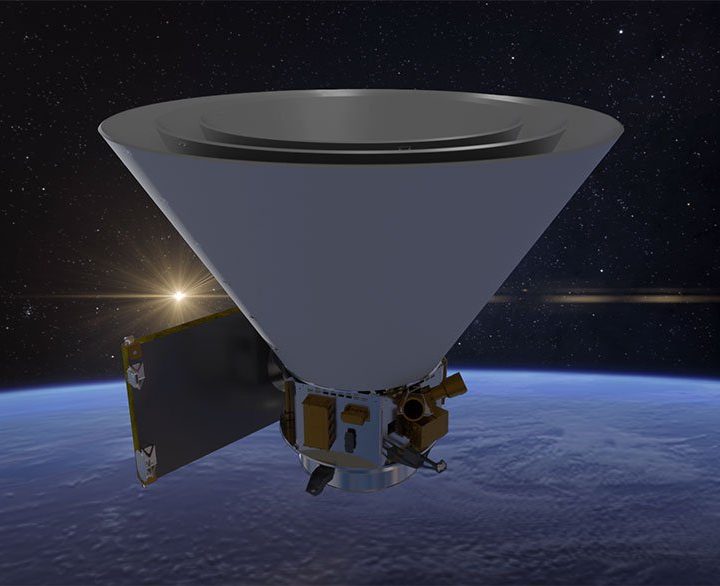
Illustration of NASA’s SPHEREx spacecraft.
Illustration of NASA’s SPHEREx spacecraft. NASA/JPL-Caltech

“It’s the difference between getting to know a few individual people, and doing a census and learning about the population as a whole,” said Beth Fabinsky, deputy project manager for SPHEREx at NASA’s Jet Propulsion Laboratory (JPL), in a statement. “Both types of studies are important, and they complement each other. But there are some questions that can only be answered through that census.”

Recommended Videos

SPHEREx uses different hardware from telescopes like Hubble and James Webb as well. Instead of having a very large mirror that can focus on very distant objects, it will have a primary mirror just 8 inches across. But it will be able to scan 99% of the sky every six months, which is far faster than these other telescopes. Like Webb, SPHEREx will look in the infrared wavelength and will use an instrument called a spectrometer which breaks down light to see what distant objects are composed of.

With the concept for the mission pinned down, now the team is working on getting the hardware ready for space. “We’re at the transition from doing things with computer models to doing things with real hardware,” said Allen Farrington, SPHEREx project manager at JPL. “The design for the spacecraft, as it stands, is confirmed. We have shown that it’s doable down to the smallest details. So now we can really start building and putting things together.”

The mission has faced delays due to covid, but the aim is to launch SPHEREx into low-Earth orbit by 2025 at the latest.

Georgina Torbet
Georgina has been the space writer at Digital Trends space writer for six years, covering human space exploration, planetary…
Scientists have found a hidden galaxy inside the Milky Way, and they’re calling it Loki
A lost dwarf galaxy may be hiding inside the Milky Way.
milky-way-hidden-galaxy-loki

Our home galaxy has a secret buried inside. A new study published in the Monthly Notices of the Royal Astronomical Society suggests that the Milky Way swallowed an ancient dwarf galaxy billions of years ago, and its stellar remains are still embedded within ours.

Researchers have named this lost galaxy Loki, after the Norse trickster god, and the name is quite fitting because it remained hidden in plain sight for a very long time.

Read more
NASA aims September launch for Roman space telescope and it’s going to be a huge shift
An earlier target for Roman means one of NASA’s most ambitious observatories is getting close, with the potential to open a huge new era in space discovery
Machine, Wheel, Astronomy

NASA is now aiming to launch the Nancy Grace Roman Space Telescope as soon as early September 2026, a faster timeline than its earlier commitment to fly no later than May 2027. That alone makes this one of the agency’s most important missions to watch over the next few months.

The reason is simple, Roman is built to scan vast parts of the sky with sharp infrared vision.

Read more
Blue Origin successfully re-uses a New Glenn rocket for the first time ever
Blue Origin achieves first New Glenn reflight despite payload setback
Blue Origin

Blue Origin has achieved a major milestone in its spaceflight ambitions by successfully reusing a booster from its heavy-lift New Glenn rocket for the first time. The historic launch, conducted on April 19, marks a significant step forward for Jeff Bezos’ space company as it seeks to compete with rivals like SpaceX in the rapidly evolving commercial launch market.

A Milestone With A Mixed Outcome

Read more