  1. Home
  2. Space
  3. Emerging Tech
  4. News

New SpaceX factory will build a Starship rocket every 72 hours, Elon Musk claims

Add as a preferred source on Google
 

SpaceX CEO Elon Musk is aiming to build a Starship rocket every 72 hours in the company’s new factory in Texas. 

Recommended Videos

Ars Technica reported that Musk is gearing up for SpaceX to mass-produce more Starship rockets in the Boca Chica, Texas, factory by doubling the company’s workforce and having the factory operate at all hours of the day. 

SpaceX hopes for Starship to be used as a commercial spacecraft that will be able to take off and land again, like an airplane. The aim is to have Starship ready for commercial flights by 2021. Musk has previously said that SpaceX hopes to land the Starship on the moon by next year, followed by a crewed mission a year or two later.

The Starship rocket is getting close to being ready to launch, reportedly in as little as a few months, but at first will only haul cargo. Once a launch is successful, Musk reportedly hopes to ramp up production of the rocket, reportedly starting out at making one per week and eventually working the way up to one every 72 hours. On top of that, Musk wants to keep costs to as low as $5 million for each rocket. 

“Production is at least 1,000% harder than making one of something,” Musk told Ars Technica. “At least 1,000% harder.”
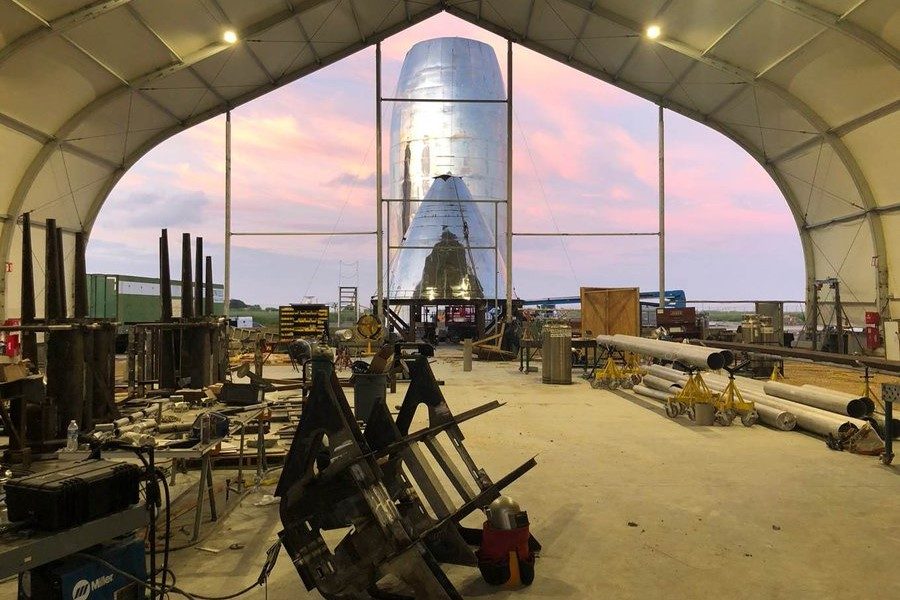
SpaceX Starship Prototype
SpaceX

SpaceX revealed a prototype of the Starship rocket in September. The chromium-nickel stainless steel rocket stands 50 meters (164 feet tall) with a diameter of 9 meters (29.5 feet) and is powered by 37 engines. 

It’s especially a tall order since the Starship rocket is made to be reused multiple times — the first such rocket of its kind. Musk’s ultimate goal for the rocket is to help set up a colony on Mars, bring people on a trip to the moon, and even be used for transcontinental travel. 

“The conventional space paradigms do not apply to what we’re doing here. We’re trying to build a massive fleet to make Mars habitable, to make life multi-planetary. I think we need, probably, on the order of 1,000 ships, and each of those ships would have more payload than the Saturn V — and be reusable,” he added. 

Allison Matyus
Former Digital Trends Contributor
Allison Matyus is a general news reporter at Digital Trends. She covers any and all tech news, including issues around social…
Scientists have found a hidden galaxy inside the Milky Way, and they’re calling it Loki
A lost dwarf galaxy may be hiding inside the Milky Way.
milky-way-hidden-galaxy-loki

Our home galaxy has a secret buried inside. A new study published in the Monthly Notices of the Royal Astronomical Society suggests that the Milky Way swallowed an ancient dwarf galaxy billions of years ago, and its stellar remains are still embedded within ours.

Researchers have named this lost galaxy Loki, after the Norse trickster god, and the name is quite fitting because it remained hidden in plain sight for a very long time.

Read more
NASA aims September launch for Roman space telescope and it’s going to be a huge shift
An earlier target for Roman means one of NASA’s most ambitious observatories is getting close, with the potential to open a huge new era in space discovery
Machine, Wheel, Astronomy

NASA is now aiming to launch the Nancy Grace Roman Space Telescope as soon as early September 2026, a faster timeline than its earlier commitment to fly no later than May 2027. That alone makes this one of the agency’s most important missions to watch over the next few months.

The reason is simple, Roman is built to scan vast parts of the sky with sharp infrared vision.

Read more
Blue Origin successfully re-uses a New Glenn rocket for the first time ever
Blue Origin achieves first New Glenn reflight despite payload setback
Blue Origin

Blue Origin has achieved a major milestone in its spaceflight ambitions by successfully reusing a booster from its heavy-lift New Glenn rocket for the first time. The historic launch, conducted on April 19, marks a significant step forward for Jeff Bezos’ space company as it seeks to compete with rivals like SpaceX in the rapidly evolving commercial launch market.

A Milestone With A Mixed Outcome

Read more