  1. Home
  2. Space
  3. News

Private astronauts enjoy extra time aboard the space station

Add as a preferred source on Google

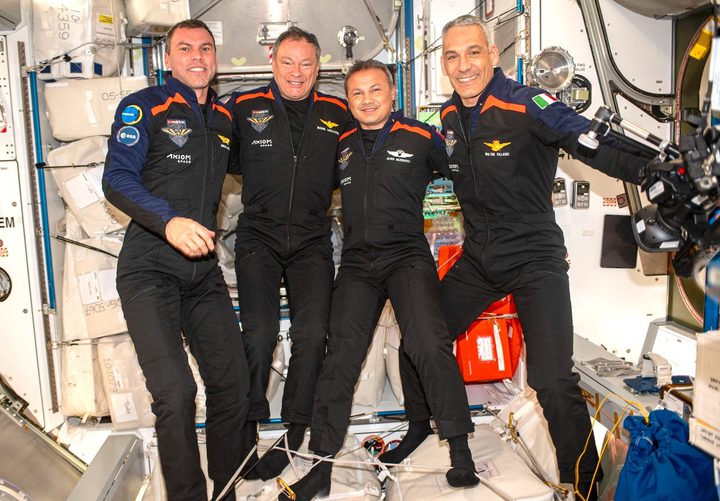
The Axiom-3 crew aboard the ISS.
The Ax-3 crew aboard the ISS. Axiom Space/NASA

Private astronauts who had been expecting to stay aboard the International Space Station (ISS) for two weeks will be staying a few extra days after their departure date was changed due to poor weather conditions at the landing site.

Recommended Videos

“Due to ongoing unfavorable weather off the coast of Florida, Dragon is standing down from Tuesday’s undocking from the space station,” SpaceX said in a post on social media on Tuesday. “The spacecraft and Ax-3 crew remain healthy, and teams will continue to monitor weather conditions for the next available undocking opportunity.”

The Ax-3 crew — comprising private astronauts Walter Villadei, Alper Gezeravcı, and Marcus Wandt, and professional astronaut Michael López-Alegría — arrived at the station on January 19. They were supposed to undock from the ISS last Saturday, but the departure has been put on hold until the forecast improves.

The latest plan is for the Dragon spacecraft and the four crewmembers to undock from the orbital outpost at 9:05 a.m. ET on Wednesday, February 7, though this depends upon a final assessment of the weather conditions at the splashdown site.

Delayed departures are not unusual for crews heading home from the space station, and it’s a safe bet that when it happens, most astronauts will be delighted to get an extra few days in space. The four Ax-3 crewmembers will likely continue with some science research activities, assist the other astronauts with various tasks, or, in Wandt’s case, spend some time snapping a few more sublime Earth photos.

Axiom Space’s first private astronaut mission, which took place in April 2022, was supposed to run for 10 days, but poor conditions at the landing site led to the four crewmembers staying in orbit for almost an extra week.

Fans of slow TV will be able to enjoy a live stream of the Ax-3 crew’s spacecraft edging away from the ISS early on Wednesday. Digital Trends has all the details on how to watch.

Trevor Mogg
Contributing Editor
Not so many moons ago, Trevor moved from one tea-loving island nation that drives on the left (Britain) to another (Japan)…
Scientists have found a hidden galaxy inside the Milky Way, and they’re calling it Loki
A lost dwarf galaxy may be hiding inside the Milky Way.
milky-way-hidden-galaxy-loki

Our home galaxy has a secret buried inside. A new study published in the Monthly Notices of the Royal Astronomical Society suggests that the Milky Way swallowed an ancient dwarf galaxy billions of years ago, and its stellar remains are still embedded within ours.

Researchers have named this lost galaxy Loki, after the Norse trickster god, and the name is quite fitting because it remained hidden in plain sight for a very long time.

Read more
NASA aims September launch for Roman space telescope and it’s going to be a huge shift
An earlier target for Roman means one of NASA’s most ambitious observatories is getting close, with the potential to open a huge new era in space discovery
Machine, Wheel, Astronomy

NASA is now aiming to launch the Nancy Grace Roman Space Telescope as soon as early September 2026, a faster timeline than its earlier commitment to fly no later than May 2027. That alone makes this one of the agency’s most important missions to watch over the next few months.

The reason is simple, Roman is built to scan vast parts of the sky with sharp infrared vision.

Read more
Blue Origin successfully re-uses a New Glenn rocket for the first time ever
Blue Origin achieves first New Glenn reflight despite payload setback
Blue Origin

Blue Origin has achieved a major milestone in its spaceflight ambitions by successfully reusing a booster from its heavy-lift New Glenn rocket for the first time. The historic launch, conducted on April 19, marks a significant step forward for Jeff Bezos’ space company as it seeks to compete with rivals like SpaceX in the rapidly evolving commercial launch market.

A Milestone With A Mixed Outcome

Read more