
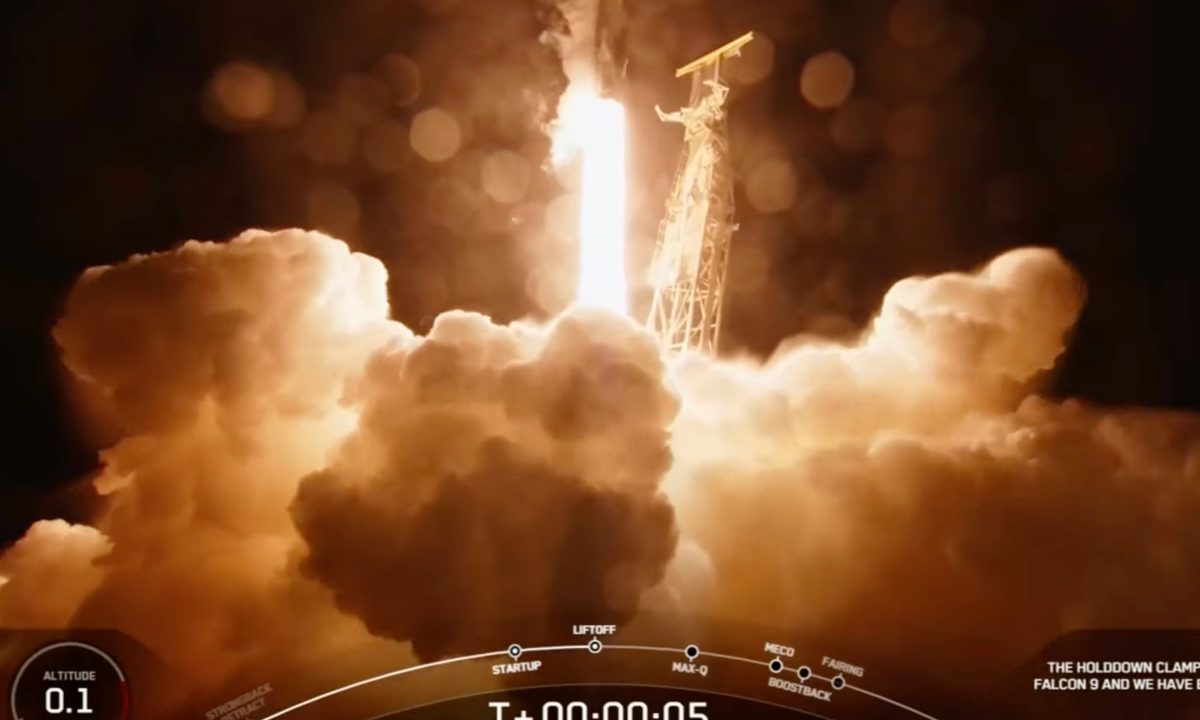
Following a scrubbed launch attempt 24 hours earlier due to weather conditions and a technical issue, NASA and SpaceX successfully launched two missions — SPHEREx and PUNCH — from Vandenberg Space Force Base in California on Tuesday night.
SPHEREx is a space telescope that will map our cosmos, while PUNCH comprises four small satellites that will study our sun’s outer layer and solar winds. Both were carried to orbit by SpaceX’s workhorse Falcon 9 rocket.
SpaceX and NASA livestreamed the launch, and also the return of the first-stage Falcon 9 booster minutes after it deployed the payloads to orbit. Tuesday’s launch marked the third flight for this particular first-stage booster, which previously launched the NROL-126 and Transporter-12 missions. Here’s how the launch looked:
Falcon 9 lifts off from pad 4E in California! pic.twitter.com/1Ef7iIBk2A
— SpaceX (@SpaceX) March 12, 2025
And here’s the return of the booster:
Falcon 9 lands at LZ-4 pic.twitter.com/yJu7ApaC93
— SpaceX (@SpaceX) March 12, 2025
During its two-year mission, the SPHEREx (Spectro-Photometer for the History of the Universe, Epoch of Reionization and Ices Explorer) Observatory will gather data on more than 450 million galaxies and more than 100 million stars. The collected data will help scientists to enhance their understanding of how the universe evolved, and will also identify water and oxygen molecules in deep space in findings that could form the basis of future deep-space missions.
Speaking recently, Olivier Dore, SPHEREx project scientist at Caltech and NASA’s Jet Propulsion Laboratory, expressed enthusiasm about the mission’s potential, saying: “I think the beauty of astronomy is that every time we look at the sky in a new way or from a different angle, we discover new phenomena.” Dore added that SPHEREx will provide “an unprecedented dataset to mine,” leading to the discovery of new cosmic phenomena.
The PUNCH (Polarimeter to Unify the Corona and Heliosphere) satellites will observe the sun and its environment in research that should give us a better understanding of the effects of solar winds on our solar system. The mission will also help to improve solar weather forecasting and lead to safer, more efficient spacecraft launches in the future.
Commenting on the two-year mission, Craig DeForest, principal investigator for PUNCH, said: “What we hope PUNCH will bring to humanity is the ability to really see, for the first time, where we live inside the solar wind itself,” adding, “While PUNCH is a research mission, we will be able to track space storms, or coronal mass ejections, in three dimensions as they approach the Earth. This is critical to forecasting space weather and how it might affect us as a space-faring society.”


